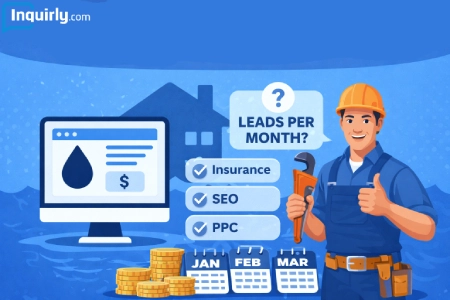
Most plumbing operations experience high volatility because they rely on reactive, single-channel marketing. To stabilize call volume and protect your profit margins, your business must transition from buying disconnected ads to building a structured lead-capture ecosystem.
Consistency in plumbing lead generation is rarely about discovering a new tactic. Instead, it is about positioning your business to capture both high-intent emergency demand and predictable, long-cycle maintenance work simultaneously.
The following strategies provide a framework to eliminate the “feast or famine” cycle. They focus on building a system that produces predictable call volume without sacrificing job quality or profit.
2. Prioritize High-Intent Search Visibility
Search traffic varies significantly in value. Informational queries rarely convert, while urgent queries often lead to immediate action.
The distinction is critical:
| Query Type | Example | Business Value |
|---|---|---|
| Informational | “how to unclog a drain” | Low |
| Commercial evaluation | “best plumber in Lisbon” | Medium |
| Transactional | “emergency plumber near me” | High |
Consistent lead generation depends on capturing transactional intent. This requires precise keyword targeting, location-specific pages, and alignment between search intent and landing page content.
3. Introduce Controlled Pricing Transparency
Complete pricing transparency is often avoided for fear of being shopped on price, but total opacity actually drives high-intent leads away. By providing a clear “investment range,” you pre-qualify customers and eliminate low-budget leads before they ever pick up the phone.
The Strategy: Range-Based Disclosure
- Service Starting Points: Use “Starting at” or “Typical Range” (e.g., Water Heater Replacement: $1,500 – $3,200). This anchors price expectations while leaving room for site-specific variables.
- Upfront Diagnostic Fees: Clearly state your dispatch or diagnostic cost. Knowing the “cost to get you through the door” reduces customer anxiety and increases booking rates.
- Cost-of-Delay Comparison: Contrast the price of a quick repair against an expensive emergency replacement. This shifts the focus from immediate cost to long-term savings.
Implementation Tools
- Loom: Add a 30-second clip explaining what’s included in your flat rate (parts, labor, warranty). Transparency on how you price builds more trust than the number itself.
- uCalc / Outgrow: Embed a “Price Estimator” on your site. Customers get an instant range in exchange for their email, qualifying them before you even call.
4. Build a Response System
Availability is passive; responsiveness is a competitive advantage. The first company to engage a lead often wins the contract. To stop leads from calling your competitors, move from “checking messages” to a formal response framework.
- Instant Acknowledgment: Use automated SMS or email triggers to confirm receipt immediately.
- The 10-Minute Standard: Aim for human contact within 10 minutes. This “speed-to-lead” window is where conversion rates are highest.
- Define the Roadmap: Every interaction must end with a clear next step (e.g., “I will have your quote sent by 4 PM today”)
5. Turn Local Presence into a Sales Engine
Local search profiles (like Google Business) are active acquisition channels, not digital phonebooks. They should capture demand at the exact moment of intent.
- Total Consistency: Ensure your business name, address, and phone number are identical across all platforms to boost search rankings.
- Visual Proof: Use high-quality photos of real, local projects, not stock images, to build instant credibility.
- The Review Flywheel: Systematize the request for customer reviews. Detailed feedback mentioning specific services helps you show up for a wider range of search queries.
6. Create Service-Specific Content Depth
Broad descriptions dilute your authority. To rank higher and convert better, build dedicated pages for every core service you offer.
- One Service, One Page: Instead of a single “Services” list, create individual pages for each offering to capture high-intent search traffic.
- Focus on Scenarios: Don’t just list what you do; describe the specific problems you solve for the client.
- Interlink for Authority: Connect related services (e.g., linking “Roof Repair” to “Gutter Cleaning”) to keep users on your site and signal expertise to search engines.
7. Balance Immediate and Compounding Channels
Lead generation channels operate on different timelines. Over-reliance on a single source creates volatility.
A balanced strategy distributes risk and stabilizes demand:
| Channel Type | Function | Impact Timeline |
| Paid Search | Immediate lead capture | Short-term |
| SEO | Organic demand generation | Medium-term |
| Referrals | Trust-based acquisition | Long-term |
8. Turn One-Time Jobs into Long-Term Equity
Real profitability comes from lifetime value, not just the first invoice. If you aren’t following up, you’re leaving money on the table for your competitors. A simple, automated retention system keeps your pipeline full without the high cost of buying new leads.
- The 48-Hour Check-In: Send a quick text or email two days after a job. This catches potential issues before they become bad reviews and proves you actually care about the results.
- Service Cycle Reminders: Don’t wait for the customer to remember you. If you did a “Spring Service,” set a calendar trigger to offer a “Winter Prep” discount six months later.
- The Referral Engine: Happy customers are your best sales team. Give them a reason to talk about you by offering a small credit or “VIP” priority for every friend they send your way.
The Goal: Aim for a 20% Repeat Rate. If your customers only call you once, you’re constantly “renting” your market instead of owning it.
9. Formalize Referral Partnerships
Most referrals happen by accident; the goal is to make them predictable. By partnering with complementary businesses, you tap into a “warm” lead source that skips the expensive bidding war of cold search.
| Tool | Best For | Why Use It? |
| GoHighLevel | Automation | Tracks lead sources and automates follow-ups. |
| ReferralRock | Partnerships | Automates “Refer-a-Friend” and partner tracking. |
| NiceJob | Reviews | Captures social proof for partners to share. |
| Apollo | Prospecting | End-to-end sales platform |
10. Measure Performance at the Revenue Level
Tracking lead volume alone provides an incomplete picture. Effective optimization requires linking marketing performance to business outcomes.
Key metrics include:
- Conversion rate by channel
- Average job value per lead source
- Cost per acquired customer
Conclusion
Successful plumbing operations are built on predictability, not the latest marketing trend. Transitioning from reactive lead buying to a structured ecosystem, centered on response speed, pricing transparency, and customer retention, allows you to stop competing on price and start winning on trust.
The First Step: Audit your response time and your Google Business Profile immediately. Optimizing these two factors alone can stabilize call volume in as little as 30 days. Once your baseline is steady, implement automation and formal partnerships to turn that momentum into a high-margin growth engine.