
Generating plumbing leads is the lifeblood of any successful service company. Whether those leads come from a glowing Google review, a targeted PPC campaign, or a trusted source where you buy plumbing leads, the common denominator for failure or success is management.
A high volume of raw inquiries is meaningless if your system leaks qualified opportunities. In fact, for many plumbing companies, the biggest constraint to growth isn’t generating more leads for plumbing, but optimizing the processes that convert the leads they already have.
This guide will take you through the five pillars of effective lead management, ensuring every incoming inquiry is prioritized, acted upon instantly and converted into booked revenue.
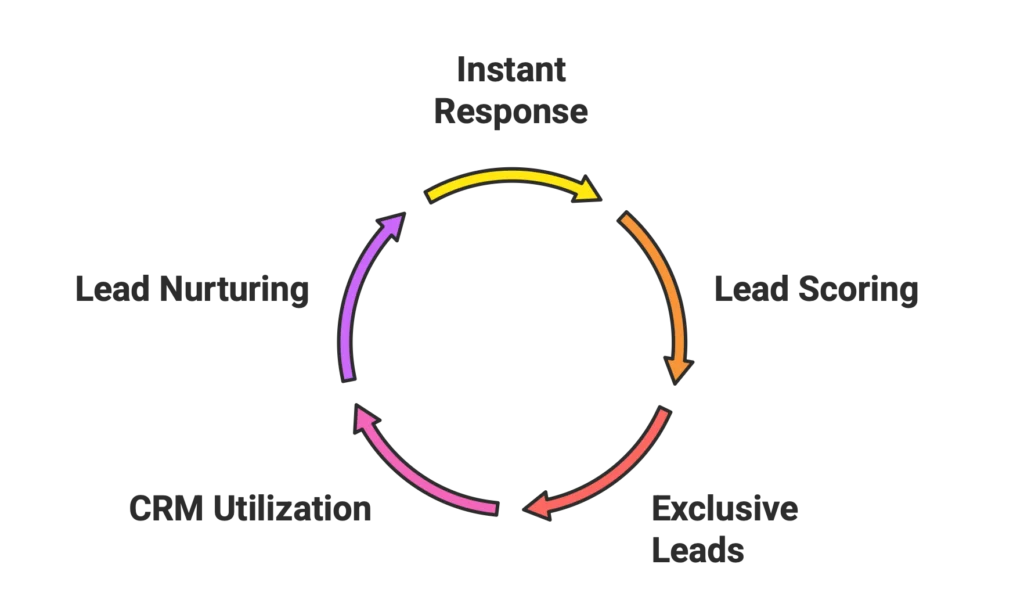
1. Instant Lead Triage and Response
In the emergency-driven world of plumbing, time is quite literally money. If a homeowner has a burst pipe or a non-functioning water heater, they are calling the first three numbers on Google. The contractor who answers fastest and schedules a technician wins.
The 5-Minute Rule: Why Speed is Important
Studies consistently show that conversion rates drop by over 80% if a lead is not contacted within the first five minutes. For high-urgency plumbing leads, that window is even smaller.
- The Race to Answer: The first company to confirm a service slot usually gets the job. Your goal is to move the lead from “Inquiry” status to “Booked Job” status as fast as possible.
- Avoid Voicemail: Never let high-value leads for plumbing hit a generic voicemail box. Instead, implement a Call Tracking and IVR (Interactive Voice Response) system. These automated softwares capture contact details and immediately send an SMS notification to the on-call dispatcher or technician, ensuring 24/7 coverage and instant follow-up, even when staff are busy.
Implementing Multi-Channel Immediate Response
Your response must adapt to the channel the lead came from:
- Phone Calls: Route calls to a dedicated answering team 24/7. Even if the call is after hours, the team should be equipped to quote standard emergency fees and confirm an arrival window for the next morning.
- Web Forms/Chatbots: The moment a web form is submitted, the lead should trigger two actions:
- An automated, personalized text message confirming receipt and providing a number to call if the emergency is critical.
- An immediate notification and call script to the office staff to attempt a call-back within 90 seconds.
- Text Messages (SMS): Ensure your business number is enabled to receive and respond to texts. Many customers prefer texting over talking, especially for less urgent inquiries. Automate simple responses to buy your team time.
2. Lead Scoring and Prioritization
Effective lead management is about allocating your most valuable resources (skilled technicians and estimators) to the highest-value opportunities. This requires a robust lead scoring system.
Criteria for Plumbing Lead Scoring
Score every incoming plumbing lead based on two main factors: Urgency and Value.
| Scoring Factor | Low Score (Low Priority) | High Score (High Priority) |
|---|---|---|
| Urgency | Routine maintenance, aesthetic fixture replacement. | Burst pipe, no hot water, major blockage. |
| Service Value | Minor drain cleaning, faucet repair (under $300). | Water heater replacement, re-piping, slab leak detection (over $1,500). |
| Customer Type | One-time residential client. | Property manager, commercial client, existing service contract holder. |
| Lead Source Quality | Shared lead list (high competition). | Exclusive, high-intent call or long-term referral partner. |
The Prioritization Queue
Once scored, your leads for plumbing should be filtered into distinct queues:
- Priority 1 (Red Alert): High Urgency + High Value (e.g., Burst pipe at a commercial restaurant). Action:Immediate dispatch, dropped everything else.
- Priority 2 (Hot): High Urgency + Medium Value (e.g., Residential hot water heater failure).
Action: Schedule within 2-4 hours, immediate follow-up. - Priority 3 (Warm): Low Urgency + High Value (e.g., Quote requested for a full bathroom remodel). Action:Schedule estimator visit within 24-48 hours.
- Priority 4 (Nurture): Low Urgency + Low Value (e.g., Routine drain cleaning quote request).
Action: Automated scheduling options, non-urgent follow-up, and placed into a long-term nurturing campaign.
3. The Power of Exclusive Leads and Direct Acquisition
When managing your lead pipeline, the source profoundly affects your management workload and conversion metrics. Shared leads create massive administrative strain; exclusive leads streamline operations.
Why Quality Trumps Quantity
Shared plumbing leads (often sold to 3-5 contractors) require the fastest response, immediate quoting, and often result in a price war. This means more time wasted by your office staff and estimators on jobs you may not win, raising your Cost Per Acquisition (CPA).
Exclusive leads, on the other hand, mean the customer has only heard from you, allowing you to focus on selling the value of your service, reliability, and expertise, rather than just the lowest price.
Integrating High-Quality Lead Generators
The decision to buy plumbing leads should be viewed as an optimization strategy, not a volume play. At Inquirly.com, we believe in delivering high-intent, exclusive calls to pre-qualify the lead and significantly reduce your administrative burden.
Inquirly is the specialized platform focused on delivering these high-quality, exclusive opportunities. We ensure the consumer is already ready to hire, so you spend less time vetting and more time serving.
- Management Advantage: Less time spent qualifying, more time spent quoting and scheduling. Our exclusive leads require a robust but simple management system focused on tracking the time-to-close and the job value.
Learn more about Exclusive Plumbing Leads Here.
4. Centralized Management: CRM
The only way to execute rapid response, accurate scoring, and effective follow-up is by using a centralized Customer Relationship Management (CRM) or Field Service Management (FSM) platform. This is the nervous system of your lead management strategy.
Recommended CRM/FSM Tools
Selecting the right platform is critical. Here are a few top-tier CRM and Field Service Management (FSM) platforms commonly used by successful plumbing businesses:
- Service Fusion: Offers a strong balance of features including complex scheduling, inventory tracking, and custom reporting.
- Jobber: Highly recommended for residential service due to its excellent Customer Hub and communication features.
- Housecall Pro: Ideal for small to mid-sized teams needing easy-to-use mobile dispatch, online booking, and quick invoicing.
- FieldEdge: A robust solution often favored by larger plumbing operations for complex scheduling, service agreement management, and integration with accounting software.
Essential CRM Features for Plumbing Leads
Lead Source Tracking
Automatically records where each lead came from (Google Ads, website, referral, Inquirly) so you can attribute revenue and calculate ROI.
Time-to-Respond (TTR) Timer
Starts the moment a lead hits your system and alerts a manager if TTR exceeds five minutes—driving faster replies and higher close rates.
Automated Follow-Up Sequences
Sends scheduled texts/emails for unaccepted quotes (e.g., 24–48 hours) and appointment confirmations, saving staff time and reducing no-shows.
Digital Job Histories
Stores every note, quote, photo, and invoice under the client profile—vital for repeat work, warranty tracking, and technician handoffs.
Mobile Dispatching
Lets dispatch assign jobs directly to a technician’s phone, moving work from “Quote” to “In Progress” without paperwork or back-and-forth.
The Lead Management Workflow
An ideal workflow within your CRM follows a standard cycle:
- Capture: Lead enters via phone, web, or direct integration (e.g., a service where you buy plumbing leads).
- Triage: Automated scoring and TTR timer start. Dispatcher attempts contact.
- Convert: Quote provided; job is booked. Lead status moves to “Job Scheduled.”
- Service: Job completed. Technician records notes/photos in the system.
- Follow-Up: Automated text requests review/feedback. Client enters the long-term nurturing sequence.
5. Nurturing Unconverted and Past Leads
Not every lead converts immediately, and not every customer is a one-time transaction. Effective lead management includes robust strategies for long-term nurturing and turning old leads into new business.
Re-Engagement Campaigns for Unconverted Leads
A homeowner who requested a quote for a water heater replacement but didn’t book might have simply been sticker-shocked or busy. Don’t discard them.
- The 30/60/90 Day Check-in: Set automated reminders to follow up at 30, 60, and 90 days. The messaging should shift from “Did you accept the quote?” to “We noticed your quote expired; prices are changing. Can we discuss alternatives?”
- Value-Driven Content: Send email campaigns focused on the specific service they requested (e.g., “5 Signs Your Old Water Heater is a Safety Risk”). This keeps your company top-of-mind without being overly aggressive.
Maximizing Customer Lifetime Value (CLV)
Your best leads for plumbing are your past customers. They already trust you and are cheaper to convert than any new lead source.
- Maintenance Contracts: Every closed job should be an opportunity to sell a preventative maintenance plan (e.g., annual water heater flush, drain line camera inspection). This provides predictable revenue and guaranteed plumbing leads for the following year.
- Targeted Re-Marketing: If a customer had a repair (like a minor leak), target them with ads for related preventative services (like whole-home leak detection systems) 6-12 months later.
6. Continuous Analysis and Optimization
The final pillar of lead management is using your data to make smarter spending decisions. If you don’t track the journey of every single plumbing lead, you are managing in the dark.
Calculating True Return on Investment (ROI)
Effective management requires knowing the performance of every dollar spent.
- Example: If you spend $5,000 on Google Ads and it generates $25,000 in revenue, the ROI is 400%. If you spend $5,000 on a shared lead list and only generate $6,000 in revenue, the ROI is 20%. The high-quality, high-CPL leads often yield the highest ROI due to superior conversion rates.
Optimization Checklist
Reviewing these metrics monthly allows you to optimize your strategy:
- Conversion Rate by Source: Which source provides the best conversion rate from lead-to-booked job? (Hint: It’s usually referrals or high-intent exclusive sources where you buy plumbing leads). Invest more here.
- Cost Per Acquisition (CPA) by Source: Which source gives you the cheapest customer? Cut spending on sources with an unsustainable CPA.
- Time-to-Close (TTC): Monitor the average time it takes from initial inquiry to job completion. If this metric is too high, it indicates bottlenecks in scheduling, dispatch, or quoting that need to be addressed by your management team.
Conclusion
The most successful plumbing companies in 2025 will be defined not by how many plumbing leads they generate, but by their surgical efficiency in managing them.
By adhering to the 5-Minute Rule, implementing robust scoring, leveraging technology (CRM/FSM), and focusing your energy on high-quality exclusive leads from proven partners, you transform your business from a reactive service provider to a proactive, revenue-driven machine. Effective lead management is the gateway to scalable growth, predictable revenue, and lasting profitability.