
When flooding strikes, the immediate concern is water damage. But for restoration companies, the real long-term opportunity and risk lies in mold. Mold often starts growing within 24 to 48 hours after a flood, making it one of the most urgent and profitable services homeowners search for once the water is gone.
This guide explains how to build a reliable system for generating mold remediation leads after flooding. We’ll cover how to align with flood cleanup and water removal services, how to market mold damage prevention, which channels drive the best results and how to use SEO, PPC and partnerships to keep your pipeline full.
Why Mold Damage is a Lead Opportunity
Most homeowners underestimate the risk of mold from water damage. Even after the visible water is removed, hidden moisture in walls, carpets and subfloors can trigger mold growth within days.Think of flood water removal as the first phase, and mold remediation as the essential second phase.
For restoration businesses, this means:
- Mold jobs are often insurance-covered, which increases approval rates.
- Homeowners who experience flooding almost always need secondary services like mold treatment.
- Positioning your company as both a flood cleanup and mold removal provider doubles your chance of winning the customer’s trust and contract.
The Dual-Job Funnel
Here’s a simple breakdown of the flood-to-mold timeline and where your company can capture new leads along the way:
(Day 0–1: emergency cleanup to prevent mold)
(Day 2–3: lead capture & homeowner education)
(Day 3–7: containment + mold removal solutions)
(Insurance reports, referrals, exclusive leads)
SEO
1. Service Page Architecture
Don’t bury mold services under a general “restoration” page. Build:
- A dedicated Mold Remediation page targeting “mold remediation [city]” and “mold removal specialists.”
- A combined Water Damage + Mold page to capture hybrid intent searches.
- Flood cleanup pages that include a CTA for free mold inspections (“We’ll be back in 48 hours to check for growth”).
2. Local SEO for Mold Terms
Most mold remediation work is hyper-local. Google’s Map Pack drives the majority of calls. To win:
- Upload before-and-after photos of mold projects to Google Business Profile. Caption them with “mold removal [city] after flood.”
- Push for reviews where customers mention both services (e.g., “They handled my flood and later came back for mold remediation”).
- Build city-specific landing pages: “Mold Remediation in Plano,” “Mold Removal in Fort Lauderdale.” Add neighborhood/zip mentions.
3. Content Strategy That Pulls Leads
Homeowners Google their fears. Blog content should intercept those searches and build trust:
- “How long after a flood does mold start?”
- “Insurance coverage for mold from water damage”
- “Signs of mold after water damage”
Each blog should funnel readers into a free inspection CTA.
Example CTA: “Just had a flood? Book your free post-flood mold inspection within 48 hours.”
Local Service Ads (Google Guaranteed)
When homeowners search “flood cleanup near me” or “mold removal after water damage,” they’ll often see Local Service Ads (LSAs) before anything else on Google.
Unlike traditional Google Ads where you pay per click (even if the person never calls you), LSAs are pay-per-lead. That means you only get charged when a potential customer actually calls, messages or books your service.
Here’s why LSAs work especially well for flood and mold remediation:
- They show above all other ads. In a crisis, visibility matters. LSAs appear at the very top of the search results, even above standard pay-per-click ads.
- They include the “Google Guaranteed” badge. This green checkmark signals that Google has verified your business (license, insurance, and background checks). For customers in panic mode after flooding, that badge makes you look immediately more trustworthy than a competitor without it.
- You can target specific flood-affected zip codes. After a storm or hurricane, you can adjust your service area settings to focus on the neighborhoods hit hardest, ensuring your ads reach the people who need you right now.
- You control your budget. LSAs let you set a weekly budget and pause when your schedule is full, so you don’t waste money on leads you can’t serve.
Lead Generation Companies
If your internal marketing team is small, you may benefit from outsourcing to restoration lead generation services. These companies specialize in mold remediation and water damage leads, offering pay-per-lead pricing models.
Pros:
- Quick access to leads during seasonal flooding.
- No need to manage complex PPC campaigns.
Cons:
- Leads are often shared with competitors unless they are exclusive.
- Quality varies (some homeowners are just “price shopping”).
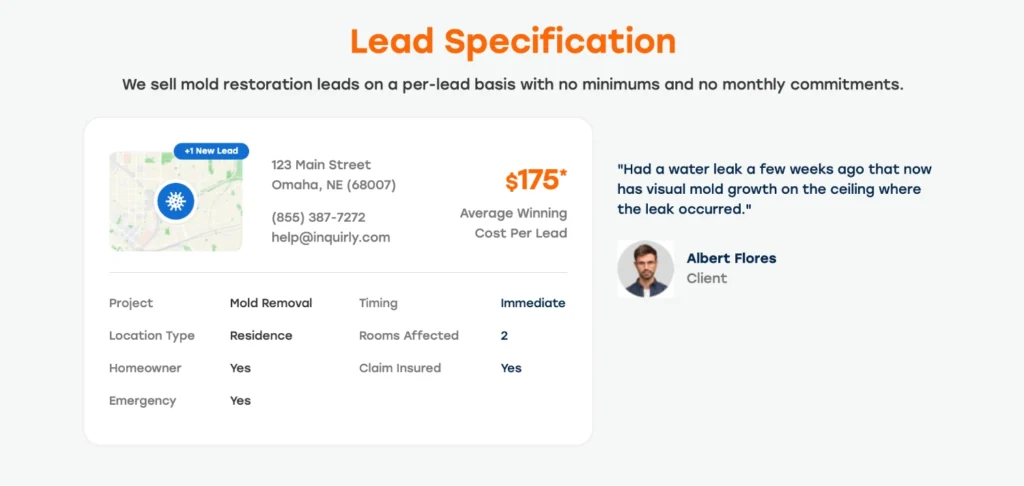
Inquirly.com offers exclusive mold removal leads – meaning the homeowner inquiry goes only to your company, not to three or four competitors. This exclusivity dramatically increases close rates and reduces wasted ad spend.
Partnerships
SEO and PPC are essential, but offline referrals remain powerful:
- Plumbers → First responders when pipes burst. Offer co-branded cards/flyers: “Flood damage? Partnered with [Your Company] for mold remediation.”
- Insurance Agents → Need reliable mold reports. Build credibility with detailed moisture maps and documentation.
- Property Managers → Rental properties after storms almost always require mold remediation. Host quarterly “lunch and learns” about mold risk.
Target Insurance Work with Documentation Expertise
For many homeowners, the biggest question after a flood is: “Will my insurance cover mold remediation, or do I have to pay myself?”
If your company can confidently answer that question and guide them through the claims process, you immediately become the preferred provider.
Insurance carriers require evidence to justify mold remediation costs. If the damage isn’t properly documented, adjusters may deny or reduce coverage. That’s why your team should treat every flood job like a case file. The stronger the evidence, the easier it is for the adjuster to approve the claim and the faster you get paid.
What to Document (Step by Step)
- Before work begins
- Take wide photos and close-ups of water damage, visible mold, and affected rooms.
- Capture the source of flooding (burst pipe, roof leak, storm entry point).
- Record initial moisture readings with a meter.
- During remediation
- Document containment setup (plastic barriers, HEPA filters, negative air pressure).
- Take photos of mold removal solutions being applied.
- Keep logs of daily humidity and moisture levels as materials dry.
- After completion
- Provide final photos of cleaned, treated areas.
- Include lab testing results if mold samples were taken.
- Add a written summary outlining what was removed, cleaned, and restored.
How to Market This Expertise
- Add a page on your website like “Insurance Claim Support for Flood & Mold Damage” explaining your process.
- Train office staff to tell callers: “We’ll handle the documentation your insurance adjuster needs.”
- Share case studies on your site: “After a Houston flood, we worked directly with State Farm to secure coverage for $18,000 worth of mold remediation.”
Build Relationships with Adjusters & Contractors
- Adjusters: Invite them to walkthroughs, provide clear reports, and make their job easier → they’ll recommend you in future claims.
- Restoration contractors: Water removal crews often pass jobs to mold specialists. Show them you’re skilled with insurance paperwork, and they’ll trust you with their referrals.
Conclusion
After a flood, homeowners need more than just water removal, they need fast mold treatment, clear guidance, and insurance support. The companies that act quickly, document properly and build trust are the ones that win repeat business and referrals.
Alongside strong local SEO and emergency ads, tools like Inquirly.com can deliver exclusive mold remediation leads, helping you stay busy when demand spikes.
👉 In the end, it’s about being visible, responsive, and reliable when people need help most.
FAQ
How can mold remediation companies get more leads after flooding?
Focus on fast-response marketing, strong SEO for flood and mold keywords, and exclusive partnerships with lead providers like Inquirly.com.
Are Google Local Service Ads effective for flood cleanup and mold removal?
Yes. They appear above traditional ads, are pay-per-lead, and carry the Google Guaranteed badge, which boosts homeowner trust.
Why is insurance documentation important for winning jobs?
Homeowners often rely on insurance to cover mold damage. Companies that document thoroughly win more referrals from adjusters and contractors.
Can content marketing really generate mold remediation leads?
Yes. Educational blogs about water damage, mold treatment, and prevention build trust and capture long-term organic traffic.
Are lead generation companies worth using?
They can help during peak flooding seasons. Services like Inquirly.com provide exclusive mold remediation leads, unlike shared leads from most providers.
What’s the fastest way to capture emergency flood cleanup calls?
Use 24/7 call handling, update your Google Business Profile during storms, and run click-to-call ads for immediate response.