
The difference between a scaling roofing business and one struggling with stagnation often comes down to one factor: flawless lead management execution.
If your team is managing valuable prospects through scattered spreadsheets, emails, and fragmented communication channels, you are actively sacrificing revenue and eroding your competitive edge. These inefficiencies directly lead to missed follow-ups, slow quoting times, and critically poor conversion rates.
Why a Roofing CRM?
A CRM centralizes all your prospects, automates routine tasks, and gives your team a single source of truth for lead status, communications, and next steps. For roofers, the right CRM ties together leads from paid vendors, web forms, phone calls, referral sources, and field estimates so nothing slips through the cracks.
This guide provides a practical, 10-step strategic framework for implementing and leveraging your CRM.
Tools to consider
- AccuLynx – an all-in-one roofing platform combining CRM, job production, aerial measurements and estimating – built specifically for roofers. Great when you need job-level operations tightly coupled with leads.
- JobNimbus – a flexible roofing CRM with workflows, mobile app, QuickBooks sync and payment features; popular with small-to-medium roofers.
- HubSpot CRM – a general-purpose CRM that’s excellent for organized lead management, marketing automation, and scaling processes (free tier is useful for startups).
Set up your Roofing CRM to manage leads effectively
1) Define your lead sources and capture points
Begin by identifying every channel where roofing leads originate, including lead generation services, your website, paid ads, social media messages, referrals, walk-ins, and direct phone calls. Each source should have a clearly defined path into your CRM so no lead is lost or delayed.
Decide how leads are captured (API, Zapier, email forwarding, or call tracking integrations) and assign clear ownership for first contact. For example, exclusive leads from Inquirly should enter the CRM instantly, trigger an automated confirmation message, and create a follow-up task for a sales call within minutes.
2) Create a simple, actionable pipeline
Your pipeline should reflect the natural flow of roofing jobs. Common stages include:
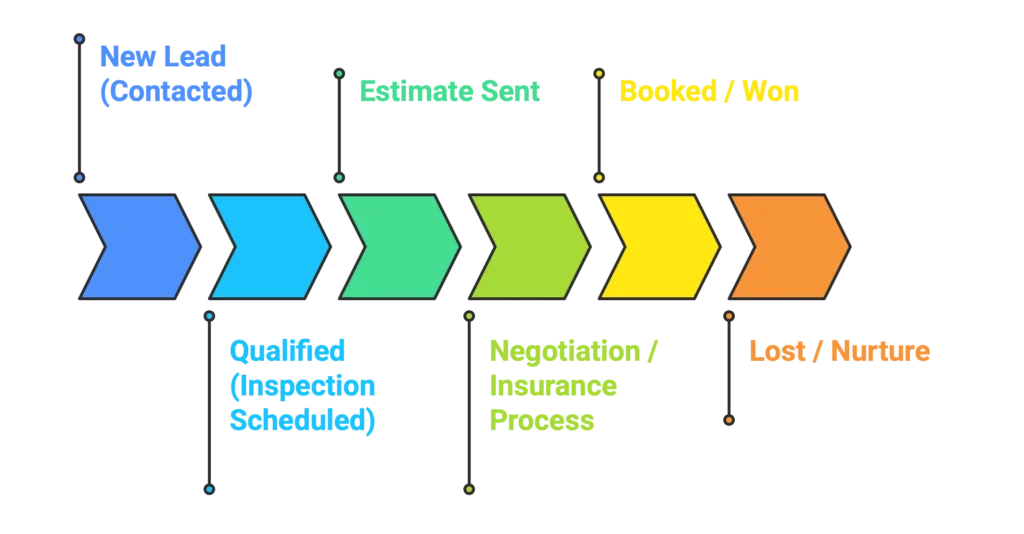
- New Lead (Contacted): Initial inquiry received and first contact attempted.
- Qualified (Inspection Scheduled): The lead meets criteria and inspection is scheduled.
- Estimate Sent: After inspection, a proposal is shared with pricing and options.
- Negotiation / Insurance Process: Any back-and-forth discussions or insurance approvals.
- Booked / Won: Customer confirms the job.
- Lost / Nurture: Leads that don’t convert immediately but may be viable later.
Keep the pipeline shallow and actionable, each stage should imply a specific next step. For example, after sending an estimate, the next step might be a follow-up call in 48 hours to discuss approval.
3) Standardize lead qualification
Effective lead management starts with consistent qualification. Create simple rules that define what a strong roofing lead looks like and ensure everyone follows the same criteria.
Capture essential details like property type, urgency of the issue, insurance involvement, and decision timeline. This allows your team to focus effort on high-potential opportunities while placing lower-priority leads into nurture workflows instead of wasting time on poor fits.
4) Implement lead scoring and prioritization
Lead scoring helps your team focus on the opportunities most likely to convert. Assign points based on engagement, urgency, and qualification factors, such as answered calls, homeowner status, active leaks, or insurance claims.
When combined with CRM automation, lead scoring ensures that high-value leads are followed up faster and more consistently, improving close rates without increasing manual work.
5) Automate first-response and nurture flows
Speed and consistency are critical in roofing sales. Set up automatic responses that confirm receipt of a lead and explain the next steps, creating a professional first impression.
Follow this with internal reminders for sales staff to make direct contact. For leads that are not ready to commit, nurture sequences keep your company top of mind through helpful, non-pushy follow-ups until the timing is right.
6) Integrate estimating, scheduling and the field crew
A roofing CRM should connect sales with operations. After an inspection:
- Upload photos, measurements, and estimates directly in the CRM
- Assign tasks to field technicians, syncing jobs with their mobile apps
- Track materials, crew schedules, and completion status
Using platforms like AccuLynx or JobNimbus ensures seamless handoffs, minimizing miscommunication and speeding up job completion.
7) Use templates and scripts
Templates and scripts are essential for consistent and professional communication across your team. Without them, messages to leads can vary widely, resulting in missed information or lost trust. Create templates for every stage of the customer journey:
- Initial call scripts: Guide staff on what questions to ask, how to confirm property details, and how to explain next steps clearly.
- Appointment confirmations: SMS or email templates that confirm inspection dates, provide directions, and set expectations for the visit.
- Estimate follow-ups: Email or call scripts that remind homeowners about the proposal, explain financing options, or clarify insurance coverage.
- Post-inspection messages: Templates for thanking leads, summarizing findings, and outlining next steps if they aren’t ready to book immediately.
Using these scripts ensures that every lead receives the same professional experience, even if handled by different team members. It also helps newer staff respond confidently without improvising critical conversations, reducing the risk of mistakes and improving the likelihood of booking jobs.
8) Connect payments and accounting
Integrating your CRM with accounting software like QuickBooks or Xero streamlines financial management and eliminates duplicate entry. Each job should have deposits, invoices, and final payment statuses linked directly in the CRM.
Benefits include:
- Automatic tracking: As payments come in, your CRM updates the job record automatically, giving a real-time view of outstanding balances.
- Revenue analysis: You can see which lead sources or campaigns generated the most revenue, helping you calculate cost per booked job.
- Reduced errors: Eliminates manual data entry and miscommunication between sales and finance teams.
9) Track metrics that matter
A CRM’s value comes from actionable insights. Focus on metrics that show performance, not vanity statistics. Key metrics include:
- Lead volume by source: Identify which channels, like Inquirly, Google Ads, or referrals, bring in the most leads.
- Conversion rates between stages: Track how many leads move from initial contact to inspection, from inspection to estimate, and from estimate to booked job.
- Average time to booking: Measure how long it takes for a lead to become a confirmed job, helping spot bottlenecks in your process.
- Revenue per lead: Understand the financial value of each lead and channel.
10) Create a feedback loop
Lead management is not static – your CRM is most effective when it informs continuous improvement. Schedule regular reviews of your CRM data to answer questions like:
- Which lead sources produce the highest number of booked jobs?
- Are some sales reps consistently faster or more effective in follow-ups?
- Where in the pipeline do leads tend to stall, and why?
Use these insights to refine lead scoring, adjust qualification criteria, tweak automated workflows, and invest more in channels that consistently produce results. Over time, this feedback loop allows your roofing business to optimize processes, improve team performance, and maximize ROI from each lead.
Looking for Exclusive Roofing Leads?
Exclusive roofing leads give contractors a significant advantage because they are delivered to only one company, reducing competition and increasing the likelihood of booking the job. Services like Inquirly specialize in providing these exclusive leads in real time, connecting roofing businesses with homeowners who are actively seeking services.
Conclusion
Setting up a roofing CRM effectively transforms how your business manages leads, from capturing inquiries to closing jobs. By defining sources, creating an actionable pipeline, standardizing qualification, scoring and prioritizing leads, automating responses and tracking key metrics, roofing businesses can increase efficiency, improve team performance, and maximize ROI. Paired with exclusive lead sources like Inquirly, a well-configured CRM ensures no opportunity is missed and every lead is given the attention it deserves, turning inquiries into booked jobs and predictable growth.