
Tag Archives: plumbing leads

10 Ways to Generate Plumbing Leads Consistently

Most plumbing operations experience high volatility because they rely on reactive, single-channel marketing. To stabilize call volume and protect your profit margins, your business must transition from buying disconnected ads to building a structured lead-capture ecosystem.

Consistency in plumbing lead generation is rarely about discovering a new tactic. Instead, it is about positioning your business to capture both high-intent emergency demand and predictable, long-cycle maintenance work simultaneously.

The following strategies provide a framework to eliminate the “feast or famine” cycle. They focus on building a system that produces predictable call volume without sacrificing job quality or profit.

2. Prioritize High-Intent Search Visibility

Search traffic varies significantly in value. Informational queries rarely convert, while urgent queries often lead to immediate action.

The distinction is critical:

Query TypeExampleBusiness Value
Informational“how to unclog a drain”Low
Commercial evaluation“best plumber in Lisbon”Medium
Transactional“emergency plumber near me”High


Consistent lead generation depends on capturing transactional intent. This requires precise keyword targeting, location-specific pages, and alignment between search intent and landing page content.

3. Introduce Controlled Pricing Transparency

Complete pricing transparency is often avoided for fear of being shopped on price, but total opacity actually drives high-intent leads away. By providing a clear “investment range,” you pre-qualify customers and eliminate low-budget leads before they ever pick up the phone.

The Strategy: Range-Based Disclosure

  1. Service Starting Points: Use “Starting at” or “Typical Range” (e.g., Water Heater Replacement: $1,500 – $3,200). This anchors price expectations while leaving room for site-specific variables.
  2. Upfront Diagnostic Fees: Clearly state your dispatch or diagnostic cost. Knowing the “cost to get you through the door” reduces customer anxiety and increases booking rates.
  3. Cost-of-Delay Comparison: Contrast the price of a quick repair against an expensive emergency replacement. This shifts the focus from immediate cost to long-term savings.

Implementation Tools

    • Loom: Add a 30-second clip explaining what’s included in your flat rate (parts, labor, warranty). Transparency on how you price builds more trust than the number itself.
    • uCalc / Outgrow: Embed a “Price Estimator” on your site. Customers get an instant range in exchange for their email, qualifying them before you even call.

    4. Build a Response System

    Availability is passive; responsiveness is a competitive advantage. The first company to engage a lead often wins the contract. To stop leads from calling your competitors, move from “checking messages” to a formal response framework.

    1. Instant Acknowledgment: Use automated SMS or email triggers to confirm receipt immediately.
    2. The 10-Minute Standard: Aim for human contact within 10 minutes. This “speed-to-lead” window is where conversion rates are highest.
    3. Define the Roadmap: Every interaction must end with a clear next step (e.g., “I will have your quote sent by 4 PM today”)

    5. Turn Local Presence into a Sales Engine

    Local search profiles (like Google Business) are active acquisition channels, not digital phonebooks. They should capture demand at the exact moment of intent.

    • Total Consistency: Ensure your business name, address, and phone number are identical across all platforms to boost search rankings.
    • Visual Proof: Use high-quality photos of real, local projects, not stock images, to build instant credibility.
    • The Review Flywheel: Systematize the request for customer reviews. Detailed feedback mentioning specific services helps you show up for a wider range of search queries.

    6. Create Service-Specific Content Depth

    Broad descriptions dilute your authority. To rank higher and convert better, build dedicated pages for every core service you offer.

    • One Service, One Page: Instead of a single “Services” list, create individual pages for each offering to capture high-intent search traffic.
    • Focus on Scenarios: Don’t just list what you do; describe the specific problems you solve for the client.
    • Interlink for Authority: Connect related services (e.g., linking “Roof Repair” to “Gutter Cleaning”) to keep users on your site and signal expertise to search engines.

    7. Balance Immediate and Compounding Channels

    Lead generation channels operate on different timelines. Over-reliance on a single source creates volatility.

    A balanced strategy distributes risk and stabilizes demand:

    Channel TypeFunctionImpact Timeline
    Paid SearchImmediate lead captureShort-term
    SEOOrganic demand generationMedium-term
    ReferralsTrust-based acquisitionLong-term

    8. Turn One-Time Jobs into Long-Term Equity

    Real profitability comes from lifetime value, not just the first invoice. If you aren’t following up, you’re leaving money on the table for your competitors. A simple, automated retention system keeps your pipeline full without the high cost of buying new leads.

    • The 48-Hour Check-In: Send a quick text or email two days after a job. This catches potential issues before they become bad reviews and proves you actually care about the results.
    • Service Cycle Reminders: Don’t wait for the customer to remember you. If you did a “Spring Service,” set a calendar trigger to offer a “Winter Prep” discount six months later.
    • The Referral Engine: Happy customers are your best sales team. Give them a reason to talk about you by offering a small credit or “VIP” priority for every friend they send your way.


    The Goal: Aim for a 20% Repeat Rate. If your customers only call you once, you’re constantly “renting” your market instead of owning it.

    9. Formalize Referral Partnerships

    Most referrals happen by accident; the goal is to make them predictable. By partnering with complementary businesses, you tap into a “warm” lead source that skips the expensive bidding war of cold search.

    ToolBest ForWhy Use It?
    GoHighLevelAutomationTracks lead sources and automates follow-ups.
    ReferralRockPartnershipsAutomates “Refer-a-Friend” and partner tracking.
    NiceJobReviewsCaptures social proof for partners to share.
    ApolloProspectingEnd-to-end sales platform

    10. Measure Performance at the Revenue Level

    Tracking lead volume alone provides an incomplete picture. Effective optimization requires linking marketing performance to business outcomes.

    Key metrics include:

    • Conversion rate by channel
    • Average job value per lead source
    • Cost per acquired customer

    Conclusion

    Successful plumbing operations are built on predictability, not the latest marketing trend. Transitioning from reactive lead buying to a structured ecosystem, centered on response speed, pricing transparency, and customer retention, allows you to stop competing on price and start winning on trust.

    The First Step: Audit your response time and your Google Business Profile immediately. Optimizing these two factors alone can stabilize call volume in as little as 30 days. Once your baseline is steady, implement automation and formal partnerships to turn that momentum into a high-margin growth engine.

    How to Choose Best Plumbing Lead Generation Services 

    In plumbing, demand rarely arrives on a predictable schedule. Jobs appear when something breaks, and the contractor who responds first, while appearing credible, wins. Lead generation services promise to fill that gap, but not all of them are built for quality, consistency, or long-term growth. Choosing the right provider is less about finding the biggest platform and more about understanding how leads are sourced, filtered, priced, and converted.

    This guide breaks down what actually matters when evaluating plumbing lead generation services, so you can avoid wasted budget and build a more reliable pipeline.

    Understand What “Lead Generation” Really Means

    Before comparing providers, clarify what you’re buying. Not all “leads” are equal, even if they’re sold under the same label.

    There are three common models:

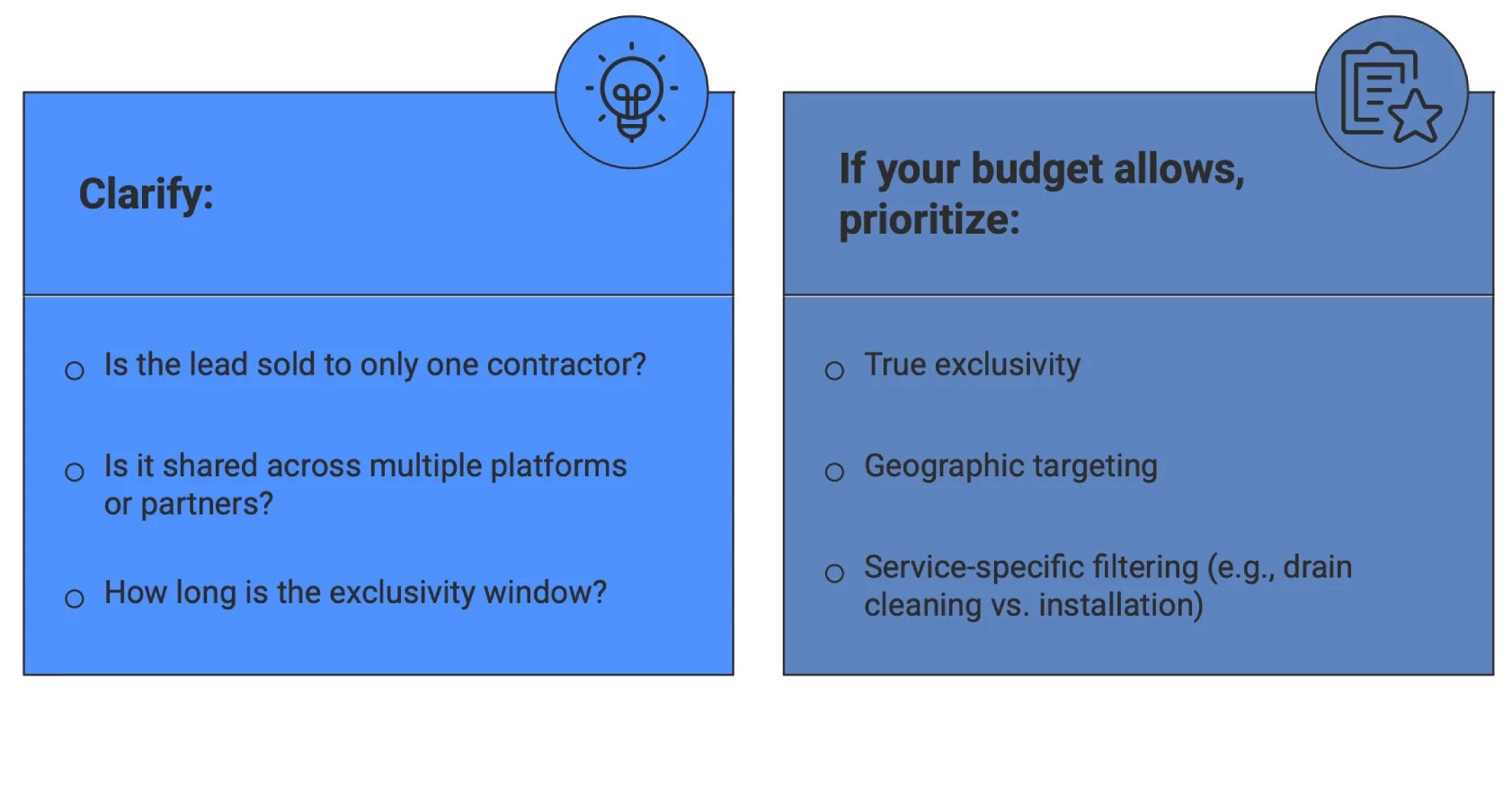
    • Shared leads: Sold to multiple contractors. Lower cost, but highly competitive.
    • Exclusive leads: Sent to only one contractor. Higher cost, better conversion potential.
    • Pay-per-call leads: You receive inbound calls from potential customers. Often high intent, but quality varies depending on filtering.


    Many platforms blend these models. The key is not the label but the intent level and source transparency. A cheap lead that goes nowhere is more expensive than a premium lead that closes.

    Prioritize Lead Exclusivity (But Verify It)

    Exclusive leads are often marketed as the gold standard, but exclusivity is not always absolute.

    Inquirly.com offers a high-intent alternative for plumbers seeking true exclusivity by delivering leads directly to a single contractor instead of sharing them with competitors. The Inquirly model maximizes ROI through customizable location targeting and a fair, contract-free billing system designed for long-term profitability.

    Look for Transparency and Reporting

    In the plumbing industry, a lead source you can’t measure is a liability. Reputable providers offer full transparency, giving you direct access to the lead’s origin, conversion rates, and detailed call recordings. High-quality services prioritize these performance metrics and offer straightforward refund processes for invalid leads, ensuring you only pay for genuine opportunities.

    Conversely, avoid “black box” providers that hide behind oversimplified dashboards or focus on lead volume over actual business outcomes. If a company makes it difficult to track traffic sources or dispute bad leads, it’s a major red flag. Ultimately, your goal is a partner that values data over vanity metrics, allowing you to scale with confidence rather than guesswork.

    Assess Lead Qualification Criteria

    A lead is only useful if it meets your service criteria. Use this quick framework to evaluate whether a lead generation service is actually delivering usable opportunities or just volume.


    ✔️ What Strong Lead Providers Deliver

    CriteriaWhat to Look ForWhy It Matters
    Location MatchLead is within your exact service radiusPrevents wasted time on unreachable jobs
    Job Type FitRequest aligns with your services (e.g., repairs, installs)Improves close rate
    Urgency LevelClear indication (emergency, same-day, flexible)Helps prioritize high-value jobs
    Customer IntentSpecific problem described (not vague browsing)Signals higher conversion likelihood
    Budget SignalsSome indication of willingness to spendFilters out price shoppers


    ❌ Warning Signs of Weak Leads

    IssueWhat It Looks LikeImpact on Your Business
    Incomplete DataMissing phone, vague request (“need plumbing help”)Hard to contact or qualify
    Wrong Job TypeCommercial leads sent to residential plumbers (or vice versa)Low relevance, wasted effort
    Low IntentGeneric inquiries, multiple quotes requestedHigh competition, low conversion
    Out-of-Area RequestsLeads outside your service zoneNo revenue potential


    Balance Lead Services With Owned Channels

    Lead generation services shouldn’t be your only growth channel. Relying entirely on third-party platforms leads to rising costs, limited control, and increasing competition.

    A more effective approach is to balance them with owned channels. Use lead services for short-term demand, but build long-term stability through local SEO, paid search and customer retention.

    This mix reduces risk, improves margins, and gives you more control over growth.

    Conclusion

    Choosing a lead generation partner is a high-stakes decision that dictates the efficiency of your dispatch and the health of your profit margins. To move beyond simply “buying phone calls,” a plumbing business must demand granularity in data and transparency in sourcing. The most effective partnerships are built on high-intent, exclusive opportunities that allow your technicians to focus on conversions rather than competing with five other companies for the same leaky faucet.

    By prioritizing lead quality over sheer volume, you ensure that every dollar of marketing spend translates directly into billable hours. While third-party services provide the necessary momentum to scale quickly, the ultimate goal is a diversified ecosystem, where external leads complement your own branded digital presence. This balanced approach eliminates platform dependency and builds a more resilient, high-equity plumbing brand.

    Get More Local Plumbing Leads: 10 Ways to Dominate Local Search Results 

    In the plumbing industry, the customer journey is compressed into minutes, not days. When a residential or commercial client faces a plumbing failure, the decision-making process is driven by three variables: proximity, perceived competence, and immediate availability.

    By 2026, standard Search Engine Optimization (SEO) has become a commodity. To outperform local competitors, a plumbing firm must move beyond keyword density and focus on “operational signals” -the digital evidence that a company is active, responsive, and physically present. The following ten strategies outline how to secure a dominant market share in local search results through technical and operational integration.

    1. High-Priority Management of Local Services Ads (LSA)

    Google Local Services Ads (“Google Guaranteed”) are one of the most effective sources of high-intent plumbing leads, appearing above standard search results and charging per lead rather than per click.

    Operational Reality:
    Ranking is influenced by proximity, business hours, review quality, responsiveness, dispute history, and budget. While Google does not publish exact criteria, consistently missed or delayed responses can reduce visibility because unserved leads harm user experience.

    Practical Actions:

    • Keep hours and service areas accurate
    • Answer calls reliably during advertised availability
    • Respond quickly to message leads
    • Monitor lead quality and dispute invalid charges
    • Maintain strong, recent reviews


    Management Perspective:
    LSAs perform best when supported by strong operations. Visibility alone does not generate revenue — consistent response and booking capability do.

    2. Technical Schema Markup and Search Intent

    Search engines use “Schema” (structured data) to understand the specific details of a business. Without proper technical markup, a plumbing site is just a collection of words.

    • LocalBusiness: By using specific code to define your service area, price range and frequently asked questions, you increase the likelihood of appearing in “Position Zero”, the featured snippet at the top of the search results.
    • High-Intent Keywords: Focus content on “problem-solution” queries (e.g., “slab leak detection cost” or “emergency main shutoff repair”) rather than broad terms like “plumbing.” This attracts users who are ready to book a service immediately.

    3. Performance Metrics: Core Web Vitals

    Mobile performance is a non-negotiable ranking factor. A plumbing website must be optimized for “thumb-driven” navigation.

    • Speed Requirements: Sites must load in under 2.5 seconds on a 4G connection. If a user in an emergency has to wait for a slow site to load, they will bounce back to the search results, which signals to Google that your site is a poor result for that query.
    • Accessibility: Ensure the “Emergency Call” button is persistent and easy to find on all screen sizes.

    4. Multi-Channel Authority and Brand Mentions

    Local search is no longer confined to Google. “Brand signals” from other reputable platforms are now used to verify a business’s standing.

    • Local Ecosystems: Presence on Nextdoor, the Better Business Bureau, and local Chamber of Commerce directories creates a “citation” network. Consistent Name, Address and Phone number (NAP) data across these sites is essential for maintaining trust with search algorithms.
    • Social Validation: While Facebook may not directly drive plumbing leads, active local community engagement signals to Google that the brand is a legitimate and active local entity.

    5. Exclusive Lead Generation Partnerships

    Organic demand fluctuates. Exclusive lead providers help stabilize workload by supplying inquiries delivered only to one contractor, eliminating direct competition.

    Platforms such as Inquirly generate pre-qualified plumbing leads through targeted campaigns. These are especially useful when entering new markets or filling seasonal gaps. Because the lead is not shared, conversion depends primarily on response speed and service quality rather than price competition.

    6. Systematic Review Acquisition and Reputation Control

    Online reviews function as both a ranking factor and a conversion filter. In urgent situations, customers often select the highest-rated provider among the top results with minimal comparison.

    Operational Focus:
    Search visibility improves when reviews accumulate steadily over time. A continuous flow of recent feedback signals active operations and reliable service, whereas long gaps may reduce perceived credibility.

    Recommended Tools:
    Manual review collection is inconsistent at scale. Reputation management platforms automate the process and centralize monitoring.

    • NiceJob
      Automates review invitations and reminders.
    • Podium
      Sends automated text review requests and manages customer conversations from a unified inbox.

    7. Service-Specific Landing Pages Built Around Real Problems

    Customers search by problem, not by category. A homeowner dealing with a flooded basement will not browse a generic “plumbing services” page,  they will look for the exact issue they are facing. Pages focused on specific scenarios align with this intent and rank more effectively.

    Strong pages briefly explain symptoms, risks, and how the company resolves the issue, supported by real project examples and a clear call to action.


    Typical high-value topics include:

    • Burst or frozen pipes
    • Sewer backups
    • Water heater failure
    • Slab leaks
    • Emergency shut-off repairs

    8. Geographic Depth Over Broad Coverage

    Search engines favor businesses that demonstrate real activity in specific areas, not those that claim to serve an entire region without evidence. Local relevance comes from showing familiarity with neighborhoods, housing types, and infrastructure.

    Effective signals include nearby project examples, recognizable locations, and consistent service-area information across platforms. Focusing on core zones often produces stronger results than spreading resources thinly across a large territory.

    Tools and How to Use Them

    To execute this strategy systematically, many companies rely on local SEO tracking and listing tools:

    1. Whitespark Local Rank Tracker — Provides highly granular local ranking data and identifies competitor presence in each area.
    2. Google Business Profile Insights — Shows where map searches originate, helping identify real demand hotspots.

    9. Call Handling as a Revenue Function

    In emergency plumbing, the phone call is the sale. Missed or poorly handled calls translate directly into lost revenue, regardless of ranking.

    Effective call handling means answering promptly, gathering essential details, providing a clear arrival window, and securing the booking immediately. Analytics tools like CallRail or WhatConverts help identify missed calls, peak demand times, and channel performance, allowing staffing decisions based on real data.

    10. Transparent Positioning That Reduces Risk

    Customers hesitate when pricing or process is unclear. Providing structured expectations increases trust and inquiry rates, particularly for high-cost repairs.

    Key trust signals include:

    • Upfront pricing policies
    • Licensing and insurance confirmation
    • Service guarantees or warranties
    • Financing options for major work
    • Clear explanation of what happens after booking

    Conclusion

    Local search dominance comes from aligning visibility with operational strength. High rankings generate opportunities, but consistent response, credibility, and clear communication determine how many of those opportunities become jobs.

    Companies that combine strong digital presence with disciplined execution capture a disproportionate share of demand, not because they use secret tactics, but because they are the easiest competent provider to hire when a problem occurs.

    How Many Plumbing Leads Do You Actually Need Per Month?

    For many plumbing companies, growth comes down to one question: Are we getting enough leads? When the schedule slows, the typical response is to increase ads or add new lead sources.

    But the issue isn’t volume alone. Too few inquiries create gaps, while too many can overwhelm your team, reduce response quality, and waste budget. The goal is not maximum leads, it’s a steady flow of qualified inquiries that match your capacity and revenue targets.

    To determine how many leads you actually need each month, you need to look at your business from both a financial and operational perspective.

    Start With Revenue, Not Leads

    The most reliable way to estimate lead demand is to work backward from your monthly revenue target.

    Every plumbing business operates at a different scale. Instead of asking, “How many leads should we buy?”, start with a more practical question: What revenue do we want to generate each month?

    Once that number is clear, you can estimate how many jobs are needed and from there, how many leads are required. This ensures your marketing supports your business goals, not the other way around.

    Average Job Value Determines Workload

    Your average job value has a direct impact on how many leads you need. Plumbing businesses with mostly small repairs require more completed jobs to reach their revenue goals, while companies focused on replacements, upgrades, or repiping can generate the same revenue with fewer jobs.

    Because pricing varies by market and service mix, it’s best to calculate your average using recent data. Even a rough internal estimate is more reliable than industry averages.

    The higher your average ticket, the fewer jobs and leads you need each month.

    Conversion Rate

    Several factors influence how efficiently your business converts leads into booked jobs:

    • Response speed – Customers often call multiple plumbers; the first to respond usually wins.
    • Call handling – Clear communication and proper qualification improve booking rates.
    • Follow-up timing – Web inquiries should be returned quickly.
    • Scheduling availability – Limited or delayed appointments reduce conversions.
    • Service area accuracy – Out-of-area requests lower performance.
    • Lead source quality – Emergency and high-intent local searches typically convert better than shared or general inquiries.

    Across the industry, conversion rates often range between 30% and 60%, but this varies by operations, pricing, and local competition. Because performance differs for every business, these percentages should be used only as estimates. The most reliable approach is to track your own leads and booked jobs, even a month or two of data can provide a more accurate benchmark.

    When Simple Calculations Help

    Once you know your revenue goal, average job value, and close rate, you can estimate your monthly lead range.

    For example, if you need about 100 jobs per month and convert around 40% of inquiries, you would need roughly 250 leads.

    This type of calculation helps with planning and budgeting by showing whether your current lead volume supports your growth goals. However, it should be treated as a guideline, not a fixed target. Demand, service mix, and conversion rates change over time, so your lead needs will naturally fluctuate.

    Why Lead Quality Matters More Than Volume

    Two plumbing companies can receive the same number of leads but generate very different revenue. The difference is lead intent.

    High-quality leads come from customers ready to book, typically through local search, targeted ads, strong SEO or exclusive lead providers. These convert faster and require less follow-up. Lower-quality leads, such as shared inquiries or out-of-area requests, take more time and often convert poorly.

    If your conversion rate is low, adding more leads usually increases workload, not results. Focus on improving lead quality instead.

    Ways to improve lead quality:

    • Prioritize local SEO and geo-targeted Google Ads
    • Use call tracking tools like CallRail
    • Work with exclusive lead services such as Inquirly.com to avoid shared competition

    Estimated Monthly Lead & Cost Example

    The table below shows a realistic planning scenario for a service-focused plumbing business. These figures are estimates, based on common industry ranges. Your actual results will depend on job value, conversion rate, lead quality, and local competition.

    Assumptions:

    • Leads needed: ~285/month
    • Monthly revenue goal: €40,000
    • Average job value: €350
    • Close rate: ~40%
    Cost per LeadEstimated Leads NeededMonthly Marketing CostCost per Booked Job
    €20285€5,700~€50
    €30285€8,550~€75
    €40285€11,400~€100
    €50285€14,250~€125


    What this shows:

    • Lead cost has a major impact on your monthly marketing budget
    • Higher-quality leads (better conversion) reduce total costs
    • Increasing average job value lowers the number of leads required

    These numbers should be used as a planning range, not a fixed benchmark. If your average job value is higher, or your close rate improves, your actual lead needs – and costs – will be significantly lower.

    Final Thoughts

    There is no single answer to how many plumbing leads you need per month. The right number depends on your revenue goals, average job value, conversion performance, and team capacity.

    Successful plumbing companies don’t focus on maximizing lead volume. They focus on balance, maintaining a consistent flow of qualified inquiries, responding quickly, converting efficiently and keeping workloads aligned with operational capacity.

    When these elements work together, marketing becomes predictable, costs stay under control, and growth becomes sustainable.

    Why Emergency Plumbing Leads Convert Better Than Regular Leads

    Plumbing companies often measure marketing performance by cost per lead. A cheaper lead appears attractive on paper. But revenue is driven by conversion, not volume. When you compare emergency plumbing leads to standard, non-urgent inquiries, the difference in close rates becomes clear.

    Emergency leads consistently outperform regular plumbing leads in three areas: speed to hire, acceptance of pricing, and job value. The reasons are practical, not theoretical. They reflect how homeowners behave when time is limited and risk is high.

    Understanding that behavior allows plumbing contractors to structure their marketing and operations around higher-converting demand.

    1. Emergency Situations Remove the Shopping Phase

    A homeowner planning a kitchen upgrade has time. They may request three estimates, compare online reviews and delay the project for weeks.

    A homeowner with a burst pipe does not have that option. When water is actively damaging flooring, cabinets, or drywall, the objective shifts from “Who is the best value?” to “Who can fix this immediately?”

    The traditional comparison phase disappears. In many emergency scenarios, the customer contacts the first available plumber who answers and can provide a fast arrival time. That compression of decision-making is the primary reason emergency plumbing leads close at higher rates. The sales process is shortened from days to minutes.

    2. The Cost of Delay Is Higher Than the Cost of Service

    In emergency situations, price sensitivity drops because the cost of waiting is often higher than the repair itself. Water damage spreads quickly, increases the risk of mold (within 24 to 48 hours), and can lead to expensive structural repairs. Homeowners see the service as damage control rather than an optional expense.

    While small price differences matter for routine jobs, emergency customers focus on stopping the problem as quickly as possible. For plumbing contractors, this typically means higher average job values, fewer price objections, and less time spent negotiating.

    3. Fewer Competitors Respond After Hours

    Another structural advantage of emergency plumbing leads is reduced competition. Many plumbing companies operate during standard business hours. Some advertise emergency service but route calls to voicemail after 6 p.m. Others rely on answering services that fail to dispatch quickly.

    When emergencies happen at night, on weekends or during holidays, the field narrows.

    A contractor who maintains:

    • Reliable live call answering
    • Clear dispatch systems
    • Fast response crews

    4. Emergency Jobs Create Long-Term Customers

    Emergency jobs do more than close at a higher rate in the moment. They often create stronger long-term customers. When a plumbing company steps into a stressful situation and resolves it efficiently, that experience leaves a lasting impression. The homeowner does not simply remember the repair; they remember who showed up quickly, who communicated clearly, and who restored order when the situation felt out of control. That memory becomes the benchmark for future decisions.

    As a result, customers who first engage a company during an emergency frequently return for additional services. They are more likely to call the same plumber for routine repairs, maintenance work, or system upgrades because the initial interaction established trust under pressure.

    5. Revenue Per Lead Is Typically Higher

    Emergency plumbing work often involves more than a simple repair. Water damage may require:

    • Leak isolation
    • Component replacement
    • Pressure testing
    • Temporary shutoffs
    • Coordination with restoration contractors

    The job scope expands quickly. While regular service calls might average smaller invoices, emergency jobs frequently produce larger work orders. Even if marketing costs per emergency lead are higher, the revenue per closed job typically offsets the difference.

    For plumbing companies tracking return on ad spend rather than cost per lead alone, emergency campaigns often deliver stronger margins.

    Practical Recommendations

    To get the full value from emergency plumbing leads, marketing and operations need to work together. The companies that convert the most emergency calls are not just visible—they are fast, organized, and easy to reach. The following actions help turn urgent inquiries into booked jobs consistently.

    1. Never Miss the First Call
    Emergency customers rarely leave voicemails. If the call isn’t answered, they move to the next company. Use a 24/7 live answering service or call management tools such as CallRail or Smith.ai to ensure every call is picked up and routed immediately.

    2. Use Dispatch Software to Reduce Response Time
    Speed wins emergency work. Field service management platforms help assign the nearest technician, track availability and provide accurate arrival windows. Faster dispatch directly increases close rates.

    3. Provide Instant Booking and Communication
    Customers want certainty right away. Automated text confirmations and technician tracking improve trust and reduce cancellations. Tools like Podium allow instant SMS updates and real-time job status communication.

    4. Optimize for Mobile and Click-to-Call
    Most emergency searches happen on mobile devices. Your website and Google Business Profile should prioritize one-tap calling. Google Business Profile and mobile-optimized landing pages ensure customers can contact you within seconds.

    Get Exclusive Emergency Plumbing Leads with Inquirly

    If your team is ready to respond quickly, the quality of your lead source matters.

    Inquirly delivers exclusive plumbing leads from homeowners actively searching for immediate service in your area. Leads are sent in real time and are never shared with multiple contractors, giving you the first opportunity to respond and secure the job.

    If you want higher-intent calls, less competition, and more booked emergency work, partner with Inquirly and start receiving exclusive plumbing leads today.

    Conclusion

    Emergency plumbing leads convert better because they come from customers who need immediate help, not multiple estimates. The decision happens quickly, price becomes secondary and the company that responds first usually secures the job.

    For plumbing businesses with the right systems and availability in place, focusing on emergency demand can improve close rates, increase job value and create long-term customers. When urgency drives the call, fast response turns opportunity into revenue.

    How to Generate Plumbing Leads Without Relying on Referrals

    Referrals are powerful. They convert quickly, they cost nothing, and they reflect a strong reputation. But building a plumbing business that depends entirely on word of mouth creates instability. Some months referrals flow naturally. Other months they slow down without warning. Growth becomes reactive instead of strategic.

    Plumbing companies that want predictable revenue need more than satisfied customers. They need structured lead generation systems that produce consistent inquiries, regardless of how often past clients recommend them.

    The companies that scale successfully combine multiple marketing channels so that no single source determines their future.

    The Risk of Referral-Only Growth

    Referrals depend on timing. A previous customer must know someone with a plumbing issue at the right moment. Even when service quality is excellent, that timing cannot be controlled.

    There is also a ceiling to referral-driven expansion. Hiring new technicians, entering additional neighborhoods, or increasing monthly revenue targets requires more volume than referrals alone can reliably deliver.

    Marketing should not feel like waiting. It should function as a steady pipeline.

    Strong Local Presence Online


    Plumbing is rarely a planned purchase. It begins with disruption. Water where it shouldn’t be. A heater that suddenly stops producing hot water. A ceiling stain spreading by the hour. In those moments, homeowners do not research brands for days – they look for immediate solutions.

    That search almost always happens online.

    If your company is not visible at that precise moment of urgency, the opportunity doesn’t disappear, it simply goes to the plumber who is. 

    Strong local presence means more than having a website. It means showing up in:

    • Map results
    • Service-specific searches
    • Emergency-related keywords
    • Mobile-first queries
    • “Near me” intent searches


    Google’s local algorithm favors relevance, proximity, and credibility. That translates into well-structured service pages, accurate business listings, and consistent customer reviews.

    A properly optimized Google Business Profile alone can become one of the highest-converting assets in a plumbing company’s marketing stack. It captures buyers who are ready to call, not just browsing.

    The companies that dominate, build structured location pages, invest in ongoing review acquisition and treat search presence as a measurable growth channel.

    When visibility improves, inbound calls become steady rather than sporadic. And steady calls are what allow a plumbing business to hire confidently, forecast revenue and grow without depending entirely on referrals.

    Paid Search: Capturing Immediate Demand


    Plumbing is urgency-driven. Google Ads allows your company to appear at the top of those high-intent searches immediately. Unlike SEO, which compounds over time, paid search delivers visibility the moment campaigns go live.

    The mistake many plumbing companies make is running broad campaigns. Effective paid search is highly focused:

    • Emergency services
    • Water heater repair and replacement
    • Sewer line issues
    • Leak detection
    • After-hours calls

    Budget should prioritize services with strong margins and immediate need. Every campaign must be tracked down to cost per booked job, not just cost per click.

    When structured correctly, paid search becomes a controllable faucet for lead volume. Need more calls? Increase spend strategically. Entering a new area? Launch geo-targeted campaigns.

    This level of control simply does not exist with referrals.

    Plumbing Lead Generation Companies


    For plumbing businesses looking to scale faster, lead generation companies can accelerate growth. Lead generation firms invest in campaigns and sell resulting inquiries to contractors. However, there are two very different models within this space.

    Shared Lead Platforms

    Large home service marketplaces typically distribute a single inquiry to multiple plumbers at once. Contractors compete to respond first, often within minutes.

    The advantage is lower cost per lead. The downside is competition. Homeowners field several calls, compare pricing immediately, and the conversation often becomes transactional.

    Conversion rates depend heavily on speed and aggressive follow-up. Margins can shrink if pricing becomes the primary differentiator.

    Shared leads can supplement volume, but they rarely create pricing power.

    Exclusive Lead Providers

    Exclusive lead companies route each inquiry to a single plumbing contractor. No simultaneous competition. No race to undercut.

    This model typically carries a higher upfront cost, but conversion rates tend to be stronger because the sales conversation is not interrupted by competitors. The homeowner engages directly with one company, allowing the discussion to focus on professionalism, availability and trust.

    For plumbing companies aiming for higher-value jobs and stronger margins, exclusive leads often provide the best long-term economics, even if the initial price per lead appears higher.


    Ready to Scale Your Plumbing Lead Flow?

    Inquirly focuses exclusively on high-intent home service leads, including plumbing. The model is designed to connect contractors with customers who are actively searching for services.

    Inquirly offers flexible options depending on your strategy and budget:

    • Form leads: typically range from $15 to $50 per lead
    • Inbound phone calls: generally range from $30 to $120 per call

    Pricing varies based on geography, competition, and lead type, allowing contractors to scale gradually or expand aggressively depending on demand.

    Structured Local Partnerships

    Not all non-referral leads come from digital channels. Strategic partnerships create another layer of predictability.

    Property managers, real estate agents, restoration companies, HVAC contractors and insurance adjusters regularly encounter plumbing issues. Formalizing relationships with these professionals turns occasional work into consistent opportunity.

    This is different from passive word-of-mouth. Partnerships involve clear communication, service-level expectations, and often priority scheduling agreements.

    Over time, these relationships generate steady, high-trust work that is less volatile than customer referrals.

    Conclusion

    Relying on word-of-mouth is a great sign of quality, but it isn’t a growth strategy. To build a plumbing business that scales predictably in 2026, you must own your lead flow through a mix of local SEO, high-intent paid search, and strategic partnerships. By diversifying your sources and utilizing exclusive plumbing leads, you stop waiting for the phone to ring and start controlling your company’s expansion. Transitioning from reactive to proactive lead generation is the only way to ensure your vans stay on the road, regardless of the referral climate.