
Author Archives: Autumn Andel

How to Get Mold Remediation Leads After Flooding

When flooding strikes, the immediate concern is water damage. But for restoration companies, the real long-term opportunity and risk lies in mold. Mold often starts growing within 24 to 48 hours after a flood, making it one of the most urgent and profitable services homeowners search for once the water is gone. 

This guide explains how to build a reliable system for generating mold remediation leads after flooding. We’ll cover how to align with flood cleanup and water removal services, how to market mold damage prevention, which channels drive the best results and how to use SEO, PPC and partnerships to keep your pipeline full.

Why Mold Damage is a Lead Opportunity

Most homeowners underestimate the risk of mold from water damage. Even after the visible water is removed, hidden moisture in walls, carpets and subfloors can trigger mold growth within days.Think of flood water removal as the first phase, and mold remediation as the essential second phase. 

For restoration businesses, this means:

  • Mold jobs are often insurance-covered, which increases approval rates.
  • Homeowners who experience flooding almost always need secondary services like mold treatment.
  • Positioning your company as both a flood cleanup and mold removal provider doubles your chance of winning the customer’s trust and contract.

The Dual-Job Funnel

Here’s a simple breakdown of the flood-to-mold timeline and where your company can capture new leads along the way:

Flood Water Removal
(Day 0–1: emergency cleanup to prevent mold)
⬇️
Free Mold Inspection
(Day 2–3: lead capture & homeowner education)
⬇️
Mold Remediation
(Day 3–7: containment + mold removal solutions)
⬇️
Trust & Repeat Business
(Insurance reports, referrals, exclusive leads)

SEO

1. Service Page Architecture

Don’t bury mold services under a general “restoration” page. Build:

  • A dedicated Mold Remediation page targeting “mold remediation [city]” and “mold removal specialists.”
  • A combined Water Damage + Mold page to capture hybrid intent searches.
  • Flood cleanup pages that include a CTA for free mold inspections (“We’ll be back in 48 hours to check for growth”).

2. Local SEO for Mold Terms

Most mold remediation work is hyper-local. Google’s Map Pack drives the majority of calls. To win:

  • Upload before-and-after photos of mold projects to Google Business Profile. Caption them with “mold removal [city] after flood.”
  • Push for reviews where customers mention both services (e.g., “They handled my flood and later came back for mold remediation”).
  • Build city-specific landing pages: “Mold Remediation in Plano,” “Mold Removal in Fort Lauderdale.” Add neighborhood/zip mentions.

3. Content Strategy That Pulls Leads

Homeowners Google their fears. Blog content should intercept those searches and build trust:

  • “How long after a flood does mold start?”
  • “Insurance coverage for mold from water damage”
  • “Signs of mold after water damage”


Each blog should funnel readers into a free inspection CTA.

Example CTA: “Just had a flood? Book your free post-flood mold inspection within 48 hours.”

Local Service Ads (Google Guaranteed)

When homeowners search “flood cleanup near me” or “mold removal after water damage,” they’ll often see Local Service Ads (LSAs) before anything else on Google.

Unlike traditional Google Ads where you pay per click (even if the person never calls you), LSAs are pay-per-lead. That means you only get charged when a potential customer actually calls, messages or books your service.

Here’s why LSAs work especially well for flood and mold remediation:

  • They show above all other ads. In a crisis, visibility matters. LSAs appear at the very top of the search results, even above standard pay-per-click ads.
  • They include the “Google Guaranteed” badge. This green checkmark signals that Google has verified your business (license, insurance, and background checks). For customers in panic mode after flooding, that badge makes you look immediately more trustworthy than a competitor without it.
  • You can target specific flood-affected zip codes. After a storm or hurricane, you can adjust your service area settings to focus on the neighborhoods hit hardest, ensuring your ads reach the people who need you right now.
  • You control your budget. LSAs let you set a weekly budget and pause when your schedule is full, so you don’t waste money on leads you can’t serve.

Lead Generation Companies

If your internal marketing team is small, you may benefit from outsourcing to restoration lead generation services. These companies specialize in mold remediation and water damage leads, offering pay-per-lead pricing models.

Pros:

  • Quick access to leads during seasonal flooding.
  • No need to manage complex PPC campaigns.

Cons:

  • Leads are often shared with competitors unless they are exclusive.
  • Quality varies (some homeowners are just “price shopping”).


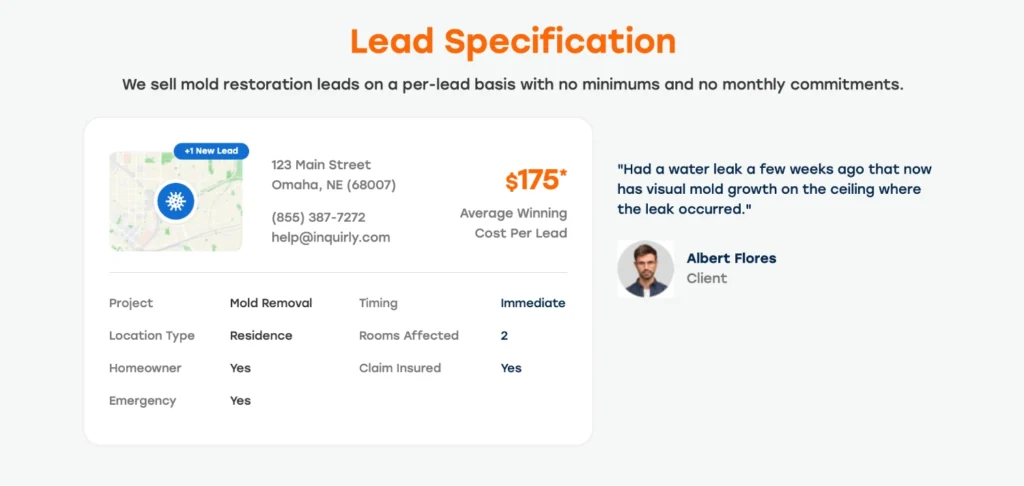
Inquirly.com offers exclusive mold removal leads – meaning the homeowner inquiry goes only to your company, not to three or four competitors. This exclusivity dramatically increases close rates and reduces wasted ad spend.

Partnerships

SEO and PPC are essential, but offline referrals remain powerful:

  • Plumbers → First responders when pipes burst. Offer co-branded cards/flyers: “Flood damage? Partnered with [Your Company] for mold remediation.”
  • Insurance Agents → Need reliable mold reports. Build credibility with detailed moisture maps and documentation.
  • Property Managers → Rental properties after storms almost always require mold remediation. Host quarterly “lunch and learns” about mold risk.

Target Insurance Work with Documentation Expertise

For many homeowners, the biggest question after a flood is: “Will my insurance cover mold remediation, or do I have to pay myself?”

If your company can confidently answer that question and guide them through the claims process, you immediately become the preferred provider.

Insurance carriers require evidence to justify mold remediation costs. If the damage isn’t properly documented, adjusters may deny or reduce coverage. That’s why your team should treat every flood job like a case file. The stronger the evidence, the easier it is for the adjuster to approve the claim and the faster you get paid.

What to Document (Step by Step)

  1. Before work begins
    • Take wide photos and close-ups of water damage, visible mold, and affected rooms.
    • Capture the source of flooding (burst pipe, roof leak, storm entry point).
    • Record initial moisture readings with a meter.
  2. During remediation
    • Document containment setup (plastic barriers, HEPA filters, negative air pressure).
    • Take photos of mold removal solutions being applied.
    • Keep logs of daily humidity and moisture levels as materials dry.
  3. After completion
    • Provide final photos of cleaned, treated areas.
    • Include lab testing results if mold samples were taken.
    • Add a written summary outlining what was removed, cleaned, and restored.

How to Market This Expertise

  1. Add a page on your website like “Insurance Claim Support for Flood & Mold Damage” explaining your process.
  2. Train office staff to tell callers: “We’ll handle the documentation your insurance adjuster needs.”
  3. Share case studies on your site: “After a Houston flood, we worked directly with State Farm to secure coverage for $18,000 worth of mold remediation.”

Build Relationships with Adjusters & Contractors

  • Adjusters: Invite them to walkthroughs, provide clear reports, and make their job easier → they’ll recommend you in future claims.
  • Restoration contractors: Water removal crews often pass jobs to mold specialists. Show them you’re skilled with insurance paperwork, and they’ll trust you with their referrals.

Conclusion

After a flood, homeowners need more than just water removal, they need fast mold treatment, clear guidance, and insurance support. The companies that act quickly, document properly and build trust are the ones that win repeat business and referrals.

Alongside strong local SEO and emergency ads, tools like Inquirly.com can deliver exclusive mold remediation leads, helping you stay busy when demand spikes.

👉 In the end, it’s about being visible, responsive, and reliable when people need help most.


FAQ

How can mold remediation companies get more leads after flooding?

Focus on fast-response marketing, strong SEO for flood and mold keywords, and exclusive partnerships with lead providers like Inquirly.com.

Are Google Local Service Ads effective for flood cleanup and mold removal?

Yes. They appear above traditional ads, are pay-per-lead, and carry the Google Guaranteed badge, which boosts homeowner trust.

Why is insurance documentation important for winning jobs?

Homeowners often rely on insurance to cover mold damage. Companies that document thoroughly win more referrals from adjusters and contractors.

Can content marketing really generate mold remediation leads?

Yes. Educational blogs about water damage, mold treatment, and prevention build trust and capture long-term organic traffic.

Are lead generation companies worth using?

They can help during peak flooding seasons. Services like Inquirly.com provide exclusive mold remediation leads, unlike shared leads from most providers.

What’s the fastest way to capture emergency flood cleanup calls?

Use 24/7 call handling, update your Google Business Profile during storms, and run click-to-call ads for immediate response.

How to Get Flood Damage Repair Leads

Flood damage is one of the most urgent and high-value jobs in the restoration industry. When water invades a home, it spreads quickly, weakens structures, damages personal belongings and creates health risks. For emergency restoration companies, this urgency is an opportunity. Flood jobs are often covered by insurance, making them more profitable than smaller daytime jobs. But capturing these leads need a clear system for restoration company SEO lead generation, water damage PPC campaigns, content marketing and insurance restoration leads.

This comprehensive guide breaks down how to consistently generate flood damage repair leads and turn them into paying jobs.

Flood Damage Lead Landscape

Let’s clarify the types of leads and why flood repair is a unique category:

  • Water damage leads – General leads for water leaks, moisture damage, or appliance overflows.
  • Flood damage leads – Urgent, large-scale jobs caused by storms, heavy rain, or burst mains. These are typically insurance-backed and require immediate response.
  • Insurance restoration leads – Jobs that come with active or pending insurance claims. Customers want a contractor who understands documentation and billing.
  • Restoration leads – The broad category covering water, fire, mold, and storm jobs.


Flood damage sits at the top of this hierarchy: it’s urgent, usually profitable, and extremely competitive. That’s why water damage restoration marketing requires a dual approach: fast-response ads (PPC) plus long-term SEO.

SEO for Restoration Company Lead Generation

Restoration company SEO lead generation is one of the most sustainable ways to get consistent flood damage leads. While PPC brings instant calls, SEO builds long-term visibility.

On-Page SEO

  • Dedicated Service Pages: Don’t bury flood services inside a generic “Water Damage” page. Create a specific page: “Flood Damage Repair in [City]”.
  • Local Landing Pages: Cover multiple service areas with pages like “Flood Damage Cleanup in Plano, TX”. Use references to local neighborhoods or landmarks for authenticity.
  • Content Clusters: Build supporting blogs, e.g. “What to Do in the First 24 Hours After a Flood”“How Insurance Covers Basement Floods”.


Off-Page SEO

  • Citations & Directories: Ensure consistent NAP (Name, Address, Phone) on Google Business Profile, Yelp, Angi, and insurance directories.
  • Local PR: Pitch storm-preparedness tips to local newspapers and link back to your site.
  • Partnership Links: Partner with plumbers, roofers, and property managers for backlinks and referral traffic.


Technical SEO

  • Schema markup: Add FAQ and Service schema.
  • Page speed: Homeowners won’t wait 6 seconds for your page to load on mobile.
  • Conversion elements: Sticky “Call Now” button, live chat, and emergency hotline.


🔧 Tools to use:

Water Damage PPC Campaigns

SEO is long-term, but water damage PPC can generate leads tomorrow. The downside: it’s expensive (CPCs in competitive US markets can hit $100+). That’s why campaigns must be precise.

Campaign Setup

  • Emergency Keywords: “24/7 flood damage repair near me”“emergency water removal [city]”.
  • Geo-Targeting: Keep ads within a 15-20 mile radius of your office. Anything further delays response.
  • Ad Types:
    • Search Ads → Good for intent.
    • Call-Only Ads → Essential for after-hours jobs.


The best practices for PPC in this industry are straightforward. Your ad copy must stress urgency. A line like “On-Site in 60 Minutes – Insurance Approved – Call 24/7” makes clear that you respond quickly and handle insurance claims, which reassures prospects. Use Google ad extensions to show location, phone number, and reviews, since these improve both visibility and trust. Finally, don’t send clicks to your homepage. Direct all paid traffic to a dedicated emergency landing page with a clear call-to-action and click-to-call button.


🔧 Tools to use:

Working With Insurance Restoration Leads

Since flood jobs are often insurance-covered, working with insurance restoration leads is smart. These customers are high-intent and ready to hire.

Sources of Insurance Leads

  • Lead providers: Inquirly (exclusive restoration leads), HomeAdvisor, Angi.
  • Insurance adjuster partnerships: Build relationships with local adjusters who recommend trusted contractors.
  • Property managers: They handle flooded apartments and want reliable partners.


Tips for Converting Insurance Leads

  • Answer within 5 minutes.
  • Train staff to highlight documentation support (“We’ll handle insurance-ready reports and photos”).
  • Follow up with a same-day confirmation email outlining process + ETA.

Local Authority

For flood damage leads, authority is everything. Homeowners want to see proof you’ve handled situations like theirs. A short case study about restoring a flooded basement, with photos or a video clip of the process, shows real expertise and builds confidence. Seasonal guides tied to local risks, like “How to Prepare for Flood Season in Houston,” also help position your company as a trusted resource.

Reviews carry just as much weight. A simple five-star Google review that mentions flood damage repair or insurance support can convert better than any ad. The key is asking quickly, right after a successful job, when the customer is most grateful. Use Podium to automate SMS review requests.

Lead Tracking & Conversion Optimization

Even the best marketing won’t matter if you don’t track leads and conversions.

  • Call Tracking: Use unique numbers for SEO, PPC, referrals.
  • CRM: Centralize lead details (address, damage type, insurance info).
  • Call Recording: Train your staff to qualify leads better.
  • Conversion Metrics: Track cost-per-lead (CPL), cost-per-booked job, and close rate.


Long-Term Strategies for More Flood Leads

Flood damage is seasonal in many markets, so preparing in advance keeps pipelines full.

  • Referral Partnerships: Plumbers, roofers, and HVAC techs can funnel emergency jobs.
  • Community Visibility: Sponsor local preparedness fairs or provide flood-readiness checklists.
  • Storm Tracking Campaigns: Run PPC ads around forecasted storms (“Emergency Flood Cleanup Near You”).
  • Always-On Ads: Keep Local Services Ads live 24/7; turning them off reduces visibility


Partner With Inquirly for Exclusive Flood Leads

Even the best strategy can take months to pay off. That’s why many companies combine SEO and PPC with exclusive lead partnerships.

Inquirly delivers high-intent, exclusive water restoration leads directly to your phone, so you’re not competing with three other contractors on the same call. Pair this with strong after-hours coverage and you’ll capture more flood damage repair leads without wasting ad spend.

👉 Get Exclusive Flood Damage Leads with Inquirly

Conclusion

Flood jobs are urgent, profitable, and competitive. To win them consistently, emergency restoration companies need a system that blends:

  • SEO for long-term visibility.
  • PPC for immediate emergency calls.
  • Insurance restoration partnerships for high-value jobs.
  • Smart tracking to maximize every lead.

The companies that combine water damage PPC campaigns, restoration company SEO lead generation and exclusive restoration leads will dominate their local markets. Floods won’t wait and neither should your business.

How to Get Emergency Restoration calls after hours

Most restoration jobs don’t start with a tidy appointment. They start with chaos: ankle-deep water in a living room, smoke still hanging in the air or a sewage backup that no one wants to face alone. And more often than not, those calls for help come long after the office lights are off.

This is where companies either prove themselves or disappear from the customer’s mind. After-hours calls aren’t a side task. They’re the moments that shape your reputation and drive some of the most profitable work you’ll ever book.

Importance of After-Hours Calls

  • Emergencies don’t wait. Water spreads quickly, fire damage worsens without action, and sewage becomes hazardous within hours. Customers need immediate help, and the first company that answers gets the job.
  • Higher-value opportunities. After-hours calls are usually urgent, which means bigger contracts. Many involve insurance-covered damage, making them more profitable than small daytime jobs.
  • Missed calls = missed revenue. One unanswered phone call can cost thousands in lost restoration work.

How to Get Emergency Restoration Calls After Hours

For emergency restoration companies, these after-hours calls are often the highest-value jobs: urgent, insurance-backed, and time-sensitive. Missing one means not just losing revenue, but potentially losing long-term customer trust.

This guide shows you how to build a reliable system for capturing after-hours calls, the tools that make it easier, and the best practices your team should follow to turn emergencies into booked jobs

1. Set Up a 24/7 Call Answering System

The number one rule: never let an emergency call go to voicemail. If you can’t pick up, someone else needs to.

Options to cover after-hours calls:

  • Live Answering Services
    Outsource to a call center trained in service-based industries. They can answer, reassure the caller, and forward details to your on-call technician.
    • Ruby – 24/7 virtual receptionists.
    • PATLive – US-based answering service with dispatch features.
    • AnswerConnect – Works well for small-to-midsize businesses.
  • Call Routing & Forwarding Tools
    Use VoIP systems that ring multiple numbers until someone answers.
  • Budget Option
    • Google Voice – Free, but basic. Can forward calls to personal mobiles.

Pro Tip: Use “simultaneous ring” so the first available staff member picks up, rather than relying on one person to catch every call.

2. Creating an On-Call System That Works

Since restoration technicians can’t be awake around the clock, a fair rotation system is essential. Many companies set up a shared calendar, such as Google Calendar, to assign night and weekend shifts. Tools like When I Work or Deputy can send automatic reminders so technicians never forget when it’s their turn. Rotating shifts evenly also prevents burnout, which is crucial for keeping staff motivated to answer calls during difficult hours.

3. Setting the Right Tone on the Phone

When a customer calls in the middle of the night, they’re often stressed and overwhelmed. The way you answer can either reassure them or drive them away. A plain “Hello” can sound unprofessional. Instead, something like, “Thank you for calling SafeDry Restoration, this is Alex. You’re in good hands,” immediately establishes trust and professionalism.

Follow a short, consistent script to qualify each call quickly. Start by confirming the address to be sure the job is in your service area. Ask about the cause of the damage: burst pipe, flooding or sewage, so you know what equipment to bring. Check if the water is still running and how long the issue has been going on. Finally, find out if insurance is involved, since that changes how the work will be documented and billed. These quick questions take just a couple of minutes but can save hours of wasted trips and confusion later.

4. Use Technology to Prevent Missed Leads

  • Call Tracking & Recording
    • CallRail – Track which marketing source drove the call.
    • Podium – Call + text + CRM integration.
  • Call Blaster (Multi-Ring Systems)
  • Text Auto-Response
    If you miss a call, immediately send:
    “We received your emergency call. A technician is reviewing it and will call you back within 2 minutes.”
    Podium and RingCentral can automate this.

5. Making Sure People Know You’re Available

Even the best system won’t help if customers don’t realize you’re open after hours. Update your Google Business Profileto show 24/7 availability. Highlight “Emergency Restoration Service” in your Google Local Services Ads and paid search campaigns. Add clear “Call Anytime” banners on your website so homeowners know they can reach you day or night. Continuous visibility is key, pausing your ads or appearing closed can quickly shift business to competitors who look available.

6. Quality, safety and compliance (do not skip)

If you record calls, many states require telling the caller. A simple “this call may be recorded for quality” covers you. At night, consider a two-person rule for high-risk conditions (electrical hazards, contaminated water) and make sure PPE is stocked. Your restoration technicians should be trained to document for insurance without slowing down the response.


Call distribution by time window

6–9 pm 22%
9 pm–12 am 28%
12–3 am 18%
3–6 am 8%
Business hours 24%

Example split. Replace percentages with your own call log data.

After-hours conversion funnel

Calls received 100%
Answered live 92%
Qualified 74%
Dispatched 58%
Booked 46%

Replace values with your weekly KPI snapshot to track improvement.

What to measure each week

A few numbers will tell you if after-hours coverage is really working:

  • Answer rate after hours (target 80-85%+)
  • Average pickup time (target 15-20 seconds)
  • Missed call recovery (booked within 10 minutes of missed)
  • Call-to-book conversion for after-hours calls
  • Average time-to-onsite vs promised window

Quick seven-day rollout plan

  • Day 1: Turn on simultaneous ring; confirm forwarding; set missed-call text.
  • Day 2: Publish on-call rotation with calendar reminders.
  • Day 3: Finalize greeting and qualification script; print a one-pager.
  • Day 4: Update Google Business Profile to “Open 24 hours”; adjust ad copy to “day or night.”
  • Day 5: Stock trucks for night work; review safety and consent language.
  • Day 6: Add tracking numbers per channel in CallRail; test recordings.
  • Day 7: Review a mock night; measure pickup time and practice the handoff.


Want more (and better) after-hours demand?

Strong handling wins the job; strong supply fills the pipeline. If you need a steadier stream of exclusive, high-intent leads that ring at night too, consider a partner built for this space.

Inquirly delivers exclusive emergency calls to emergency restoration companies and pairs them with routing and tracking so you can book work quickly and see ROI clearly.
👉 Get more twenty four seven emergency restoration calls: https://inquirly.com

Lead Management Playbook: Tips to Turn Every Call Into a Job

In the restoration business, most jobs don’t start with a slow sales process, they start with an emergency call. Someone has water pouring into their home, and they need help right away. That means the way you handle those first few minutes on the phone matters as much as the actual service you provide.

This playbook lays out a practical system your team can use to capture more of those high-intent calls. It covers how to respond quickly, qualify jobs without wasting time, route leads to the right person and keep track of every outcome. Used consistently, it not only helps you book more jobs but also makes sure your marketing spend actually turns into revenue.

Lead Handling Checklist

  • ✅ Answer within 3 rings (or call back in <5 min)
  • ✅ Introduce yourself + company name immediately
  • ✅ Qualify within 2 minutes (location, source, urgency, insurance)
  • ✅ Log details in CRM with outcome notes
  • ✅ Follow up with confirmation text/email


Let’s break down into details:

The Five R Framework (Full Call Flow)

Respond
Speed
Reassure
Trust
Rapid Qualify
Accuracy
Route
Efficiency
Record
Accountability


  1. Respond Fast – Answer within 3 rings (15–20 seconds).
    • Builds trust and boosts Quality Score with LSA.
    • Avoids missed-call charges.
  2. Reassure – Immediately introduce yourself and your company.
    • “Thanks for calling SafeDry Restoration, this is Alex. You’re in good hands.”
    • Creates professionalism and instant credibility.
  3. Rapid-Qualify – Ask targeted questions in the first 90 seconds. (More details down in the article)
  4. Route – Schedule a technician right away. Offer two appointment slots.
  5. Record – Log details in your CRM. Note the marketing source (Google Ads, referral, SEO) to tie ROI back to campaigns.

Introduce Yourself the Right Way

A common mistake is answering with a plain “Hello.” It sounds unprofessional and immediately makes the caller doubt if they reached the right company.

Instead, start with:
“Thank you for calling [Company Name], this is [Your Name]. How can I help you today?”

This approach builds trust, reassures the caller that they dialed the right number, and sets the stage for a professional conversation.

Use Call Blaster to Avoid Missed Opportunities

In restoration, a missed call often means a missed job. Emergencies don’t wait, and homeowners won’t call twice, they’ll move on to the next company in search results. If you have multiple staff members who can handle calls, Call Blaster routes each lead to several numbers at once. The first available person picks up, ensuring the caller reaches a live representative almost immediately.
This system reduces missed-call charges, improves your response time, and spreads the workload across your team. For growing businesses, it’s one of the simplest ways to scale lead handling without investing in a full call center.

For small to mid-size restoration companies, tools like Grasshopper (app & website), RingCentral or CallRail are easy to set up and integrate with CRMs. If you want a budget-friendly option, Google Voice can also handle basic simultaneous call forwarding.

System to apply:

  • Assign multiple phone numbers in your CRM.
  • Test routing rules (e.g., round-robin vs. simultaneous ring).
  • Always record outcomes – so if Rep A missed, Rep B’s notes are logged.

Qualify Early to Save Time for Everyone

In water damage restoration, speed is critical, but speed without clarity can lead to wasted trips, frustrated customers, and lost revenue. That’s why every intake call should include a structured qualification process. The goal is not just to gather information, but to decide whether this is a job you can and should take on immediately.

Here are key areas to cover in the first 2–3 minutes of the call:

1. Confirm Service Area

Start with the caller’s address or zip code. Many restoration companies lose time driving across town to jobs outside their ideal zone. Having a clear service map in front of your dispatcher ensures you only commit to locations where you can realistically meet your response-time promise.

2. Identify the Source of Water

Ask about the cause of the damage. Burst pipes, storm flooding, roof leaks, sewage backups, and appliance failures all require different equipment, certifications, and levels of urgency. For example, Category 3 water (sewage) demands faster response and more specialized safety protocols than a small clean-water leak.

3. Establish Duration and Ongoing Risk

Find out how long the issue has been happening and if water is still entering the property.

  • If it’s been going on for hours or days, you can anticipate secondary damage like mold or structural weakening.
  • If the water source is active (a pipe still leaking), you may need to advise the homeowner to shut off the main valve immediately while you dispatch a crew.

4. Check for Insurance Involvement

Insurance coverage changes how you frame the job. If the customer has an open claim (or plans to file one), reassure them that your company provides insurance-ready documentation, photos, and moisture reports. If they don’t have coverage, be upfront about pricing and payment expectations so there are no surprises later.

5. Gauge Urgency and Fit

Not all calls are true emergencies. Some customers may want an estimate for preventive work or minor issues. Categorizing calls into urgent vs. non-urgent helps you assign the right priority and keep emergency crews free for time-sensitive jobs.

✅ Pro Tip: Use a call qualification script or checklist so that every team member asks the same questions, in the same order. This reduces mistakes, standardizes the customer experience, and ensures your dispatch decisions are always based on reliable data.

✅ Pro Tip: Track call outcomes in a CRM or call log. Over time, you’ll see patterns, like which zip codes generate the best-paying jobs, or which water sources (e.g., sewage backups) are most profitable. This helps refine both your marketing targeting and operations planning.

Stay Active

One of the biggest mistakes restoration companies make is turning their ads or accounts on and off depending on how busy they feel. This creates long gaps where competitors step in and capture the calls you should have received. Lead generation works best when it runs continuously. If your Google Local Services Ads or paid campaigns go dark, your visibility drops, and it can take time and extra spend to rebuild momentum once you switch them back on.

Staying active also applies to how your team handles calls. If you only respond during certain hours or slow down during off-seasons, you miss opportunities that would have turned into paying jobs. Water damage emergencies don’t follow business hours, they happen at night, on weekends and even during holidays. Companies that answer consistently, no matter the day or time, build a stronger reputation in their local market because customers quickly learn they can be relied on.

This doesn’t mean you always have to spend at peak levels. Even if you reduce your ad budget during quieter months, keeping campaigns live ensures your business stays present and doesn’t lose its ranking position. Likewise, monitoring your accounts regularly – instead of pausing them – helps you catch small issues before they turn into lost leads. Over time, the businesses that remain visible and available every single day outperform those that only show up when it’s convenient.

Turning Better Lead Handling into More Jobs

Having the right system in place is only half of the equation, you also need a consistent stream of quality leads to feed into it.

Instead of wasting ad spend on low-quality clicks, Inquirly delivers exclusive, high-intent restoration leads directly to your phone. Combined with proper lead handling practices like Call Blaster, this creates a reliable system that:

  • Increases call answer rates
  • Maximizes conversion opportunities
  • Ensures every marketing dollar is trackable

👉 Get More Exclusive Leads with Inquirly

How to Advertise Water Damage Services Locally

water damage business is unlike most home services: it operates in a world of urgency. Your marketing must be structured so that when someone in your city searches “emergency water damage restoration near me”, your company is the one they see and the one they trust to call.

Local visibility, reputation and quick response times matter more than flashy branding. And in today’s competitive field, companies that invest in restoration marketing, from SEO for water damage restoration to paid ads and local partnerships, consistently outperform those that rely on word of mouth alone.

In this article, we’ll explore how to build a well-rounded strategy for water restoration marketing. You’ll learn how to optimize for local SEO, run paid campaigns that generate calls during emergencies, produce content that builds trust and form partnerships that drive steady referrals.

Table of Contents

  1. Why Local Marketing Matters
  2. Foundations: Tracking, Offers, Coverage
  3. Local SEO That Wins Emergencies
  4. Paid Acquisition for “Right-Now” Leads
  5. High-Converting Landing Pages & Calls
  6. Content That Builds Local Authority
  7. Reviews, Reputation, and Social Proof
  8. Partnerships and Referral Networks
  9. Budgets, KPIs and a 90-Day Plan
  10. Common Mistakes to Avoid
  11. FAQ

Local Marketing Matters

The water restoration industry is hyper-local. Homeowners want someone nearby who can arrive in less than two hours. This urgency shapes everything about damage restoration marketing.

Unlike other industries, you can’t rely solely on brand awareness. When water damage strikes, people will not remember the billboard they saw two weeks ago. They’ll pull out their phone, type “water restoration [city],” and call the first trusted provider they see. That’s why investing in restoration company marketing and restoration SEO is essential.

Local marketing ensures your company:

  • Shows up in “near me” search results when people need urgent help.
  • Builds credibility by featuring real reviews and proof of past jobs.
  • Clarifies service coverage so customers know exactly which neighborhoods you serve.

Foundations: Tracking, Offers, Coverage

Before ads or SEO, get the plumbing right.

Tracking & Attribution

  • Use call tracking with dynamic numbers (e.g., one for Google Ads, one for SEO).
  • Add UTM tags to every ad and profile link.
  • Record calls (with consent) to diagnose close-rate issues.
  • Route calls to a 24/7 line. Missed calls kill ROI.

Emergency Offer & Proof

  • 24/7 response, on-site ETA, free moisture inspection, IICRC-certified techs.
  • Show before/after photos, insurance-ready reports, and clear next steps.

Coverage Map

  • Publish a visual service area and a list of zip codes or neighborhoods.
  • Promise realistic ETAs by zone. Don’t over-promise.

Strong Local SEO

Search engine optimization is one of the most reliable long-term strategies for water damage restoration marketing. While paid ads bring instant leads, SEO ensures your business becomes a permanent fixture in your local search ecosystem.

Start with your Google Business Profile. This free listing is often the first thing a homeowner sees after searching. Treat it like a storefront: add high-quality photos of completed jobs, upload before-and-after images, keep your hours accurate, and respond promptly to reviews. A well-maintained profile signals credibility both to potential customers and to Google’s ranking algorithm.

On your website, create pages tailored to the exact services people look for. Instead of a single generic services page, build individual sections for emergency water removal, basement flooding, sewage cleanup, and mold prevention. Add local city pages as well. For example, a company in Dallas might publish “Water Damage Restoration in Plano” or “Flood Cleanup in Frisco.” Each page should reference local landmarks or neighborhoods so it feels authentic to the area.

Finally, make sure your business details: name, address and phone number are identical everywhere they appear online. Directories, social profiles, and citations must all match or you risk confusing search engines. Done right, a structured SEO for water damage restoration strategy becomes a steady pipeline of calls that doesn’t disappear the moment you stop paying for ads.

Paid Advertising for Immediate Leads

While SEO compounds over time, paid advertising is the fastest way to capture urgent leads. Internet marketing for restoration companies often relies on two primary platforms: Google Ads and Google Local Services Ads (LSA).

Local Services Ads are particularly effective for restoration companies. They appear at the very top of search results with the “Google Guaranteed” badge, which instantly builds trust. Since LSAs operate on a pay-per-lead model instead of pay-per-click, you only pay when someone actually reaches out. For businesses that handle emergency situations, this can be one of the most cost-effective tools in water damage marketing.

Using Content to Build Local Authority

Most restoration companies treat content as optional, but it’s one of the best ways to stand out in search results and position yourself as a trusted expert. Restoration digital marketing thrives on content that answers real homeowner questions.

Start with bottom-of-funnel topics that address emergencies directly. Articles like “What to Do in the First 24 Hours After Water Damage in [City]” or “Emergency Checklist for Burst Pipes in [Region]” not only rank well but also give customers a reason to trust you before they even call.

From there, build mid-funnel and top-funnel content that educates and prevents future damage. A blog on “5 Common Causes of Basement Flooding in [City]” helps attract people searching for preventive advice, while a seasonal piece like “Hurricane Season Flood Preparedness Guide” builds awareness ahead of storms.

Videos and photos also play a role. Quick before-and-after clips or short explanations of drying equipment can be repurposed on YouTube, Facebook and even your Google Business Profile. This kind of content humanizes your brand, making it clear that you’re not just another contractor but a professional restoration expert.

Don’t let another emergency call go to your competitor. Partner with Inquirly and get exclusive water damage leads in your service area

Contact us Today

Reviews, Reputation and Social Proof

Reviews drive the Map Pack and conversion. This is a core pillar of water damage marketing and restoration marketing.

Simple SOP

  1. Tech finishes job → customer walkthrough.
  2. Tech requests review via QR or text.
  3. Office sends follow-up link same day and 48 hours later.
  4. Respond to every review within 24 hours.


Response Template

  • Positive: “Thanks, [Name]. Glad we could get you dry fast. We’re here 24/7.”
  • Negative: “Sorry for the stress, [Name]. I’m the owner. I’ll call now to make this right.”

Partnerships and Referral Networks

Not every lead comes from the internet. Strong offline partnerships are still a cornerstone of marketing for restoration companies. Plumbers, property managers, real estate agents, and insurance adjusters all encounter water damage problems regularly, and they often recommend trusted providers to their clients.

How to Make It Real

  • Create a one-page referral kit: your ETAs, services, three case photos, contact line.
  • Offer co-branded magnets, emergency cards, and a partner hotline.
  • Run quarterly lunch-and-learns on moisture basics for property managers.
  • Publish partner spotlights on your blog (earn reciprocal links).

Budgets, KPIs and a 90-Day Plan

Google LSA 40%
Google Ads 35%
Retargeting 10%
SEO and Content 15%


Three phases with clear actions and a single focus for each block

1 Lay the rails for tracking and visibility

Days 1 to 14

Call tracking active and U T M parameters on every link
Google Business Profile updated with fresh project photos
Homepage and Emergency page and 2 priority city pages live
Review request process documented and technicians trained
Action focus: build the foundation so every lead is attributed and answered
2 Acquire demand and improve conversion

Days 15 to 45

Local Services Ads live with active monitoring and dispute handling if needed
Google Ads for emergency intent and general intent with weekly pruning
Split test landing page headline and primary call to action
4 content pieces published 2 emergency guides and 2 local authority articles
Action focus: increase qualified calls and make booking effortless
3 Scale authority and diversify lead sources

Days 46 to 90

5 to 10 citations added and 1 local news pitch sent
2 new city pages launched and 10 new job photos added
Partner lunches started and 3 referral agreements secured
Retargeting live with before and after creatives and recent reviews
Quarterly review on cost per lead close rate and landing page conversion
Action focus: compound trust and stabilize volume beyond search ads


FAQ

How is “water damage restoration marketing” different from general home-services marketing?
Urgency is higher, so you optimize for immediate calls, not form leads next week. You need 24/7 dispatch, call-only ads and fast ETAs.

What channels produce the fastest jobs?
Google LSA and emergency-intent Search campaigns. Retargeting supports trust. Water damage restoration SEO compounds long-term.

What should I measure weekly?
Answered calls, booked jobs, CPL by source, landing page conversion, review velocity.

How long until SEO works?
You can see Map Pack gains in 6-12 weeks with strong GBP and reviews. Organic rankings for competitive terms take longer.

Tips to get more electrician job leads 

For many electricians, getting work isn’t the hard part, it’s keeping the work coming in week after week, month after month. You can do great jobs, have happy customers, and still face empty days in the calendar. That’s why electrician lead generation has become a crucial part of running a profitable business in 2025.

The problem is that most advice out there sounds the same: “Do SEO, get reviews, run Google ads.” Those are valuable, but they’re also the same tactics every competitor is using. If you want to grow faster and avoid a race to the bottom, you need lead sources that other electricians haven’t tapped into yet.

In this guide, we’ll cover eight less common, high-impact strategies for generating electrical contractor job leads, ones that can work alongside your existing marketing or stand alone as fresh revenue channels.

Table of Contents

  1. Why You Need a Lead Generation Plan
  2. Partner with EV Dealerships and Solar Installers
  3. Build Niche Landing Pages for High-Value Jobs
  4. Work with Insurance Adjusters and Restoration Companies
  5. Offer Maintenance Contracts to Property Investors
  6. Network at Trade Events Most Electricians Ignore
  7. Work with a Lead Generation Company
  8. Conclusion

Why You Need a Lead Generation Plan

Work in the electrical trade can be unpredictable. In summer, air conditioning failures can keep you busy. In winter, it’s heating issues and storm-related repairs. But spring and fall can bring slower weeks, unless you have a system to fill the gaps.

Without a plan, you end up taking whatever jobs come your way, often at lower rates, just to keep working. With a plan, you can focus on higher-value jobs, schedule ahead, and grow your customer base on your terms.

Quick 30-Day Action Plan

One focus each week. Scroll through and keep tasks light so they get done.

Week 1

EV & Solar Outreach

Line up partnerships that feed you charger installs and solar tie-ins.

  • Make a list of 10 EV dealers and 5 solar installers within 50 miles.
  • Prepare a flat-rate install package (scope, price range, timeline).
  • Create a one-page PDF the sales team can hand to buyers.
  • Book three in-person intros with sales managers.
Week 2

Niche Landing Page

Publish one service plus location page aimed at high-value jobs.

  • Pick a niche (example: backup generators for restaurants in [City]).
  • Add 2–3 photos and a short case note (problem → fix → result).
  • Include a simple price guide and a single CTA (Book a site visit).
  • Submit the URL in Google Search Console.
Week 3

Property Investors

Turn one-off calls into repeat work with maintenance agreements.

  • Join a local landlord or investor meetup (next available date).
  • Bring a one-page maintenance plan (quarterly checks and priority calls).
  • Schedule two intro calls with property managers.
  • Offer one complimentary first inspection.
Week 4

Inquirly Lead Boost

Add a fast lead source while other channels ramp up.

  • Start an Inquirly trial focused on your highest-margin services.
  • Use a dedicated number to attribute calls correctly.
  • Reply to every inquiry within 10 minutes (text and call).
  • Record cost per lead and booked jobs for two weeks.

1. Partner with EV Dealerships and Solar Installers

Electric vehicles and solar energy are two industries expanding at record speed and both rely on electricians. Every EV buyer needs a charger installed, and every solar project requires integration with the electrical system.

Start by identifying dealerships and solar installers in your area, then meet with their sales managers to offer a fixed-price installation package they can present to customers. Provide them with printed or digital materials explaining exactly what’s included. By positioning yourself as their go-to partner, you enter the customer’s journey early, often before they’ve even considered shopping around for another electrician.

2. Build Niche Landing Pages for High-Value Jobs

Most electricians fight over broad keywords like “electrician near me”. But those are expensive and competitive. Instead, target specific, high-value services that fewer people are marketing.

High-Value Niche Landing Page Ideas

High-Value Niche Landing Page Ideas
Service + Location Target Customer Why It’s Valuable Suggested CTA
Backup Generator Installation Dallas · Restaurants Restaurant owners Prevents food spoilage and downtime during outages Book a Site Visit
Data Cabling & Networking San Diego · Offices Small business owners Faster internet and reliable communications Get a Free Quote
Outdoor Security Lighting Miami · Luxury Homes High-income homeowners Boosts property security and curb appeal Request a Lighting Plan

3. Work with Insurance Adjusters and Restoration Companies

When storms, fires, or floods damage electrical systems, insurance adjusters and restoration companies need trusted electricians on call. Reach out to adjusters directly, introduce your services, and offer fast, no-cost estimates for claim-related work. Restoration companies, in particular, often have tight timelines and will rely on whoever can respond first.

By building these relationships before disaster strikes, you position yourself to receive high-value jobs during peak demand periods, without competing in crowded ad spaces.

4. Offer Maintenance Contracts to Property Investors

Landlords and property investors value predictable costs and minimal downtime. Offering a maintenance plan — with regular inspections, priority service, and discounted repairs — meets both needs while giving you a consistent source of work.

You can connect with potential clients by attending landlord meetups or investor events. Having a simple, clearly priced agreement ready to share makes it easier for them to say yes, especially if you include a complimentary first inspection.

5. Network at Trade Events Most Electricians Ignore

Home shows are saturated with electricians. Instead, focus on events where you’ll stand out, such as facility management expos, commercial property summits, or real estate investor conferences. At these gatherings, you’re meeting decision-makers who control large portfolios and long-term contracts.

A modest display, a short conversation, and a clear follow-up plan can lead to connections that pay off for years.

What to bring:

  • A small booth or tabletop display
  • A “Free Electrical Safety Check” offer for attendees
  • Printed materials with your contact info and key services

6. Working with a Lead Generation Company

For electricians who want to boost their pipeline quickly, working with a lead generation company can be a practical option. Instead of relying solely on organic marketing or word-of-mouth, these services connect you directly with homeowners or businesses already searching for electrical help. The biggest advantage is speed, within days of signing up, you can start receiving calls or inquiries from potential customers.

That said, quality matters more than quantity. Some companies sell the same lead to multiple electricians, which often turns into a race to see who calls first. Others may provide contacts that aren’t actively looking for service, leading to wasted time and budget. It’s important to work with a provider that offers exclusive, high-intent leads and clear reporting so you can track results.

Learn more about exclusive electrician leads and check the pricing for Inquirly:

Conclusion

Treat lead generation like an operation, not a one-off campaign. Block a standing hour each week to do three things: ship one small asset (a one-pager, a photo case note, a short landing-page update), review last week’s numbers, and decide one test for the next seven days. Keep your metrics boring and tight: response time to new inquiries, booked jobs per source, and profit per job. If a channel can’t beat your baseline within two weeks, park it and move on.

Build a tiny “offer library” you can reuse: one fixed-price site visit, one maintenance plan, and one seasonal promo. Pair each offer with a script for phone, a text template, and a two-line email, so anyone on your team can run it the same way every time. Add before/after photos to every new job folder the day it wraps; those images sell your next job more than any slogan.

If you need the fastest results, go straight to channels that connect you with people actively looking for help right now. Fill a form for Inquirly here.