
Category Archives: snow removal

How to Get More Snow Removal Jobs Before the Season Ends

As winter approaches its end, snow removal companies face a unique challenge: maximizing revenue before the season tapers off. Competition increases, budgets tighten and many potential customers delay hiring until the last minute. To stay ahead, you need a strategic approach that attracts high-quality leads, converts prospects and builds long-term customer relationships.

This article walks you through actionable strategies to get more snow removal jobs before the season ends, combining practical marketing techniques, operational best practices and smart lead generation.

1. Understand Your Target Market

Before executing a marketing plan, you must clearly define who your ideal customers are. Common segments in snow removal include:

  • Residential homeowners
  • Commercial property owners (offices, retail, warehouses)
  • HOAs and apartment complexes
  • Municipal or government contracts

Each of these segments has different needs, decision timelines, and sales cycles. For example, residential homeowners may respond well to localized advertising and referral discounts, while commercial clients may require formal proposals and service contracts.

Developing buyer personas helps you tailor messaging that resonates with each group, ensuring your offers address their specific pain points, like safety, convenience or liability reduction.

2. Optimize Your Website for Local SEO

Optimising your website for search engines is crucial for capturing organic traffic. Here’s what to focus on:

a. Keyword Research

Use keywords that potential customers are searching for, such as:

  • “snow removal services near me”
  • “best snow plowing company”
  • “commercial snow removal [your city]”
  • “emergency snow removal services”

Incorporate these keywords naturally into your titles, headings, meta descriptions and content.

b. Local SEO Signals

Make sure your business appears in local search results. To optimize:

  • List your business on Google Business Profile
  • Ensure your NAP (Name, Address, Phone) is consistent across directories
  • Encourage customers to leave positive reviews
  • Include localized content on your website (e.g., service pages like “Snow Removal in [City, Region]”)


Local SEO boosts visibility on search engine results pages (SERPs) and attracts customers actively searching for snow removal assistance now.

3. Produce High-Value Content

Content marketing helps attract prospects while establishing your authority in the snow removal niche. Consider:

Blog Topics

  • “5 Tips for Choosing the Best Snow Removal Service”
  • “How to Prepare Your Property for Winter Storms”
  • “Understanding Snow Removal Contracts”
  • “Why Early Season Snow Removal Booking Saves You Money”

Use internal links between your blog posts and service pages to help search engines crawl your site and keep users engaged longer.

FAQs and Service Guides

Answer common questions about pricing, service areas, equipment used, and snow removal timing. These pages can rank well for long-tail queries and position your company as a reliable resource.

4. Use Dedicated Lead Generation Companies

To scale your outreach and secure more jobs quickly, leverage premium lead services such as Inquirly’s Exclusive Snow Removal Leads. Inquirly provides real-time, exclusive leads from customers actively searching for snow removal services, meaning you’re the first and only contractor to receive their inquiry. This exclusivity increases your chances of conversion and reduces wasted time competing over shared leads.

By integrating Inquirly leads into your sales workflow, you can rapidly connect with motivated customers, respond faster than competitors and ultimately book more jobs before the season ends. If you’re looking to boost your prospect pipeline and reach customers ready to hire now, consider the benefits of exclusive snow removal leads from Inquirly: Contact us today

5. Implement Email Marketing Campaigns

If you’ve collected email addresses from prospects or previous customers, email marketing can help convert leads and encourage repeat business.

Campaign Ideas

  • Seasonal specials (“10% off any service booked before January 31st”)
  • Service reminders (“Next Snowstorm? We’re Ready!”)
  • Customer appreciation offers


Use segmented lists (e.g., residential vs. commercial) to tailor your messaging. Email automation tools can help streamline follow-ups and ensure timely outreach.

Top Email Marketing & Automation Tools

1. MailerLite
Great for beginners and small businesses just getting started with email campaigns. It’s easy to use, includes automation features and has a drag-and-drop builder, plus a generous free tier. 

2. Mailchimp
One of the most popular options for small to medium businesses. It offers templates, automation, audience segmentation and analytics, making it a solid all-around choice. 

3. ActiveCampaign
Known for some of the most powerful automation workflows, including behavior-based triggers and CRM integration – ideal if you want to automate follow-ups and nurture leads with complex sequences.

6. Offer Incentives and Promotions

Discounts and value-added offers can tip the scale for undecided prospects. Ideas include:

  • Early-season booking discounts
  • Referral bonuses for existing customers
  • Package deals (e.g., driveway + sidewalk clearing)
  • Priority response for contract clients

Make sure these promotions are prominent on your website, social media, and PPC ads to attract immediate attention.

Conclusion

Ending the snow removal season strong requires a mix of strategic marketing, operational efficiency, and proactive outreach. From optimizing your website for local search to integrating exclusive lead services like Inquirly’s snow removal leads, every step enhances your visibility and increases your chances of securing new business.

Start with clear goals, tailor your efforts to your target customers and measure your results as you go. With the right combination of SEO, advertising, lead generation and customer engagement, you can maximize bookings and revenue before the snow melts away.
How Much do Snow Removal Leads Cost

For many landscaping and property maintenance professionals, the winter season represents a high-stakes pivot. When the ground freezes and the lawn mowers are tucked away, snow removal becomes the primary driver of revenue. However, the seasonal nature of the industry creates a frantic “gold rush” for clients as soon as the first snowflake falls.

Understanding the market for snow removal leads and specifically the difference between shared and exclusive opportunities, is the key to a profitable winter.

In this guide, we will break down the industry standards for lead generation and look specifically at how Inquirly’s pricing model helps contractors secure high-value contracts.

Shared vs. Exclusive Leads 

Before looking at specific dollar amounts, it is vital to understand the “Lead Quality Spectrum.” Most lead generation platforms operate on one of two models:

1. Shared Leads (The High-Competition Model)

Shared leads are the standard offering from large-scale home service directories.

  • How it works: A homeowner’s request is sold to 3 to 5 contractors simultaneously.
  • The Reality: This creates a “race to the bottom” on price. Because the customer is being bombarded by multiple callers, they often choose the lowest bid. For contractors, the true cost is the time wasted on low closing rates and prospects who have already hired a competitor.

2. Exclusive Leads (The High-Conversion Model)

Exclusive leads are routed to exactly one contractor, ensuring you own the opportunity.

  • How it works: The lead is locked to your business. You aren’t competing for the customer’s attention, allowing you to build a professional relationship from the first interaction.
  • The Reality: While the upfront investment is higher, the cost per acquisition is significantly lower. You close a higher percentage of jobs and protect your margins because you aren’t being pitted against “budget” competitors in real-time.

Breaking Down Lead Costs

When analyzing the market for snow removal opportunities, costs can be segmented by the type of interaction and the “exclusivity” of the lead. Generally, the market is divided into two categories: Shared and Exclusive.

Pricing for Shared Leads

Shared leads are the most common model found on large home-service directories. In this model, a homeowner’s contact information is sold to 3 to 5 different contractors simultaneously.

  • Average Cost: $15 – $30 per lead.
  • The Dynamics: Because these leads are cheaper, they appeal to businesses with very tight marketing budgets. However, because you are competing with several other companies in real-time, these often lead to a “race to the bottom” on price.
  • The Hidden Cost: While the entry price is low, the closing rate is typically much lower. You may spend more time calling prospects who have already hired a competitor than actually clearing snow.

Inquirly.com Pricing

Inquirly operates on an exclusive basis, focusing on high-intent traffic to ensure that contractors aren’t just getting names and numbers, but actual opportunities to book work. Here is how the pricing breaks down for snow removal:

Standard Lead Pricing – Prices vary based on the “delivery method” of the lead. Generally, the more direct the contact, the higher the value.

  • Form Leads ($25 – $40 per lead): These occur when a prospect fills out a detailed request on Inquirly. These are ideal for residential routes and smaller commercial properties where you need to see the scope of work before providing a quote.
  • Live Calls ($35 – $120 per call): A live call is the most valuable asset in the snow industry. This is a customer on the line, right now, looking for help. These leads have the highest conversion rates, especially during active snow events.


The “Average Winning Cost” Metric

Inquirly notes an Average Winning Cost Per Lead of $350.

While the initial acquisition cost may seem high, it is a strategic investment in securing high-value seasonal contracts, such as HOAs or commercial centers. When compared to the total value of these contracts, which can range from $5,000 to over $50,000, the marketing expense remains a small percentage of the overall revenue. This approach prioritizes long-term ROI and predictable cash flow over the upfront cost of the lead.

Why Snow Removal Lead Costs Vary

Whether you are buying form leads or taking live calls, several environmental factors will influence the price you pay:

  1. Lead Type: As noted, a direct phone call is always more expensive than a form fill because the “intent to buy” is significantly higher.
  2. Market Competition: In cities with frequent, heavy snowfall (like Minneapolis, Chicago, or Boston), the cost per lead is higher because more contractors are bidding for the same digital real-house.
  3. Property Scale: Commercial snow removal leads are inherently more expensive to generate than residential ones. A lead for a 50-unit apartment complex is a “whale” compared to a single-family driveway, and the pricing reflects that potential.
  4. Weather Urgency: During a “State of Emergency” or a blizzard warning, the demand for snow services spikes. Lead costs often fluctuate based on the immediate weather forecast.

Conclusion

Navigating the costs of snow removal leads requires a shift from looking at “price per lead” to “profit per lead.” While shared leads are cheap, they are often a waste of time. Exclusive leads from Inquirly, ranging from $25 for forms to $120 for calls, offer a direct path to growth. By understanding that a $350 winning cost can secure a massive seasonal contract, you can budget effectively and dominate your local market this winter.

Secure Your Winter Routes Today Don’t wait for the first blizzard to start marketing. Get exclusive snow removal leads tailored to your service area. Contact Us Today.

How Much Does it Cost To Start Snow Removal Business in 2026 

Starting a snow removing business is one of the most reliable ways to generate high seasonal income. When a season comes, demand skyrockets and businesses that are properly equipped can charge premium rates. While the startup costs are significant, viewing them as strategic investments rather than financial barriers is key to building a profitable operation.

Projecting startup costs for 2026 requires balancing the investment in reliable equipment with the necessity of modern efficiency tools. Below, we break down the costs into three distinct entry points, showing you how to start small and scale big.

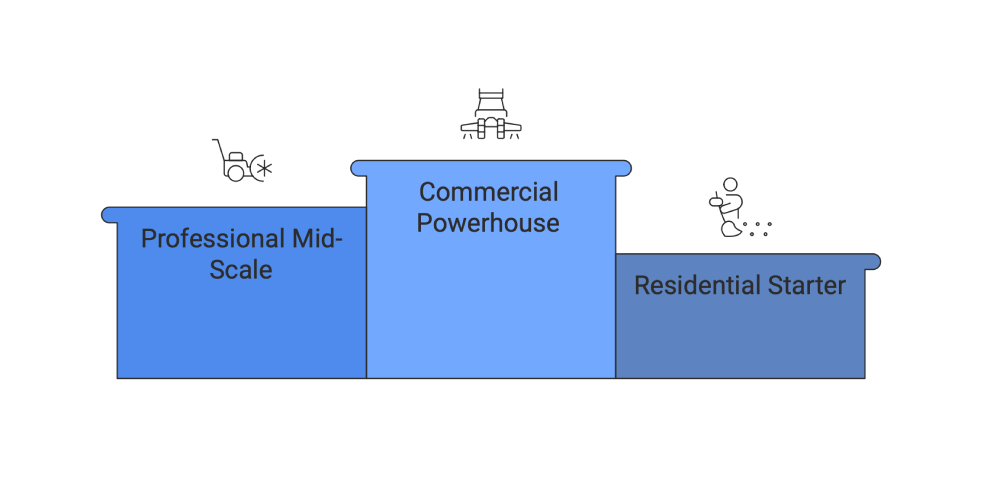
The Three Paths to Entry: Choosing Your Scale

The cost to start depends entirely on your target market: residential driveways, small business parking lots, or large commercial contracts.

Path 1: The Residential Starter

(The Side Hustle)

This is the low-cost entry point, focused on a specific neighborhood or small route. It minimizes initial snow removal costs by relying on lighter, smaller equipment and used gear.

Equipment & CostEstimated Cost Range (2026)Strategy
Used 1/2 Ton Truck (with 4×4)$15,000 – $25,000A capable personal truck can often pull duty.
Small Straight Blade Plow (7.5 ft)$4,500 – $6,500Lighter plow designed for residential driveways and tight spaces.
Commercial Snow Blower (1 Unit)$1,500 – $2,500Essential for clearing sidewalks and paths.
Shovels, Salt Spreader (Handheld)$500For detail work and walking paths.
Initial Working Capital & Insurance$2,500 – $4,000Basic liability insurance is a must, even for residential work.
TOTAL MINIMAL STARTUP$24,000 – $38,500This is the most affordable way to begin.

*Please bear in mind that all costs presented are averages.

Path 2: The Professional Mid-Scale

(Investment for Growth)

This path is designed for entrepreneurs aiming to transition from a side hustle to a full-time, scalable business. It targets small commercial lots and dense residential routes, necessitating better, more reliable equipment. This is where your investment in high-quality snow plows for trucks begins.

A. The Heavy-Duty Vehicle Investment

For consistent snow plowing, you need a truck that won’t break down when you need it most.

Vehicle OptionEstimated Cost Range (2026)Benefit for Mid-Scale
Used Heavy-Duty Truck (3-5 years old)$30,000 – $55,000The most realistic option: better capability than a 1/2 ton, less upfront cost than new.
Plow and Spreader Installation$6,500 – $9,000An 8 ft straight blade plow installed, perfect for mid-sized parking lots.
Commercial Salt Spreader (Tailgate)$3,000 – $5,000Enables profitable de-icing contracts-a huge revenue stream.
Total Vehicle & Plow Cost$39,500 – $69,000

*Please bear in mind that all costs presented are averages.


Key Investments in this Tier:

  • Working Capital: A sufficient cash buffer to cover unexpected maintenance, especially for used equipment, and the hiring of a single helper during major events.
  • Vehicle: A dedicated used heavy-duty truck (3/4 ton or 1-ton) that is prepared for constant use, including pre-season maintenance funds.
  • Plow and Spreader: A commercial-grade straight blade plow (8-9 ft) and a tailgate-mounted salt/sander spreader. Enabling profitable de-icing contracts is a huge revenue stream at this level.
  • Business Protection: Higher limits of Commercial General Liability (CGL) insurance, a dedicated commercial auto policy, and necessary local operating permits.
  • Efficiency: Initial investment in route optimization or basic CRM (Client Relationship Management) software to manage a growing list of clients efficiently.


Key Takeaway: This path is about buying durability and reducing risk. The investment here allows you to confidently service small commercial properties and scale your route without fearing breakdowns.

Path 3: The Commercial Powerhouse

(Investment for Maximum Profit)

This path targets large industrial parks, retail centers, and institutional contracts. These contracts are demanding but offer the highest profit margins, requiring brand-new, reliable equipment and advanced planning.

Investment Strategy:

This investment tier is non-negotiable for large-scale operations. The focus is on zero downtime and specialized equipment for high-volume, rapid clearance.

Key Investments in this Tier:

  • Vehicle: Brand-new, warrantied heavy-duty truck (1-ton or larger) with full plow-prep package.
  • Specialized Equipment: A Commercial V-Plow (9 ft+) for superior snow cutting capability and a large, high-capacity hopper spreader for bulk salt application across massive lots.
  • Premium Protection: The highest limits of CGL insurance (often required by corporate clients) and mandatory Workers’ Compensation insurance for a growing team.
  • Digital Infrastructure: A professional website, dedicated digital marketing (Local SEO), and subscription to advanced, real-time fleet management and route optimization software.
  • Contingency Fund: A substantial cash reserve designed to cover immediate, premium-rate repairs for critical components or the cost of hiring subcontractors during severe back-to-back storms.


Key Takeaway: This level of investment guarantees reliability and speed, allowing you to secure and fulfill the highest-paying, most demanding contracts in your market.

Strategic Investment: Generating High-Quality Leads

Beyond equipment, a successful snow removal business requires a consistent pipeline of paying customers. While building relationships and local reputation is essential, partnering with professional lead generation services can immediately provide high-value, exclusive leads, especially for new companies or those looking to expand rapidly into commercial markets. This turns marketing spend into a predictable investment in future revenue.

For example, specialized lead providers like Inquirly.com focus on delivering exclusive, pre-qualified leads directly to snow removal operators. Prices vary on the type of lead, as their form leads cost between $25 – $40 per lead and calls cost between $35 – $120 per call.

Contact Us For More Information.

Final Summary: Tiers of Investment

This table summarizes the approximate financial tier required to launch at each scale. Remember, these are broad estimates that vary based on the price of used trucks and regional labor rates.

Entry PathTarget MarketKey Investment FocusApproximate Investment Tier (2026)
1. Residential StarterDriveways, sidewalks, neighborsLow cost, functional used equipment$25,000 – $40,000
2. Professional Mid-ScaleSmall commercial lots, dense residentialReliable used truck, operational efficiency$50,000 – $90,000
3. Commercial PowerhouseLarge retail, industrial, institutionsZero downtime, brand-new heavy equipment$100,000 – $160,000+

Conclusion

The Investment Pays Off

The initial snow removal costs should be viewed as the necessary entry fee to an industry with exceptional earning potential.

For the aspiring entrepreneur, starting with the Residential Starter path is a realistic and accessible way to generate income immediately. Once cash flow is established, you can use those profits to upgrade your truck and secure better snow plows for trucks.

For those ready to command the highest rates and offer the best snow removal services, the Commercial Powerhouse investment is a guarantee of reliability. By strategically investing in the right equipment and planning for contingencies, you ensure your business is the one clients trust when the snow flies hardest. The key is to choose the path that aligns with your current budget and future revenue goals, turning those initial costs into significant seasonal profits.

How to Find Clinets for Snow Removal Business in 2026? 

The business landscape for Snow Removal Services is rapidly evolving, driven by advancements in logistics, AI, and client expectations for reduced liability. By the 2026 winter season, the difference between a thriving Snow Removal Business and a stagnant one will hinge on its willingness to adapt to these technological and operational shifts.

This guide provides a strategic forecast, detailing the essential investments and mindset changes required to proactively secure high-value leads in a highly competitive, future-focused market. We move beyond simple marketing tactics to explore how data, efficiency and specialized sourcing will define success.

1. Digital Dominance

In the upcoming seasons, every lead starts on a digital device. Desperate homeowner or a multi-property facility manager, they all are searching for snow removal services with high urgency. Your digital presence must be instant, conversational, and completely reassuring.

A. Evolving from Keywords to Conversational Intent

The days of simply ranking for “snow plowing near me” are ending. By 2026, search engines will be smarter, focusing less on static keywords and more on conversational intent. Clients are using voice search and generative AI tools to ask complex questions.

  • The AI-Ready Website: Your online content must be rich and structured (using technical schema markup) to feed these smart systems. Instead of just listing services, you need specific pages that answer granular questions like, “Which snow removing company in my area offers brine application before the snow starts?” or “Who has full sidewalk crew liability insurance?”
  • GBP Reviews: Your Google Business Profile (GBP) remains your most important asset. Potential clients are using review sentiment – the actual words in your reviews – to filter services. If your reviews frequently mention “fast response” and “no damage,” you are more likely to be selected by an AI or search filter focused on those qualities. Dedicate time to collecting and responding professionally to every review.
  • Tool Recommendation: Semrush or Ahrefs: These advanced SEO tools are essential for analyzing the complex, long-tail search queries that will dominate 2026. They help you uncover exactly what questions clients are asking so you can optimize your website content for conversational, high-intent searches.

B. Precision Advertising

The old method – blasting ads regionally when the weather forecast hints at snow, is wasteful and outdated. The 2026 strategy integrates meteorological and logistical data to turn ad spend into hyper-precise lead acquisition.

  • The Intent-Based Trigger: We are forecasting the rise of advertising models integrated with proprietary weather APIs. Your high-budget PPC campaigns for commercial snow removing won’t just activate on a Snow Warning; they will activate only when specific conditions are met: for example, when pavement temperature is predicted to drop below freezing and accumulation is forecasted above three inches. This ensures your dollars are spent precisely when clients are in peak panic/buying mode.

2. Operational Modernization

Selling an Audit-Proof Business

Commercial clients don’t hire a contractor; they hire an audit shield. The single most powerful sales tool you will possess in 2026 will be the software you run your business on.

A. The Field Service Management (FSM) Imperative

If you are still managing crews and invoices with spreadsheets, you are rapidly becoming irrelevant. FSM software is the operational backbone that guarantees transparency, efficiency, and critically – liability defense.

  • Solving the Paper Trail Nightmare: FSM tools eliminate the devastating “he-said, she-said” arguments that lead to lawsuits. Every service delivery is time-stamped, GPS-verified, photographed before and after, and instantly uploaded to the cloud. You are selling an indisputable digital record of compliance.
  • Selling Efficiency as Profit: FSM allows you to show clients the data on route optimization and material consumption (salt/brine usage). You can prove that your efficiency saves them money, turning your internal operation into a quantifiable competitive edge in the proposal stage.
  • Tool Recommendation: ServiceTitan: These are the industry’s central nervous systems. They consolidate your CRM (client history), FSM (dispatch, tracking), and invoicing into one platform. For a snow removal business, their real-time photo/GPS logging capabilities are the most critical feature, turning your service into an easily auditable product.

B. Securing Exclusive, Qualified Leads

In the snow removal industry, speed and reliability matter just as much as price. Yet many contractors still rely on public bid sites or generic marketing platforms where multiple companies chase the same customer. The result? Long delays, wasted time and shrinking profit margins.

That’s why more professionals are turning toward exclusive, verified leads – customers who are matched directly with one contractor. These leads tend to close faster, require less follow-up, and make marketing spend more predictable.

Looking for Exclusive Snow Removal Leads?

Through Inquirly, the average winning cost for a successful lead is about $350*. The platform connects businesses with exclusive leads, priced between $25-$40 per lead or $35-$120 per call, depending on category and region. This makes Inquirly a cost-efficient and transparent alternative to traditional lead marketplaces.

3. The Commercial Imperative

Protecting the Client’s Assets

For property managers, HOA boards, and facility directors, peace of mind during a snowstorm is everything. They don’t just want snow cleared – they want risk eliminated. To win their trust (and their contracts), your proposal should present your company as a risk mitigation partner, not merely a service provider.

A. The Assurance of IoT and Sensor-Backed Proof

In high-risk environments such as hospitals, distribution centers, or logistics hubs, verbal assurances aren’t enough. Clients need verifiable proof that their property was serviced properly and on time.


The Evidence Layer

By integrating Internet of Things (IoT) sensors – either embedded in pavement or placed strategically across the property – you can automatically track surface temperatures and trigger alerts when conditions reach critical thresholds (e.g., 34°F). When de-icing is applied, the system records the exact time and temperature, creating a timestamped digital log of compliance. This evidence not only satisfies contractual requirements but also protects both you and your client from potential slip-and-fall disputes


The Transparency Layer
Give clients access to a secure digital dashboard where they can view your equipment locations in real time (via GPS), review service logs, and access compliance records anytime. This transparency transforms your service from reactive to proactive, giving decision-makers confidence that operations are under control even during severe weather.

Tool Recommendation: Stop sending static PDFs. Platforms like PandaDoc allow you to send professional, interactive proposals that look great on any device. They also provide real-time engagement insights, letting you see which sections the client views most (for example, insurance or compliance) so you can follow up with precision and close deals faster.

B. Building Iron-Clad B2B Relationships

Mass marketing is for consumers; professional networking is for premium commercial contracts.

  • Focus on the Gatekeepers: Your highest-value clients are not always the property owners; they are the property managers and facility directors. Dedicate resources to networking within professional organizations like BOMA (Building Owners and Managers Association) or local IFMA (International Facility Management Association) chapters. These relationships are the source of the most stable, multi-year, and high-margin snow removal leads. They only refer businesses they trust implicitly.

4. Operational Flexibility and The Reputation Engine

Scaling for an unpredictable 2026 season requires flexibility without compromising quality. Your off-season strategy must focus entirely on preparing for surge capacity and maximizing client retention.

A. Vetted Subcontractor Ecosystems

The ability to handle a surprise storm across a large territory demands a reliable subcontractor network. By 2026, this network needs to be digitally managed.

  • Compliance Control Center: Use your FSM or a dedicated platform to manage the compliance of every subcontractor: ensuring insurance certificates are current, equipment lists are verified, and training records are up-to-date. This centralized control drastically reduces your own liability and ensures you can bid on massive contracts with confidence.
  • Redundancy as a Selling Point: Promote your vetted network as “Redundant Coverage” in your proposals, assuring clients that a single equipment failure will not interrupt service. This eliminates a key fear for facility managers.

B. Turning Retention into Perpetual Marketing

The cheapest lead you will ever generate is the one who renews. Your reputation is your most powerful, perpetual marketing asset.

  • Automate the Gratitude and the Ask: Use your CRM to automatically send a personalized, time-sensitive request for a review immediately after a job is successfully completed, when client satisfaction is highest. Furthermore, encourage video testimonials from satisfied property managers—seeing another professional vouch for your reliability is far more persuasive than text.
  • The Executive Debrief: Conduct a mandatory, formal, post-season meeting with every commercial client. Use the data collected throughout the season (from your FSM system) to present a detailed “Service Performance Report.” Show them graphs on response times, service duration, and compliance adherence. This data-driven review justifies their renewal decision and locks in the next year’s contract before your competition even wakes up.

Conclusion:

The successful Snow Removal Business of 2026 will be a logistics, data, and risk-management enterprise first, and a physical plowing company second. The ability to guarantee service, prove compliance, and integrate technology into every step of the operation will be the premium feature that commands high prices and secures the best clients.

The algorithmic winter is coming. By investing now in the right FSM systems, digital authority, and strategic lead pipelines, you position your business to thrive when others are merely struggling to survive.