For a roofing contractor, the cost of customer acquisition is the most volatile variable on the balance sheet. However, the 2026 market has shifted from volume-based leads toward high-intent, verified data. The traditional model of buying “shared” leads is increasingly inefficient as homeowners grow weary of receiving twelve phone calls within seconds of submitting a form.
To scale your local business sustainably, you must move beyond simply “buying names.” Specifically, you need a strategic partner that understands the difference between a high-margin roof replacement and a low-margin repair inquiry. This distinction ensures your marketing spend is focused on the most profitable projects.
1. Identify the Lead Procurement Model
Before analyzing costs, you must categorize how a service acquires and distributes its data. Not all sources are compatible with every business model.
- Aggregator Services (Shared Leads): These platforms sell the same homeowner information to 3-5 contractors. While the cost per lead (CPL) is lower, the operational burden is higher. Your sales team must be staffed to respond within seconds, or the ROI will vanish.
- Exclusive Lead Providers: These companies, like Inquirly generate leads specifically for your brand, connecting you with homeowners who are ready to hire. While exclusive leads often cost between $150 and $250, the higher closing rate and lack of competition result in a much better ROI for your local business.
- Pay-Per-Qualified-Appointment: A newer, lower-risk model where you only pay when a representative actually sits down with a homeowner. This shifts the marketing risk onto the lead provider but requires a higher commission or flat fee per appointment.
2. Audit Sourcing Channels and Intent
The ROI of a roofing lead is dictated by its origin. High-volume, low-cost leads often stem from “interruption marketing,” whereas premium leads come from “intent-based” searches.
- Search Engine Marketing (High Intent): Leads via Google Ads or Microsoft Advertising target “problem-aware” homeowners searching for things like “emergency roof repair.” Because these people are actively looking for a solution, they naturally offer the highest conversion rates.
- Local Services Ads (LSA): Providers using Google Local Services Ads leverage the “Google Guaranteed” badge. This Google Screened status provides the highest trust equity in the 2026 market.
- Social Media Ads (Medium Intent): Meta or TikTok ads use “disruptive” marketing. Since the homeowner wasn’t actively searching, these leads require a longer nurturing cycle and more aggressive follow-up.
3. Integration and Speed
In the current roofing climate, “Speed to Lead” is the primary driver of conversion. If a service sends you leads via an email or a CSV file at the end of the day, they are effectively selling you “dead” data.
Requirements for a Modern Partner:
- Direct CRM Integration: The service must push leads directly into your CRM (AccuLynx, or Salesforce) via Zapier.
- Automated SMS Concierge: The best services initiate a text conversation with the homeowner the millisecond the form is submitted, “holding” the lead until your office can call.
- Real-Time Recording: For phone-based leads, you should have access to call recordings to audit lead quality and your own team’s performance.
4. Critical Red Flags and “Bad Data” Policies
A professional lead generation service should have a clear “Return Policy.” After all, you will inevitably encounter “bad” leads in the roofing industry. How the agency handles these cases defines the partnership, so make sure they stand behind their data.
Avoid providers who refuse to credit you for:
❌ Disconnected or fake phone numbers.
❌ Renters who do not have the authority to authorize a roof replacement.
❌ Inquiries located outside of your specified service area (geofencing errors).
❌ Commercial inquiries if you are strictly a residential contractor.
5. Analyzing the Cost Per Acquisition (CPA)
Stop focusing on the Cost Per Lead (CPL). A $50 lead that converts at 2% is significantly more expensive than a $200 lead that converts at 15%.
CPA = CPL/Conversion Rate
Use the table below to compare how different lead tiers impact your bottom line:
| Lead Type | Avg. Cost | Est. Conversion | Resulting CPA |
| Shared/Aggregated | $60 | 3% | $2,000 |
| Exclusive Search | $190 | 12% | $1,583 |
| Live Transfer | $350 | 25% | $1,400 |
Note: While Live Transfers have the highest upfront cost, they often result in the lowest CPA and the highest efficiency for your sales reps.
6. Transparency and Reporting
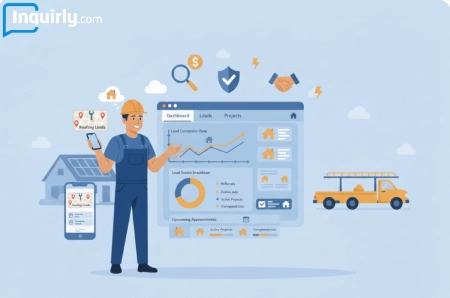
A reputable agency will provide a transparent dashboard. You should be able to track every dollar spent back to a specific lead and a specific job. In 2026, data attribution is non-negotiable. If an agency cannot tell you exactly which ad creative or keyword generated a $30,000 roof replacement, they are not optimized for growth.
Summary
When choosing your partner, prioritize exclusivity and intent over raw volume. Indeed, a local roofing business is better served by 10 high-quality, exclusive appointments than 100 shared “price-shoppers.” Therefore, seek a partner that acts as an extension of your sales team by iterating on targeting based on field feedback.