Author Archives: Autumn Andel

What Is Restoration Company Culture?

For years, restoration contractors focused on operational tools like restoration software or SEO-driven restoration marketing tactics to drive business growth. But many overlooked the most important driver of sustainable success: Restoration Company Culture.

So, what is Restoration Company Culture, and why should it matter to you?

In simple terms, it’s the shared values, behaviors, beliefs and expectations that define how your team operates day to day, especially under pressure. But in practice, it’s the difference between a team that just clocks in and one that shows up with purpose, consistency and commitment to excellence. In a business where urgency, empathy, and trust matter, that culture directly impacts your customer satisfaction, reputation, retention and long-term growth.

If your competitors are investing in culture while you’re focused solely on lead generation, you’re playing a short-term game. Because no matter how great your restoration marketing is, it’s your people and how they act on-site that define the brand customers remember.

Curious About How to Start a Successful Restoration Company in 2025? This article will help you Get the steps and insights you need to launch with confidence.

Company Culture Matters

(Especially in the Restoration Industry)

The restoration industry is emotionally and physically demanding. Clients are often distressed. Timelines are tight. No two jobs are the same.

A strong culture ensures that your team can operate under pressure without compromising professionalism, safety or care. It provides direction when leadership isn’t present and it creates alignment even in chaotic field conditions.

Think of company culture as the “invisible system” that guides behavior when no one’s watching. It helps reduce turnover, increase morale and standardize customer experience even across multiple teams or service areas.

In industries like restoration where trust and reliability are non-negotiable, culture is a client experience strategy.

What Defines a Great Restoration Company Culture?

A great Restoration Company Culture isn’t built from a mission statement alone. It’s visible in small, repeatable actions. Here’s what sets the best apart:

  • Shared Ownership: Teams take pride in outcomes, not just clocking hours.
  • Responsiveness: A culture of urgency, not delay. Quick communication internally and externally.
  • Consistency: Whether it’s a solo technician or a full crew, every customer gets the same quality, attitude, and service.
  • Transparency: Leaders are open about wins, losses and expectations.

When culture is strong, it shows. In customer reviews; your team’s body language; how calmly they handle tough calls. And it gives your restoration marketing real substance.

How Restoration Marketing and Culture Work Together

You can’t market what you don’t live.

Many water restoration marketing campaigns promise rapid response, reliable servic, or compassionate help. But if your internal culture doesn’t actually deliver on those traits, customers will notice and they’ll leave reviews that reflect that gap.

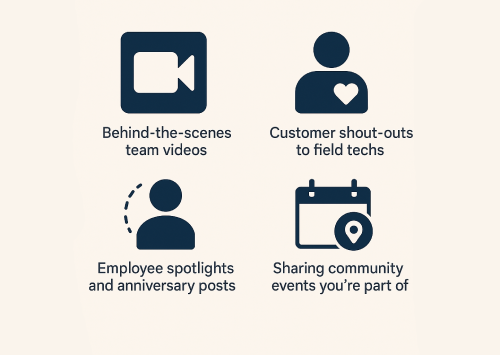
When your company culture is clearly defined and lived out daily, your restoration marketing becomes more than a strategy. You can showcase real technicians, highlight team stories and back up every claim with lived proof.

Culture-driven marketing includes:
How Restoration Software Can Reinforce Culture

When used strategically, Modern restoration software becomes a culture-reinforcing tool. If your culture values speed, quality and documentation, your software should be structured to reinforce those priorities at every stage.

Here’s how:

Function How It Supports Culture
Clarity of Roles and Tasks Restoration software like DASH or Encircle ensures accountability and keeps every team member aligned on responsibilities.
Real-Time Updates Field staff feel more engaged and connected to both the client and project progress.
Feedback Loops Supervisors can use photos, notes, and data to reinforce positive behaviors and coach consistently.
Training Integration Digital SOPs and onboarding checklists teach new hires your standards from the very beginning.

Common Mistakes That Undermine Company Culture

Even well-meaning restoration contractors unintentionally erode their own company culture by:

  • Overpromising and underdelivering: Especially in marketing versus field execution.
  • Ignoring employee feedback: Field techs are the front line. If they’re not heard, they’ll check out or leave.
  • Tolerating toxic top performers: High revenue doesn’t excuse poor attitude. It breeds resentment.
  • Neglecting internal recognition: Small wins build morale. If leadership only points out failures, morale dips.
  • Failing to define values clearly: If your team can’t tell you your top 3 core values without looking at a poster, you haven’t embedded them.

How to Start Building a Strong Culture Today

You don’t need an HR department to start shaping company culture for restoration contractors. You just need clarity, consistency and care.

Start with these steps:

  • Write a cultural manifesto: Why do you exist, what do you believe and how do you act under stress?
  • Hire by values: Don’t just recruit for skills. Find people who live your values.
  • Recognize publicly, correct privately: Use meetings or chats to highlight wins and handle coaching 1-on-1.
  • Document behaviors, not only outcomes: Praise the technician who went the extra mile, not just the one who closed the biggest invoice.
  • Lead by example: Culture is never what you say. It’s what your team sees you do when things are hard.

FAQ

What are the 4 C’s of company culture in restoration businesses?
The 4 C’s typically refer to Clarity, Communication, Consistency and Care. In a restoration company, these translate to clear team values, open communication during high-pressure jobs, consistent service quality, and genuine care for both customers and coworkers. These traits form the cultural backbone that influences every interaction on and off-site.

How would you describe the company culture in a successful restoration firm?
A strong restoration company culture is responsive, empathetic, and accountable. Team members work with urgency and precision while supporting each other under pressure. Successful companies often describe their culture as “mission-driven,” “people-first,” or “customer-obsessed.” These values create high-performing teams and a trustworthy public image.

How does restoration company culture influence employee retention?
When a company culture is strong, employees feel valued, supported, and aligned with the company’s mission. This reduces burnout and turnover, especially in high-stress roles like water mitigation or fire damage cleanup. Culture-driven teams are more likely to stay long-term and refer like-minded technicians, reducing hiring costs and churn.

Can restoration marketing reflect company culture?
Yes and it should. Your restoration marketing becomes exponentially more powerful when it’s rooted in real cultural values. From behind-the-scenes team stories to customer testimonials, marketing that reflects your company culture builds authentic trust and differentiates your brand in a competitive industry.

Why is culture important for restoration contractors and field technicians?
Because they represent your brand in real time. Field techs are often the only face a customer sees. If they’re professional, compassionate and well-aligned with your core values, customer satisfaction increases. A positive culture ensures that performance and behavior remain consistent across every home or business you service.

7 Effective Ways to Build Online Credibility of your HVAC Business

For HVAC companies, trust used to be built through referrals and a familiar logo on the side of a van. That’s no longer enough. Today, your online presence is your first impression and often your only chance to make one. Strategic HVAC marketing plays a central role in shaping that perception. If your business doesn’t look credible online, it won’t be considered, let alone taken seriously. And nowadays, credibility is what turns browsers into buyers.

Besides comparing prices, homeowners and facility managers are sizing up your trustworthiness, professionalism, consistency and overall authority, long before they ever pick up the phone or ask for a quote. You might be a one-person operation or running a full crew, but either way, building digital trust is at the heart of a strong HVAC marketing strategy.

So, how exactly do you make your business trustworthy online without gimmicks or overhyped tactics?

Let’s unpack seven core and often misunderstood ways to establish true credibility for your HVAC business in the digital arena.

1. Build a Branded Website

(…That Doesn’t Scream “Template”)

Your website is your modern storefront. If it looks like a typical theme filled with stock photos and outdated certifications, users subconsciously equate that with inexperience or even risk. First impressions online are formed in milliseconds.

But this isn’t only about having a nice design. A credible HVAC website needs a narrative. It should walk a visitor through your expertise, values, real customer impact and proof, not just services and a phone number.

When your site is technically sound, mobile-optimized, fast-loading and thoughtfully structured, it becomes the backbone of any hvac marketing campaign.

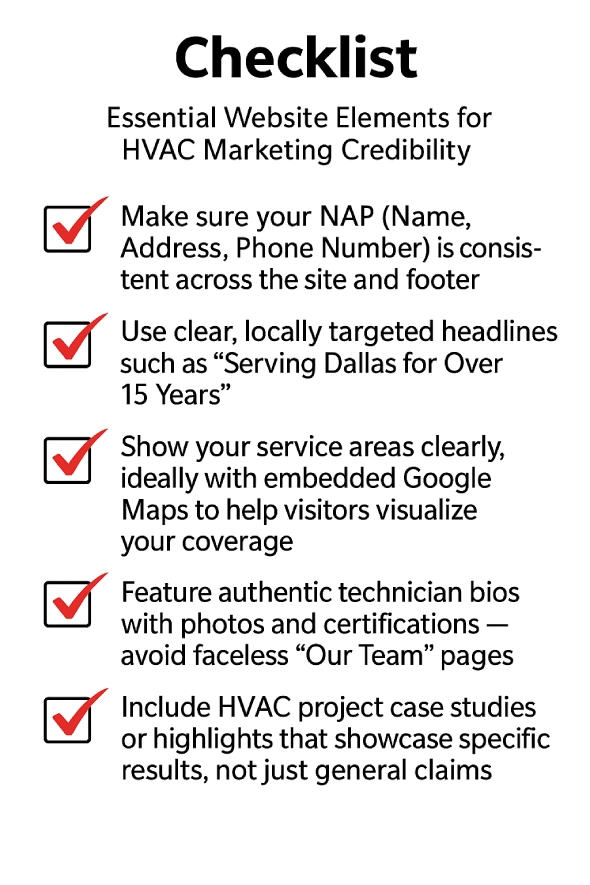
hvac marketing online credibility building strategy - checklist

2. Keep Real Reviews

(…and Respond With Intention)

More than any ad you could ever run, a five-star review from a verified customer will tip the scale in your favor. But the trick isn’t just in getting reviews, it’s in how you use them to narrate your reliability.

Encourage reviews on platforms that matter – Google, Yelp, Angi and Facebook. But don’t just collect them and move on. Curate them on your site, include them in your email footers, turn them into video snippets, and respond to each one with gratitude and professionalism (yes, even the negative ones).

This level of responsiveness communicates two key things:

  1. You care about feedback, which reflects maturity and accountability.
  2. You’re active and operational, not a ghost company from 2016.

Want a practical tool? Use NiceJob or GatherUp to automate customer review requests post-service.

3. Local SEO

(…Not Only Google Ads)

A credible HVAC business ranks organically in local search, not just in paid spots. Why? Because Google’s algorithm tends to favor businesses with a strong digital footprint – meaning consistent reviews, backlinks, location relevance, schema markup, and well-optimized content.

If your business is buried on page 3 of local results, credibility suffers. People assume “if Google doesn’t show them, they can’t be that good.” It’s unfair, but true.

Your hvac marketing plan should target location-based keywords and service-specific clusters:

  • “AC repair in Spokane WA”
  • “Furnace tune-up West Denver”
  • “Best HVAC company in North Tampa”


Also, instead of one giant blog titled “Everything About HVAC,” break it into interconnected articles:

  • Central page: “Heating Services in Boise”
  • Supporting pages: “Benefits of Heat Pump Installation,” “Troubleshooting Common Heating Issues,” “Furnace Maintenance Checklist”


*Make sure to internal link those pages and try BrightLocal or Whitespark to monitor and optimize local SEO citations.

Take a look at SEO Best Practices for HVAC Websites to improve visibility and build trust.

4. Brand Identity

Every channel you use, from Facebook to email to your truck wrap, must speak the same visual and verbal language. When users see mismatched logos, different fonts, or inconsistent tone, it subconsciously screams instability.

Brand consistency is a silent form of trust-building. Don’t underestimate how much “looking the part” affects your HVAC business marketing results.

Your online presence should reflect:

  • A unified tone of voice (professional, helpful, local-savvy)
  • Repeated color schemes and logo use
  • Signature taglines or phrases
  • Branded technician uniforms in job photos
  • Testimonials using similar formats (trust badges, review stars, etc.)

5. Educational Content

Content builds authority. Write detailed blogs, how-to guides, and troubleshooting checklists tailored to your audience. Add value before they even become customers. Educated consumers are more likely to choose brands that educated them. That’s how a long-term hvac marketing strategy quietly converts clicks into calls.

AnswerThePublic can help you mine HVAC-related search queries your audience is asking.

Start answering the questions your technicians hear daily. A few formats to explore:

  • Blog posts (optimized with HVAC keywords)
  • Short explainer videos on YouTube
  • PDF checklists and seasonal maintenance guides
  • Social media Q&A reels


Learn more about How to Create an HVAC Marketing Calendar.

6. Trust Badges, Certifications and Local Partnerships

Trust symbols are subtle, but powerful. When used properly, they validate your authority in an instant. Most HVAC businesses underuse them or bury them in the footer.

Here’s what should be front and center:

  • EPA certification badges
  • Affiliations with local Chamber of Commerce
  • Manufacturer logos (like Trane, Lennox, Carrier)
  • Licensing and bonding numbers (especially state-required ones)
  • “As Seen On” mentions if you’ve been on local news or blogs

Even something like “Proudly serving [city] since 1999” in your hero section builds comfort. In addition, if you’ve done work with local non-profits, sponsored youth sports, or been part of emergency services – document it! It’s demonstrating community-rooted trust.

7. Develop Interactive Tools

Most HVAC websites are static: pages sit, customers skim, and then bounce. But when you build something that engages, you do more than capture attention, you earn authority.

This tactic elevates your brand from “just another service provider” to a trusted industry expert. It’s functional credibility.

Here’s what that looks like for an HVAC business:

  • Home Comfort Calculator: Let users input room size, insulation type, and region to get a rough estimate of the right AC or heating unit size.
  • Seasonal HVAC Checklist Generator: Let visitors select equipment types and get a downloadable checklist personalized for their system and region.
  • Energy Savings Estimator: Show potential savings from upgrades like smart thermostats or high-efficiency systems.
  • “Is it Time to Replace or Repair?” Quiz: A short 5-question decision tool based on unit age, issues and repair history.

FAQ

Can customers tell if my HVAC company is using stock photos, and does it matter?
Yes, increasingly. Stock images often look too polished or generic and subconsciously signal inauthenticity. Customers can detect this more than you think, especially if they’ve seen the same images elsewhere. Original photos of your team, trucks, job sites, and office create a visual fingerprint of credibility. They’re subtle proof you’re real and active in the field.

Is it worth creating content in multiple languages for local communities?
Absolutely, if your service area includes multilingual communities. For instance, Spanish content in regions like South Florida, Texas, or Southern California can significantly expand reach. Not only does it build inclusivity and trust, but it also boosts your relevance in local searches where competitors may have ignored this audience.

How should I handle a fake or unfair negative review online?
Flag it through the platform’s reporting tools (Google, Yelp, etc.), but don’t rely on it being removed. Instead, respond calmly and factually, showing you took the comment seriously. The professionalism of your response often matters more than the review itself. If your average rating is solid, one negative review, even if unfair, can make you seem more real, not less trustworthy.

What digital red flags turn customers away instantly?
Slow-loading websites, outdated copyright years, broken contact forms, lack of SSL security (HTTP instead of HTTPS) and visibly outdated blog posts are among the biggest credibility killers.

Water Damage Industry Events & Trade Shows in 2025

The restoration world doesn’t revolve around trends, it reacts to disasters, responds to pressure, and rebuilds lives. But in 2025, a shift is underway that’s not about a single flood, wildfire or legislation. It’s about how the water damage restoration industry is redefining its identity, from reactive service to proactive infrastructure.

After decades of responding to the unpredictable, top water restoration companies are aligning with something much more deliberate: smarter training, cross-industry collaboration, and data-backed forecasting. The conversations happening at this year’s trade shows aren’t just about drying technology or drying timelines, they’re about long-term resilience, workforce intelligence, and turning emergency work into strategic response systems.

More importantly, these events aren’t echo chambers. They bring contractors, insurance adjusters, environmental scientists, compliance officers and tech developers into the same space to collaborate on what’s next.

So, if you’re still looking at industry expos as places to pick up brochures or shake a few hands, 2025 will prove you wrong. This year’s events are built to sharpen your edge, rethink your operations and connect you to the people shaping restoration’s future, not just reacting to its past.

In this guide, we’ll cover both major upcoming events and recently held conferences in 2025, highlighting what you can still register for and what you may have missed, but can still learn from. From the RIA Conference to ASD Certification and the PLRB Conference, here’s what matters in 2025.

Early 2025 Highlights: Insights from Past Events

Several major conferences took place in the first half of 2025, each bringing distinct value to professionals across the restoration industry:

  • PLRB Claims Conference & Insurance Services Expo
    (Mar 30 – Apr 2 | Indianapolis, IN) 
    https://web.cvent.com
    The PLRB Conference once again proved why it remains a cornerstone for professionals intersecting insurance and property restoration. With sessions covering the latest claims technologies, litigation trends, and disaster response protocols, attendees gained practical tools to better align with insurers. For restoration companies working closely with adjusters, this event set the stage for 2025 collaborations.

  • Verisk Insurance Conference U.S. 2025
    (Apr 7 – 10 | Orlando, FL) 
    https://events.verisk.com
    With an emphasis on data-driven property analysis and risk modelling, Verisk’s annual gathering helped top restoration companies understand how to better integrate with the insurance ecosystem. From predictive analytics to fraud detection technologies, water restoration companies learned how claims data impacts their margins and timelines.

  • The Experience Conference and Exhibition
    (Apr 8 – 10 | Punta Gorda, FL) 
    https://www.randrmagonline.com
    Geared toward hands-on restoration training, this event focused on practical skill development—particularly beneficial for technicians. Workshops included live water extraction demos, moisture mapping, and a focus on mold remediation. It was also a major hub for those looking to complete or renew their ASD certification.

  • International Restoration Convention & Industry Expo
    (Apr 28 – 30 | West Palm Beach, FL) 
    https://convention.restorationindustry.org
    Hosted by the Restoration Industry Association (RIA), this flagship event combined leadership panels, advocacy updates, and technology showcases. Attendees got early previews of industry reports, networked with the top restoration companies, and explored evolving challenges in workforce development and compliance.

Upcoming Mid-Year Opportunities: Still Time to Join

If you missed the spring wave, the summer lineup is equally compelling, especially for companies looking to improve operational resilience or explore new vendor partnerships:

  • Access National Conference
    (May 5 – 7 | Orlando, FL) 
    https://www.accesseventsnow.com/home
    Access focuses on innovation at the crossroads of logistics, data, and emergency services. While not exclusive to water damage restoration, it offers key insights into document recovery, records management, and digital transformation, all of which have become increasingly relevant to property restoration firms.

  • Contractor Connection RESTORE
    (May 19 – 21 | Louisville, KY) 
    https://www.candrmagazine.com
    A must-attend for restoration companies working within insurance referral networks. RESTORE emphasizes performance metrics, customer satisfaction, and technology adoption. The 2025 theme revolves around restoring trust and resilience in high-stakes restoration projects.

  • The Future of Insurance USA 2025
    (Jun 12 – 13 | Chicago, IL) 
    https://events.reutersevents.com
    If your company wants to stay ahead of how insurance carriers are thinking about climate change, AI and customer engagement, this is the place to be. Forward-thinking water damage restoration companies can use this event to align their offerings with carrier expectations.

Fall 2025: Major Events to Close Out the Year

As budgeting and strategic planning ramp up for 2026, fall conferences help professionals reflect, recalibrate, and renew partnerships:

  • Proven 2025 – The PSA User Conference
    (Aug 3 – 5 | Austin, TX) 
    https://canamsys.com
    If your team uses PSA for job management or scheduling, this is one of the most practical conferences you can attend. It’s about getting more value out of the tools you already rely on. Attendees share what works for them and where they’re struggling, so you’re not just hearing from product reps, but also from peers who use the system in real-world scenarios.

  • Core Collective
    (Aug 6 – 8 | Austin, TX) 
    https://www.thecollectivebycore.com
    This event has a different energy. It’s about real conversations on leadership, company culture, and doing meaningful work in the restoration field. If you want to recharge your mindset and think long-term about where your company is going, it’s worth attending.

  • The Experience Convention and Trade Show
    (Sep 3 – 5 | Las Vegas, NV) 
    https://www.randrmagonline.com
    This fall edition dives even deeper into equipment, science, and processes. It’s especially useful for teams evaluating new tools or training new staff. The expo floor is packed with vendors, but what sets it apart is how much of it you can actually test, touch and try.

  • ITC Vegas
    (Oct 14 – 16 | Las Vegas, NV) 
    https://vegas.insuretechconnect.com
    Although ITC Vegas is mainly known as an insurtech event, it’s drawing more restoration professionals each year and for good reason. The tools on display, like automated claims platforms, AI-driven customer portals, and remote inspection tech, are quickly becoming part of how property restoration is managed. If you want a preview of what insurers will be expecting from restoration companies in the near future, this is the event to watch.

Certification & Learning Tracks to Watch For

Throughout the year, many of these events offer optional certification courses or continuing education tracks:

  • Look for ASD certification opportunities at both Experience events.
  • The RIA Conference and Core Collective often include workshops focused on leadership and compliance.
  • Several trade shows feature courses eligible for IICRC CE credits, which are essential for maintaining credentials in water damage restoration.


FAQ

I’m new to the industry. Where should I start? +
Do I need to register early? +
Will I really get value from insurance-focused conferences? +
Can I earn certifications at these events? +
Are international attendees welcome? +

HVAC Referral Programs That Work

In an industry where reputation is everything, HVAC businesses thrive or falter based on the quality of their work and the satisfaction of their clients. But there’s a third pillar that often gets overlooked: the power of a well-executed HVAC referral program.

Before diving into tactics and examples, it’s essential to understand the context in which these programs operate. HVAC services often involve high-ticket sales, recurring maintenance plans, and time-sensitive service calls. This combination makes trust a critical currency. People don’t just hand over a friend’s contact details unless they’re confident you’ll deliver.

While exact numbers vary, companies that run structured referral programs often see a higher customer acquisition rate, as word-of-mouth referrals close faster and cost significantly less than paid leads. However, simply asking for a referral isn’t enough. Customers need a reason to act, a structure that makes participation easy, and a follow-through that respects their trust. That’s where intentional, strategic referral marketing programs come in.

Let’s break down how HVAC companies can set up referral programs that aren’t just functional, they actually work.

The Psychology Behind a Successful Refer a Friend Program

Effective referral programs tap into basic human behaviors: reciprocity, recognition and reward. Your customers already believe in your service. A refer a friend program simply gives them a nudge to share that belief. When structured right, it doesn’t feel like marketing, it most likely feels like helping a friend.

Your program should answer a few key questions: What’s in it for the referrer? How do you recognize their effort? And how simple is the process? Consider options like dual-sided rewards (e.g. $50 off for both the referrer and the new customer), public acknowledgment or tiered incentives that increase with each successful referral.

Tip: Avoid overcomplicating the entry process. A landing page with a single form field for a friend’s contact or a shareable link tied to a customer account, can make all the difference.

How to Set Up a Referral Program for HVAC Services

Referral programs are not plug-and-play. They require active management, real-time reporting, and occasional tweaking based on what converts. Here’s how to build a customer referral program from scratch that aligns with your brand and sales model:

1. Define Your Ideal Customer

Referrals reflect those who refer. Know who you’re targeting to get higher-quality leads.

2. Choose Your Incentive

Offer meaningful rewards like cash, discounts, or service credit that match the value of a new sale.

3. Develop Tracking Systems

Use tools like ServiceTitan to ensure each referral is tracked, credited, and followed up on accurately.

4. Promote Regularly

Highlight your referral program everywhere—from invoices to email campaigns and social posts.

5. Train Your Team

Your technicians should naturally mention and explain the referral program to satisfied clients.

Choosing the Right Type of Referral Program

There are three types of referral structures commonly used in the HVAC space:

  • Direct Referral: Customer sends a lead, and you pay upon conversion.
  • Affiliate-style Links: Each customer has a unique link to share, which automates the referral process.
  • Partnership Referrals: Local businesses or real estate agents refer clients in exchange for a fee or cross-promotion.

Each method has pros and cons. Direct referrals are personal but harder to track. Affiliate-style programs are scalable but less intimate. Partnerships can yield big wins but require strong external relationships.

To build a paid referral program responsibly, be transparent about payment terms and follow all FTC and local disclosure guidelines.

Want to expand your referral network beyond customers? 
Take a look at the Networking Strategies to Grow Your HVAC Business.

Measuring Success: Metrics That Matter in Referral Marketing

Just launching a program doesn’t guarantee traction. You must analyze performance:

  • 📈 Conversion Rate of Referred Leads
    See how well referred prospects turn into paying customers compared to other channels.
  • ⏱️ Time to Conversion Compared to Other Sources
    Referrals often close faster, track how long it takes these leads to convert.
  • 💰 Lifetime Value of Referred Customers
    Referred clients are usually more loyal and valuable over time.
  • 👥 Average Number of Referrals per Customer
    Measure how many new leads each happy customer typically brings in.

Use these insights to adjust incentive amounts, identify top referrers, and refine messaging. Over time, referral clients often become your most loyal base. According to industry research, they stay longer, spend more, and are themselves more likely to refer.

FAQ

What is the most successful customer referral program? +
Do referral programs work? +
What is the best referral method? +
How do I get a customer referral program? +
What are the 3 types of referral? +
What is a paid referral program? +
What is an example of a type of referral program? +

Conclusion

A strong HVAC referral program is a revenue engine built on the foundation of trust. With the right structure, messaging, and consistency, referrals can become your most effective and profitable source of new business. Focus on clarity, simplicity, and mutual value and your customers will be more than happy to spread the word.

SEO Best Practices for HVAC Websites

Most HVAC businesses aren’t struggling with the quality of their service—they’re struggling with getting noticed. You can be the best technician in town, have fair prices, and still lose jobs to competitors who simply show up first on Google. That’s the real issue. People don’t scroll anymore. They search, skim the top few results and make a decision fast, especially when their home is too hot or too cold to wait around.

Most HVAC contractors don’t have the time or frankly, the interest to learn SEO in detail. That’s fair. You didn’t sign up to be a marketer. But you do need to understand the basics if you want to grow without relying completely on word-of-mouth or expensive ads. This guide breaks down what actually works in SEO for HVAC companies, based on what helps real contractors, not just what Google says in theory.

SEO Basics for HVAC Companies

Before diving into advanced tactics, your website needs to meet the basics. These basics may sound obvious, but they’re frequently overlooked. A strong HVAC SEO strategy always starts with the technical foundation:

Mobile Optimization
Most HVAC customers search from their phones. If your site loads slowly or doesn’t display properly on mobile, both users and Google will move on.

HTTPS Secure
A secure (HTTPS) site is essential. Without it, you lose trust and rankings.

Fast Loading Speed
Compress images, use caching tools, and choose a fast hosting provider to keep your site quick and responsive.

User-Friendly Navigation
Make it simple for visitors to find your services, contact information, and the areas you serve. A clear structure improves both usability and SEO.

Keyword Research: Finding the Right HVAC SEO Keywords

Google HVAC

You can’t optimize your website without knowing what people are searching. Here’s where HVAC-specific keyword research comes in. Use tools like Google Keyword Planner or Ahrefs to identify search volumes. Keep a running list of HVAC SEO keywords that include both service types and location phrases. These will power your content strategy.

Your goal isn’t just to rank for “HVAC services” that’s too broad and competitive. Instead, dig into:

  • Local intent terms: “AC repair Phoenix” or “emergency HVAC service Atlanta.”
  • Long-tail keywords: “why is my furnace blowing cold air” or “how often to change AC filter.”
  • Service + location keywords: “duct cleaning Charlotte NC,” “mini-split install Portland.”

On-Site SEO for HVAC Websites

Now that you’ve got your keywords, it’s time to structure your site accordingly.

Page Titles and Meta Descriptions

Each page should have a unique, keyword-optimized title and meta description. Include your city, service, and a compelling reason to click. For example:

  • Title: Emergency AC Repair in Austin | 24/7 HVAC Service
  • Meta: Get fast, affordable AC repair in Austin. Call our certified HVAC technicians now – same-day service available.

Service Pages

Don’t lump all services into one page. These pages should target specific HVAC SEO keywords and include clear CTAs. Create individual pages for each one:

  • AC installation
  • Furnace repair
  • Duct cleaning
  • Commercial HVAC

Local Landing Pages

If you serve multiple cities or suburbs, build unique landing pages for each location. Avoid copy-pasting, tailor the content to local neighbourhoods, testimonials and service calls.

Content Marketing: Earning Traffic with Value

Content is a core part of HVAC search engine optimization. Write blog posts, FAQs and guides that answer your customers’ real questions. Here are some topic ideas:

  • “What to Do When Your AC Stops Working”
  • “Signs Your Furnace Needs Replacing”
  • “AC vs Heat Pump: What’s Better in Arizona?”

Use this content to naturally include your HVAC SEO keywords. You’re not writing for Google alone, you’re building trust with readers who might call you next week. Also, Google loves fresh content. An active blog signals that your HVAC business is alive and invested in educating customers.

Local SEO for HVAC Contractors


The majority of HVAC customers are looking for services nearby. That makes local SEO absolutely crucial.

Local SEO Checklist for HVAC ContractorsTo do
Google Business ProfileClaim and verify your profile. Add accurate hours, photos, a list of services, and areas you serve. Keep it updated regularly.
NAP Make sure your Name, Address, and Phone Number are written exactly the same across your website, listings, and citations.
Local Listing SitesList your business on trusted platforms like Yelp, Angie’s List, HomeAdvisor and your local chamber of commerce.
Customer ReviewsAsk happy clients to leave reviews. Respond to every review – good or bad, to show you’re active and engaged.


Link Building for HVAC SEO

Link building means getting other trustworthy websites to link to yours. These backlinks help Google see your HVAC company as credible, which improves your search rankings.

Start locally. Reach out to bloggers, news outlets, and real estate agents in your area. Offer expert advice for their content, like HVAC tips for seasonal maintenance and ask to be credited with a link.

You can also write guest posts for home improvement blogs or industry websites. These articles should be helpful and relevant, not just written to drop a link.

List your business on respected directories like local chambers of commerce or HVAC trade associations. These links are trusted and industry-relevant.

Avoid buying links or using shady SEO services. Focus on real, valuable partnerships. Quality beats quantity every time in HVAC SEO.

Tracking and Analytics

All this work means nothing if you’re not tracking results. Schedule monthly SEO audits for HVAC websites to catch errors and track growth. A data-driven approach will help you refine your HVAC SEO strategy over time.

Use tools like:

  • Google Analytics: To track visits, bounce rate, conversions.
  • Google Search Console: To monitor keyword rankings and technical issues.
  • Call tracking software: To see which pages generate calls.

Need some guidance?
Here, we provide some tips about How To Start an HVAC Business and Best HVAC Advertising Ideas in 2025


In short, SEO is a core part of staying competitive. A well-structured, search-friendly website ensures your services are visible when customers are actively looking. It’s a steady, long-term visibility that brings in qualified leads. With a consistent approach, strong local presence and attention to detail, SEO becomes one of the most reliable tools for business growth in the HVAC industry.

What You Can Learn from Other Appliance Repair Services

Appliance repair is a growing field with a wide range of opportunities for anyone looking to start a new career, improve their current business or simply learn practical skills. From understanding the basics of “what is an appliance” to mastering complex refrigerator repairman techniques, there is a lot you can gain by observing and studying other appliance repair services. Today, we’re diving into what you can learn from successful appliance repair businesses, how appliance repair training can fast-track your journey, and why even a single dishwasher repair job holds important lessons.

If you’ve been searching for terms like “appliance repair school near me” or “appliance repair training near me,” you’re already on the right path. But real growth also comes from observing others who are already doing it right. This article will cover essential lessons from established appliance repair companies and how you can apply them whether you’re an aspiring appliance technician, a small business owner,or someone interested in learning through an online appliance repair training program.


Table of Contents

  1. Why Learning Matters
  2. Understanding the Full Scope
  3. Technical Skills You Can Master from Top Appliance Technicians
  4. The Importance of Business Operations in Appliance Repairs
  5. Training and Certification
  6. How Successful Appliance Repair Services Generate New Business
  7. Conclusion 
  8. Q&A: Your Appliance Repair Questions Answered


7–9 minutes Read Time

Why Learning from Other Appliance Repair Services Matters

Studying successful companies, especially leaders in home appliance repair, shows that consistency and a customer-first approach are essential. These businesses focus on reliable service, strong brand reputation and continuous staff training to dominate local markets.

You can learn to:

  • Communicate clearly: Building loyalty through transparent updates.
  • Specialize: Becoming a top refrigerator repair man or dishwasher repair expert creates demand.
  • Use smart tools: Platforms like Housecall Pro streamline scheduling and client management, helping technicians stay organized and efficient.

According to IBISWorld, the U.S. appliance repair industry is valued at over $6.5 billion, driven by the increasing cost of new appliances and complexity of repairs. Following the best practices from thriving businesses can position you to capture a share of this market.

For operational support, Housecall Pro is one software that many appliance repair businesses use for invoicing, dispatching, and CRM.

Understanding the Full Scope: What is an Appliance?

When stepping into appliance repairs, defining “what is an appliance” properly is important. Appliances range from major installations like refrigerators and washing machines to smaller tools like microwaves and blenders. Top appliance technicians at companies like Sears Home Services often undergo extensive appliance repair training to cover this broad range.

A skilled appliance technician understands:

  • Major appliances: Refrigerators, dishwashers, stoves, washers.
  • Small appliances: Coffee makers, mixers, electric kettles.
  • Built-in systems: Wall ovens and integrated refrigerators requiring precise installation and servicing.

Having access to resources like the Appliance Blue Book can aid in identifying parts, estimating repair times, and quoting prices accurately.

Technical Skills You Can Master from Top Appliance Technicians

Observing a professional refrigerator repairman in action at top companies shows the value of precision and expertise. Technicians need to combine mechanical knowledge, electrical troubleshooting and increasingly, smart technology skills.

Skills to focus on include:

  • Efficient diagnostics: Learning logical troubleshooting saves time.
  • Electrical systems: Using multimeters (e.g., Fluke 117) for checking circuits.
  • Smart appliances: Repairing WiFi-connected devices as their adoption grows.

The Importance of Business Operations in Appliance Repairs

Behind every trusted appliance technician is a solid business model. Successful services like Mr. Appliance focus as much on customer experience and operational efficiency as they do on technical repair work.

Best practices include:

  • Optimized scheduling: Tools like Jobber help streamline dispatching and billing.
  • Transparent pricing: Customers appreciate clear, upfront quotes.
  • Online reputation management: Gathering positive reviews boosts visibility and trust.

Most of the customers trust online reviews as much as personal recommendations. Hence, after completing a dishwasher repair or refrigerator service, encouraging a customer to leave a review can make a significant difference in building your appliance repair business.

Maintaining a small but well-organized inventory ensures fast service without unnecessary part delays, another hallmark of efficient local chains.

Training and Certification

Formal training strengthens your skills and opens up better job opportunities. You can pursue an “appliance repair certification” through a local institution or take “online appliance repair training” to build a strong foundation for your career.

Options available:

  • Appliance repair course at local schools: Search “appliance repair school near me” to find hands-on classes.
  • Online appliance repair training programs: For example, Fred’s Appliance Academy offers flexible options for working professionals.

If you’re serious about becoming a top appliance technician, consider combining online study with apprenticeships to maximize learning.

How Successful Appliance Repair Services Generate New Business

Observing established businesses shows that strong technical skills alone are not enough to sustain growth. A consistent flow of repair jobs relies heavily on smart client acquisition strategies.

One key tactic these businesses use is working with lead generation platforms that specialize in appliance repair services. Platforms such as ThumbtackAngi, and HomeAdvisor enable appliance technicians to connect directly with homeowners actively seeking repairs. These services complement other efforts like referral networks, online reviews, and direct local advertising.

Inquirly, for example, specializes in generating exclusive leads and direct inbound calls, allowing appliance technicians to engage with motivated customers immediately – an approach that mirrors the operational priorities of larger companies.

Useful Resources:

Conclusion and Next Steps

Appliance repair industry is demanding a higher level of technical and business expertise. The difference between an average technician and a top-performing appliance technician often comes down to continuous learning and real-world observation.

Established companies have set a standard by investing heavily in appliance repair training, efficient dispatching tools and excellent customer service practices. They also show that scaling a home appliance repair business requires not only technical skills but also smart operations management, things like transparent pricing, regular follow-up, and mastery of digital booking systems.

If you’re aiming to follow a similar path, practical steps could include enrolling in a structured appliance repair course, either locally by searching “appliance repair school near me,” or through flexible online programs such as those offered by Fred’s Appliance Academy. Completing an appliance repair certification significantly increases employability and opens access to higher-paying opportunities within local repair companies or as an independent contractor.

Focusing on building both your technical skills and your business acumen will put you on track to succeed in an industry where demand continues to grow, particularly as more consumers opt for repairs over expensive appliance replacements. Now is the time to position yourself strategically and learn from those already leading the way.

Q&A

How do I find a good appliance repair school near me? +
Is online appliance repair training as effective as hands-on classes? +
How long does it take to become an appliance repair technician? +
What are the most in-demand appliance repair skills today? +
How profitable is starting an appliance repair business? +