Category Archives: HVAC

The Real Cost of HVAC Leads in 2025: What You Should Expect to Pay

Understanding the HVAC leads cost in 2025 is crucial for any contractor trying to grow their business without burning through budget. Finding quality HVAC leads isn’t as simple as clicking “buy now” and waiting for your phone to ring. The market’s full of big promises, recycled leads and pricing models that can drain your budget faster than a broken AC in July.

The answer depends on the method you choose, the value you place on ROI, and how wisely you select your lead generation partner. Some companies are charging sky-high rates for cold leads that don’t convert. Others – like Inquirly, are changing the game with smarter systems that deliver results without draining your wallet.

So, what should you be paying for HVAC leads in 2025? Let’s break it down.

What HVAC Leads Actually Are

Let’s rewind for a second. A “lead” is just someone interested in HVAC services, a homeowner needing a furnace repair, a landlord replacing an AC unit, or a property manager planning a full system install. Sounds simple, right?

Well, not all leads are same. Some are ready to book a job today. Others are just “shopping around” and may ghost you after a quote. The difference between these two types is huge, and it’s why understanding the cost per lead(CPL) and what goes into it matters so much.

How HVAC Lead Generation Has Changed in 2025

Five or ten years ago, HVAC companies got most of their leads from referrals, yard signs or local print ads. But in 2025? Most homeowners head straight to Google or AI when any issue occurs. The lead game is now digital, fast and competitive.

This shift is part of the reason why the HVAC leads cost 2025 varies so widely and why lead quality should always come before quantity.

The 3 Most Common HVAC Lead Pricing Models

Let’s talk about how most HVAC leads are priced today, and what each model really costs you.

Pay-Per-Lead (PPL)

With PPL, you pay a set price for each lead you receive, usually ranging from $25 to $90 for residential jobs and $100 to $300+ for commercial.


Cons:

  • You might get low-quality or “tire kicker” leads
  • Shared leads are common
  • No control over targeting unless you ask


Good PPL vendors qualify leads and only send exclusive, high-intent contacts. But bad ones? They’ll sell the same lead to five contractors and wish you luck.

Flat Monthly Fees

Here, you pay a fixed price, say $1,500/month, for a bundle of leads or unlimited access to a network. Sounds appealing at first, right?

Pros:

  • Predictable costs
  • Great for testing volume


Cons:

  • Quality varies wildly
  • You may pay the same regardless of how many leads convert


Flat fee setups work if you’re getting a steady flow of bookable jobs, but if you’re spending $2,000/month and only landing two installs, you’re upside-down fast.

Pay-Per-Click (PPC)

This is the most hands-on model, you run ads (typically on Google or Facebook) and pay per click, not per lead. A good chunk of HVAC companies use PPC for lead generation.

Pros:

  • Full control over targeting and budget
  • Scales easily


Cons:

  • Easy to waste money if not managed well
  • Requires ad expertise or a trusted partner

⚠️ Signs You’re Overpaying for HVAC Leads

💸 Paying over $100 per lead with less than 10% conversion
🔁 Leads are clearly shared or feel recycled
No transparency in reporting or performance metrics
📍You can’t track where your leads are coming from

HVAC Leads Cost 2025: What You Should Really Expect to Pay

Prices vary – a lot. But here’s a general ballpark based on current data and real contractor feedback:

🔥 Lead Type 💵 Low End 🪙 High End
Residential (PPL) $25 $90
Commercial (PPL) $100 $300
Flat Fee (Monthly) $750 $3,500
PPC (Managed) $90 $250+

Of course, these are just averages. A $50 lead might be a total waste or a goldmine, depending on how it was sourced and how hot the buyer is.

Too many contractors get locked into overpriced systems that deliver stale leads, shared five ways and barely interested in booking. Meanwhile, savvy pros are partnering with companies, who focus on real-time, high-intent, exclusive leads at prices that still leave room for profit.

What Makes a Lead Actually Worth Paying For?

The best leads:

  • 🔒 Are exclusive (not shared) – You’re not fighting 4 other contractors to win one job.
  • 🧑‍🔧 Come from people actually ready to hire – No tire kickers, just folks who need service now.
  • 📞 Include full contact info – Real names, numbers and emails. No ghost data.
  • 📍 Are matched to your service area – No wasted calls to customers outside your zone.


💡 Sometimes, it’s better to pay $90 for a booked customer than $30 for a “meh” form fill who never responds. Cheap can get expensive really fast.

HVAC Leads at Inquirly


Ready to grow your HVAC business with real, exclusive leads?
Start today – no contracts, no risk.

👉 Get Started with Inquirly

Inquirly provides exclusive leads – no sharing, no overlap, just high-quality prospects sent directly to your business. Every lead is 100% yours. The company also operates with full transparency, allowing you to see exactly where each lead originates and how it was generated.

There are no long-term contracts required. Businesses continue using Inquirly because the system delivers, not because of restrictive terms. Most importantly, the platform is built with an ROI-first mindset. The goal isn’t just to flood your inbox with contacts, it’s to deliver leads that convert, drive revenue and grow your business efficiently.

Form leads range from $10 – $30, while live call leads cost between $20 – $100, with some high-intent calls priced up to $225. Pricing depends on the type and quality of the lead, so you only pay for what fits your business.

Watch Out for These Lead Scams

Unfortunately, HVAC lead scams are real. Keep your guard up for:

  • Leads with disconnected numbers or fake emails
  • No refunds, no tracking, no transparency
  • Contracts with no exit clause

Stick with vendors that offer clear lead sources, performance tracking and contract flexibility. (Again, Inquirly checks every one of those boxes.)

How to Calculate ROI from Your Leads

Here’s a simple ROI formula to use:

(Revenue – Cost of Leads) ÷ Cost of Leads × 100 = ROI%

Say you spent $1,000 on leads and booked $4,000 in jobs. That’s a 300% ROI. Not bad, right?

With lead platforms like Inquirly, that kind of return is standard, because they focus on quality, not just quantity.
7 Effective Ways to Build Online Credibility of your HVAC Business

For HVAC companies, trust used to be built through referrals and a familiar logo on the side of a van. That’s no longer enough. Today, your online presence is your first impression and often your only chance to make one. Strategic HVAC marketing plays a central role in shaping that perception. If your business doesn’t look credible online, it won’t be considered, let alone taken seriously. And nowadays, credibility is what turns browsers into buyers.

Besides comparing prices, homeowners and facility managers are sizing up your trustworthiness, professionalism, consistency and overall authority, long before they ever pick up the phone or ask for a quote. You might be a one-person operation or running a full crew, but either way, building digital trust is at the heart of a strong HVAC marketing strategy.

So, how exactly do you make your business trustworthy online without gimmicks or overhyped tactics?

Let’s unpack seven core and often misunderstood ways to establish true credibility for your HVAC business in the digital arena.

1. Build a Branded Website

(…That Doesn’t Scream “Template”)

Your website is your modern storefront. If it looks like a typical theme filled with stock photos and outdated certifications, users subconsciously equate that with inexperience or even risk. First impressions online are formed in milliseconds.

But this isn’t only about having a nice design. A credible HVAC website needs a narrative. It should walk a visitor through your expertise, values, real customer impact and proof, not just services and a phone number.

When your site is technically sound, mobile-optimized, fast-loading and thoughtfully structured, it becomes the backbone of any hvac marketing campaign.

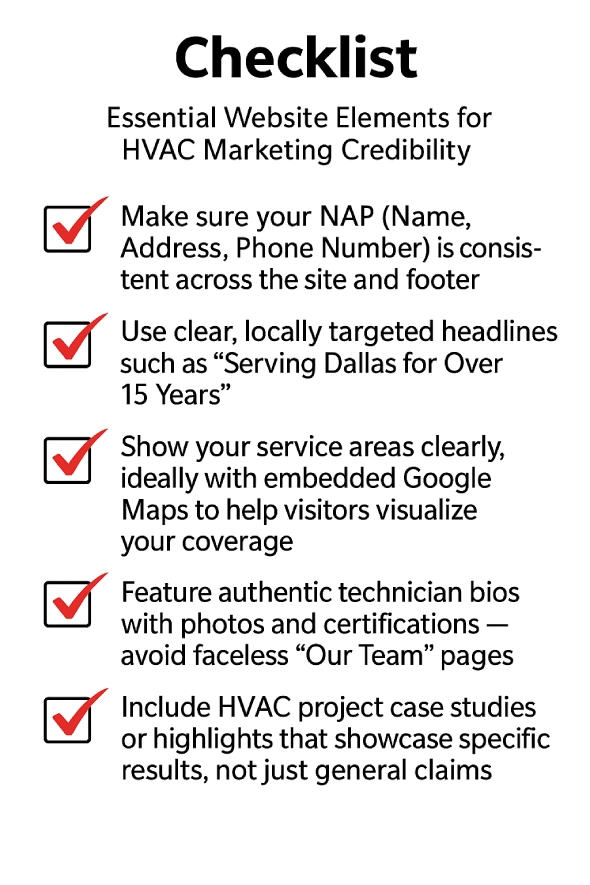
hvac marketing online credibility building strategy - checklist

2. Keep Real Reviews

(…and Respond With Intention)

More than any ad you could ever run, a five-star review from a verified customer will tip the scale in your favor. But the trick isn’t just in getting reviews, it’s in how you use them to narrate your reliability.

Encourage reviews on platforms that matter – Google, Yelp, Angi and Facebook. But don’t just collect them and move on. Curate them on your site, include them in your email footers, turn them into video snippets, and respond to each one with gratitude and professionalism (yes, even the negative ones).

This level of responsiveness communicates two key things:

  1. You care about feedback, which reflects maturity and accountability.
  2. You’re active and operational, not a ghost company from 2016.

Want a practical tool? Use NiceJob or GatherUp to automate customer review requests post-service.

3. Local SEO

(…Not Only Google Ads)

A credible HVAC business ranks organically in local search, not just in paid spots. Why? Because Google’s algorithm tends to favor businesses with a strong digital footprint – meaning consistent reviews, backlinks, location relevance, schema markup, and well-optimized content.

If your business is buried on page 3 of local results, credibility suffers. People assume “if Google doesn’t show them, they can’t be that good.” It’s unfair, but true.

Your hvac marketing plan should target location-based keywords and service-specific clusters:

  • “AC repair in Spokane WA”
  • “Furnace tune-up West Denver”
  • “Best HVAC company in North Tampa”


Also, instead of one giant blog titled “Everything About HVAC,” break it into interconnected articles:

  • Central page: “Heating Services in Boise”
  • Supporting pages: “Benefits of Heat Pump Installation,” “Troubleshooting Common Heating Issues,” “Furnace Maintenance Checklist”


*Make sure to internal link those pages and try BrightLocal or Whitespark to monitor and optimize local SEO citations.

Take a look at SEO Best Practices for HVAC Websites to improve visibility and build trust.

4. Brand Identity

Every channel you use, from Facebook to email to your truck wrap, must speak the same visual and verbal language. When users see mismatched logos, different fonts, or inconsistent tone, it subconsciously screams instability.

Brand consistency is a silent form of trust-building. Don’t underestimate how much “looking the part” affects your HVAC business marketing results.

Your online presence should reflect:

  • A unified tone of voice (professional, helpful, local-savvy)
  • Repeated color schemes and logo use
  • Signature taglines or phrases
  • Branded technician uniforms in job photos
  • Testimonials using similar formats (trust badges, review stars, etc.)

5. Educational Content

Content builds authority. Write detailed blogs, how-to guides, and troubleshooting checklists tailored to your audience. Add value before they even become customers. Educated consumers are more likely to choose brands that educated them. That’s how a long-term hvac marketing strategy quietly converts clicks into calls.

AnswerThePublic can help you mine HVAC-related search queries your audience is asking.

Start answering the questions your technicians hear daily. A few formats to explore:

  • Blog posts (optimized with HVAC keywords)
  • Short explainer videos on YouTube
  • PDF checklists and seasonal maintenance guides
  • Social media Q&A reels


Learn more about How to Create an HVAC Marketing Calendar.

6. Trust Badges, Certifications and Local Partnerships

Trust symbols are subtle, but powerful. When used properly, they validate your authority in an instant. Most HVAC businesses underuse them or bury them in the footer.

Here’s what should be front and center:

  • EPA certification badges
  • Affiliations with local Chamber of Commerce
  • Manufacturer logos (like Trane, Lennox, Carrier)
  • Licensing and bonding numbers (especially state-required ones)
  • “As Seen On” mentions if you’ve been on local news or blogs

Even something like “Proudly serving [city] since 1999” in your hero section builds comfort. In addition, if you’ve done work with local non-profits, sponsored youth sports, or been part of emergency services – document it! It’s demonstrating community-rooted trust.

7. Develop Interactive Tools

Most HVAC websites are static: pages sit, customers skim, and then bounce. But when you build something that engages, you do more than capture attention, you earn authority.

This tactic elevates your brand from “just another service provider” to a trusted industry expert. It’s functional credibility.

Here’s what that looks like for an HVAC business:

  • Home Comfort Calculator: Let users input room size, insulation type, and region to get a rough estimate of the right AC or heating unit size.
  • Seasonal HVAC Checklist Generator: Let visitors select equipment types and get a downloadable checklist personalized for their system and region.
  • Energy Savings Estimator: Show potential savings from upgrades like smart thermostats or high-efficiency systems.
  • “Is it Time to Replace or Repair?” Quiz: A short 5-question decision tool based on unit age, issues and repair history.

FAQ

Can customers tell if my HVAC company is using stock photos, and does it matter?
Yes, increasingly. Stock images often look too polished or generic and subconsciously signal inauthenticity. Customers can detect this more than you think, especially if they’ve seen the same images elsewhere. Original photos of your team, trucks, job sites, and office create a visual fingerprint of credibility. They’re subtle proof you’re real and active in the field.

Is it worth creating content in multiple languages for local communities?
Absolutely, if your service area includes multilingual communities. For instance, Spanish content in regions like South Florida, Texas, or Southern California can significantly expand reach. Not only does it build inclusivity and trust, but it also boosts your relevance in local searches where competitors may have ignored this audience.

How should I handle a fake or unfair negative review online?
Flag it through the platform’s reporting tools (Google, Yelp, etc.), but don’t rely on it being removed. Instead, respond calmly and factually, showing you took the comment seriously. The professionalism of your response often matters more than the review itself. If your average rating is solid, one negative review, even if unfair, can make you seem more real, not less trustworthy.

What digital red flags turn customers away instantly?
Slow-loading websites, outdated copyright years, broken contact forms, lack of SSL security (HTTP instead of HTTPS) and visibly outdated blog posts are among the biggest credibility killers.

HVAC Referral Programs That Work

In an industry where reputation is everything, HVAC businesses thrive or falter based on the quality of their work and the satisfaction of their clients. But there’s a third pillar that often gets overlooked: the power of a well-executed HVAC referral program.

Before diving into tactics and examples, it’s essential to understand the context in which these programs operate. HVAC services often involve high-ticket sales, recurring maintenance plans, and time-sensitive service calls. This combination makes trust a critical currency. People don’t just hand over a friend’s contact details unless they’re confident you’ll deliver.

While exact numbers vary, companies that run structured referral programs often see a higher customer acquisition rate, as word-of-mouth referrals close faster and cost significantly less than paid leads. However, simply asking for a referral isn’t enough. Customers need a reason to act, a structure that makes participation easy, and a follow-through that respects their trust. That’s where intentional, strategic referral marketing programs come in.

Let’s break down how HVAC companies can set up referral programs that aren’t just functional, they actually work.

The Psychology Behind a Successful Refer a Friend Program

Effective referral programs tap into basic human behaviors: reciprocity, recognition and reward. Your customers already believe in your service. A refer a friend program simply gives them a nudge to share that belief. When structured right, it doesn’t feel like marketing, it most likely feels like helping a friend.

Your program should answer a few key questions: What’s in it for the referrer? How do you recognize their effort? And how simple is the process? Consider options like dual-sided rewards (e.g. $50 off for both the referrer and the new customer), public acknowledgment or tiered incentives that increase with each successful referral.

Tip: Avoid overcomplicating the entry process. A landing page with a single form field for a friend’s contact or a shareable link tied to a customer account, can make all the difference.

How to Set Up a Referral Program for HVAC Services

Referral programs are not plug-and-play. They require active management, real-time reporting, and occasional tweaking based on what converts. Here’s how to build a customer referral program from scratch that aligns with your brand and sales model:

1. Define Your Ideal Customer

Referrals reflect those who refer. Know who you’re targeting to get higher-quality leads.

2. Choose Your Incentive

Offer meaningful rewards like cash, discounts, or service credit that match the value of a new sale.

3. Develop Tracking Systems

Use tools like ServiceTitan to ensure each referral is tracked, credited, and followed up on accurately.

4. Promote Regularly

Highlight your referral program everywhere—from invoices to email campaigns and social posts.

5. Train Your Team

Your technicians should naturally mention and explain the referral program to satisfied clients.

Choosing the Right Type of Referral Program

There are three types of referral structures commonly used in the HVAC space:

  • Direct Referral: Customer sends a lead, and you pay upon conversion.
  • Affiliate-style Links: Each customer has a unique link to share, which automates the referral process.
  • Partnership Referrals: Local businesses or real estate agents refer clients in exchange for a fee or cross-promotion.

Each method has pros and cons. Direct referrals are personal but harder to track. Affiliate-style programs are scalable but less intimate. Partnerships can yield big wins but require strong external relationships.

To build a paid referral program responsibly, be transparent about payment terms and follow all FTC and local disclosure guidelines.

Want to expand your referral network beyond customers? 
Take a look at the Networking Strategies to Grow Your HVAC Business.

Measuring Success: Metrics That Matter in Referral Marketing

Just launching a program doesn’t guarantee traction. You must analyze performance:

  • 📈 Conversion Rate of Referred Leads
    See how well referred prospects turn into paying customers compared to other channels.
  • ⏱️ Time to Conversion Compared to Other Sources
    Referrals often close faster, track how long it takes these leads to convert.
  • 💰 Lifetime Value of Referred Customers
    Referred clients are usually more loyal and valuable over time.
  • 👥 Average Number of Referrals per Customer
    Measure how many new leads each happy customer typically brings in.

Use these insights to adjust incentive amounts, identify top referrers, and refine messaging. Over time, referral clients often become your most loyal base. According to industry research, they stay longer, spend more, and are themselves more likely to refer.

FAQ

What is the most successful customer referral program? +
Do referral programs work? +
What is the best referral method? +
How do I get a customer referral program? +
What are the 3 types of referral? +
What is a paid referral program? +
What is an example of a type of referral program? +

Conclusion

A strong HVAC referral program is a revenue engine built on the foundation of trust. With the right structure, messaging, and consistency, referrals can become your most effective and profitable source of new business. Focus on clarity, simplicity, and mutual value and your customers will be more than happy to spread the word.

SEO Best Practices for HVAC Websites

Most HVAC businesses aren’t struggling with the quality of their service—they’re struggling with getting noticed. You can be the best technician in town, have fair prices, and still lose jobs to competitors who simply show up first on Google. That’s the real issue. People don’t scroll anymore. They search, skim the top few results and make a decision fast, especially when their home is too hot or too cold to wait around.

Most HVAC contractors don’t have the time or frankly, the interest to learn SEO in detail. That’s fair. You didn’t sign up to be a marketer. But you do need to understand the basics if you want to grow without relying completely on word-of-mouth or expensive ads. This guide breaks down what actually works in SEO for HVAC companies, based on what helps real contractors, not just what Google says in theory.

SEO Basics for HVAC Companies

Before diving into advanced tactics, your website needs to meet the basics. These basics may sound obvious, but they’re frequently overlooked. A strong HVAC SEO strategy always starts with the technical foundation:

Mobile Optimization
Most HVAC customers search from their phones. If your site loads slowly or doesn’t display properly on mobile, both users and Google will move on.

HTTPS Secure
A secure (HTTPS) site is essential. Without it, you lose trust and rankings.

Fast Loading Speed
Compress images, use caching tools, and choose a fast hosting provider to keep your site quick and responsive.

User-Friendly Navigation
Make it simple for visitors to find your services, contact information, and the areas you serve. A clear structure improves both usability and SEO.

Keyword Research: Finding the Right HVAC SEO Keywords

Google HVAC

You can’t optimize your website without knowing what people are searching. Here’s where HVAC-specific keyword research comes in. Use tools like Google Keyword Planner or Ahrefs to identify search volumes. Keep a running list of HVAC SEO keywords that include both service types and location phrases. These will power your content strategy.

Your goal isn’t just to rank for “HVAC services” that’s too broad and competitive. Instead, dig into:

  • Local intent terms: “AC repair Phoenix” or “emergency HVAC service Atlanta.”
  • Long-tail keywords: “why is my furnace blowing cold air” or “how often to change AC filter.”
  • Service + location keywords: “duct cleaning Charlotte NC,” “mini-split install Portland.”

On-Site SEO for HVAC Websites

Now that you’ve got your keywords, it’s time to structure your site accordingly.

Page Titles and Meta Descriptions

Each page should have a unique, keyword-optimized title and meta description. Include your city, service, and a compelling reason to click. For example:

  • Title: Emergency AC Repair in Austin | 24/7 HVAC Service
  • Meta: Get fast, affordable AC repair in Austin. Call our certified HVAC technicians now – same-day service available.

Service Pages

Don’t lump all services into one page. These pages should target specific HVAC SEO keywords and include clear CTAs. Create individual pages for each one:

  • AC installation
  • Furnace repair
  • Duct cleaning
  • Commercial HVAC

Local Landing Pages

If you serve multiple cities or suburbs, build unique landing pages for each location. Avoid copy-pasting, tailor the content to local neighbourhoods, testimonials and service calls.

Content Marketing: Earning Traffic with Value

Content is a core part of HVAC search engine optimization. Write blog posts, FAQs and guides that answer your customers’ real questions. Here are some topic ideas:

  • “What to Do When Your AC Stops Working”
  • “Signs Your Furnace Needs Replacing”
  • “AC vs Heat Pump: What’s Better in Arizona?”

Use this content to naturally include your HVAC SEO keywords. You’re not writing for Google alone, you’re building trust with readers who might call you next week. Also, Google loves fresh content. An active blog signals that your HVAC business is alive and invested in educating customers.

Local SEO for HVAC Contractors


The majority of HVAC customers are looking for services nearby. That makes local SEO absolutely crucial.

Local SEO Checklist for HVAC ContractorsTo do
Google Business ProfileClaim and verify your profile. Add accurate hours, photos, a list of services, and areas you serve. Keep it updated regularly.
NAP Make sure your Name, Address, and Phone Number are written exactly the same across your website, listings, and citations.
Local Listing SitesList your business on trusted platforms like Yelp, Angie’s List, HomeAdvisor and your local chamber of commerce.
Customer ReviewsAsk happy clients to leave reviews. Respond to every review – good or bad, to show you’re active and engaged.


Link Building for HVAC SEO

Link building means getting other trustworthy websites to link to yours. These backlinks help Google see your HVAC company as credible, which improves your search rankings.

Start locally. Reach out to bloggers, news outlets, and real estate agents in your area. Offer expert advice for their content, like HVAC tips for seasonal maintenance and ask to be credited with a link.

You can also write guest posts for home improvement blogs or industry websites. These articles should be helpful and relevant, not just written to drop a link.

List your business on respected directories like local chambers of commerce or HVAC trade associations. These links are trusted and industry-relevant.

Avoid buying links or using shady SEO services. Focus on real, valuable partnerships. Quality beats quantity every time in HVAC SEO.

Tracking and Analytics

All this work means nothing if you’re not tracking results. Schedule monthly SEO audits for HVAC websites to catch errors and track growth. A data-driven approach will help you refine your HVAC SEO strategy over time.

Use tools like:

  • Google Analytics: To track visits, bounce rate, conversions.
  • Google Search Console: To monitor keyword rankings and technical issues.
  • Call tracking software: To see which pages generate calls.

Need some guidance?
Here, we provide some tips about How To Start an HVAC Business and Best HVAC Advertising Ideas in 2025


In short, SEO is a core part of staying competitive. A well-structured, search-friendly website ensures your services are visible when customers are actively looking. It’s a steady, long-term visibility that brings in qualified leads. With a consistent approach, strong local presence and attention to detail, SEO becomes one of the most reliable tools for business growth in the HVAC industry.

HVAC Industry Events and Trade Shows to Attend in 2025

The HVAC world doesn’t look like it did five years ago, and it won’t stay the same for long. Between new tech, tighter environmental rules, and the pressure to build greener, more efficient spaces, everything’s moving fast. Heat pumps are pushing into colder climates. Smart systems can now flag issues before anyone even notices a problem. And those old high-GWP Global Warming Potential) refrigerants? They’re on their way out. If you want to stay in the loop, trade shows and events are a must this year. They’re where you see what’s actually working, what’s on the way, and how others are dealing with the same challenges you are.

2025’s lineup of HVAC events is looking especially important.

Table of Contents

  1. The HVAC Industry Transformation in 2025
  2. Why Attend HVAC Trade Shows This Year?
  3. Top International HVAC Events
  4. North American HVAC Expos
  5. Specialized HVAC Conferences
  6. Maximizing Your Trade Show ROI
  7. Final Recommendations


A Industry in Transformation

We are witnessing nothing short of a revolution in HVAC technologies. The push toward electrification, the phaseout of traditional refrigerants, and the integration of artificial intelligence into climate control systems are fundamentally changing how we approach temperature management in buildings. These changes represent a complete reimagining of what HVAC systems can and should do in an era of climate consciousness and smart buildings.

Why 2025 Matters More Than Ever

2025 is particularly significant for several reasons. New efficiency standards take effect across multiple markets, refrigerant transitions accelerate, and governments worldwide implement stricter decarbonization policies. For HVAC professionals, staying ahead of these changes equals to survival in an industry undergoing rapid transformation.

The Value of Face-to-Face Connections

While digital resources provide valuable information, there’s no substitute for the hands-on experience, personal connections, and live demonstrations that only major HVAC expos and conventions can offer. These events serve as the lifeblood of our industry, where innovations are unveiled, partnerships are formed, and the future of HVAC takes shape through meaningful in-person interactions.

Read more about The Role of Networking Events in HVAC Lead Generation

Premier HVAC Events: Expos and Conventions

Chillventa 2025

October 13-15 Nuremberg, Germany

Website: https://www.chillventa.de/en

As Europe’s premier refrigeration and heat pump exhibition, Chillventa offers North American contractors and engineers a valuable glimpse into technologies that will likely dominate our market in 2-3 years. The 2025 edition promises to be particularly significant with several key focuses:

Refrigerant Transition Solutions

  • Hands-on demonstrations of CO₂ systems optimized for commercial applications
  • New safety protocols for ammonia-based systems
  • Hydrocarbon solutions for specific market segments


Heat Pump Innovations

  • Industrial-scale heat pumps capable of delivering high-temperature water (up to 90°C)
  • Hybrid systems combining multiple renewable heat sources
  • Cold climate models with proven performance data from Scandinavian installations

Educational Opportunities

The concurrent conference program includes technical sessions you won’t find at U.S. events, particularly around:

  • European approaches to decarbonizing commercial refrigeration
  • Integration of heat pumps with district energy systems
  • Latest developments in compressor technology


European manufacturers are consistently 3-5 years ahead of North America in refrigerant transition and heat pump adoption. The insights you gain here will prepare you for changes coming to our market.

CIBSE Build2Perform Live

November 19‑20 • London, UK

website: https://elementallondon.show

This premier building services event offers HVAC professionals a unique opportunity to dive deep into system optimization and future trends. The 2025 program focuses on three critical areas:

1. Net-Zero HVAC Strategies

  • Case studies from the UK’s most ambitious low-carbon building projects
  • Practical approaches to heat pump retrofits in existing structures
  • Integration of thermal storage with mechanical systems

2. Smart Building Integration

  • AI-driven HVAC controls that continuously optimize performance
  • Interoperability between different building systems
  • Cybersecurity considerations for connected HVAC equipment


3. Professional Skills Development

  • Workshops on system commissioning and troubleshooting
  • New tools for energy performance analysis
  • Emerging standards and how to implement them


North American HVAC Events Worth Your Time

AHR Expo Mexico 

September 23-25 • Mexico City

website: https://www.ahrexpomexico.com/en/home/

AHR Mexico has become one of the most important regional HVAC events in North America. What makes it special is how it focuses specifically on solutions for Latin American markets. You’ll see equipment that’s been specially adapted for the local climate and building styles, something you won’t find at the bigger U.S. shows.

For networking, you can’t beat the access to manufacturers’ Latin American teams and contractors who understand the unique challenges of working in these markets. Many U.S. companies actually use this show to quietly test new products before launching them more widely – if you want to spot the next big trends before your competitors do, this is the place to be.

The more intimate setting actually works in your favor, making it easier to have real conversations with exhibitors and other attendees without the overwhelming crowds of larger shows. Just be ready to walk the show floor with an open mind – some of the most innovative solutions here come from local manufacturers you may not have heard of yet.


Specialized HVAC Conferences

HVAC Excellence Educators Conference

March 16-19 • Las Vegas

website: https://nasrc.org/event/2025

This often-overlooked event plays a crucial role in shaping the future of the HVAC workforce. It features cutting-edge training methods such as VR and AR applications for HVAC education, new tools designed to teach refrigerant transition, and best practices for developing hands-on skills.

The event also focuses on industry alignment, offering updates on certification requirements, strategies to address the ongoing technician shortage, and guidance on developing curriculum for emerging technologies.

Maximizing Your Event Experience

To derive full value from these gatherings, professionals should adopt a strategic approach. Begin by clearly defining your objectives – whether they involve sourcing specific technologies, developing professional skills, or expanding your network. Prioritize events that align most closely with your current business needs and growth areas.

Preparation is key. Review exhibitor lists and conference programs in advance, identifying must-see booths and sessions. Schedule meetings with key contacts well before the event to ensure quality face time. During the show, balance structured activities with open exploration – some of the most valuable discoveries happen in unexpected conversations.

Post-event follow-through separates successful attendees from mere visitors. Organize collected materials promptly while impressions remain fresh, and initiate follow-up communications within days of returning. Consider how to share key learnings with colleagues who couldn’t attend, multiplying the value of your investment.

Want to learn more about Hvac?
Check out:

Networking Strategies to Grow Your HVAC Business

Growing a successful HVAC business today takes more than just technical skill, it takes people skills. While digital HVAC marketing and advertising are crucial, word-of-mouth and real-world connections still hold massive value in this industry.

In fact, many HVAC businesses find their most reliable, high-quality leads come not from online ads, but from relationships they’ve built, whether with contractors, property managers, suppliers, or even satisfied customers. Trust, once earned, becomes a powerful driver of repeat business and referrals.

HVAC networking is a core growth strategy. It opens the door to long-term partnerships, strengthens your local presence, and positions your brand as a dependable solution within your market.

In this guide, we’ll cover practical, actionable strategies to build your HVAC network, generate leads through relationships, and elevate your presence in both your local community and industry.

Why Networking is Essential for HVAC Businesses

When you think about how to market your HVAC business, your mind probably jumps to paid ads, SEO, and social media. While all of these play a role, personal connections are often the catalyst for real growth, especially for local service-based businesses like HVAC.

In other words, HVAC networks are a long game with high ROI. Here’s why:

  • Referrals close faster – A recommendation from someone they trust makes customers more likely to hire you.
  • Trust is built-in – HVAC is often urgent work. People want someone they know or who comes recommended.
  • Long-term value – Relationships with other businesses can bring in steady, repeat leads over time.

Start Local: Build Your Base

Before trying to scale, start with your own neighborhood. Local HVAC networking helps you establish a strong foundation.

Join Your Local Chamber of Commerce

It may sound old-school, but Chambers are powerful. You’ll meet local business owners who may need your services or know someone who does.

Partner With Complementary Businesses

Create informal referral agreements with:

  • Electricians
  • Plumbers
  • Real estate agents
  • Property managers

For example, if a real estate agent has a client moving into an older home, you could be their go-to HVAC contact. And you do the same in return.

Attend Local Events and Home Shows

Even in a digital world, face time matters. Have a booth, give away branded swag, or do a demo. Don’t hard sell, just show up, offer value, and build trust.

Industry-Specific HVAC Networks

Beyond your zip code, there’s a whole world of HVAC networks out there. Joining them can expose you to business best practices, vendor deals, and peer support.

Join Professional Associations

Organizations like:

  • ACCA (Air Conditioning Contractors of America)
  • RSES (Refrigeration Service Engineers Society)

…aren’t just for technical certifications. They’re a hub for HVAC marketing, shared job leads, and networking.

Engage in Online HVAC Communities

From Reddit threads to private Facebook groups to forums like HVAC-Talk, your peers are everywhere. Ask questions, answer others, share your work. Be helpful, not spammy. Your reputation will grow naturally.

Go to Trade Shows and Conferences

These events are dense with opportunity. Bring business cards, listen more than you speak, and follow up with everyone you meet.

Here you will see the more detailed info about The Role of Networking Events in HVAC Lead Generation

Online HVAC Networking

While in-person connections are powerful, digital networking expands your reach.

LinkedIn for B2B Connections

  • Connect with property managers, facility directors, and other professionals who hire HVAC contractors.
  • Share industry insights to establish authority.

Facebook & Nextdoor for Local Leads

  • Join local community groups where homeowners ask for HVAC recommendations.
  • Answer questions without being overly promotional.

Online Reviews & Testimonials

  • Encourage satisfied customers to leave Google or Yelp reviews.
  • Positive feedback builds trust with potential clients.

Incentives for Referrals

People refer businesses they trust, but a little incentive never hurts.

  • Discounts for Referrals – “Get $50 off your next service for every friend who books with us.”
  • Partnership Commissions – Offer a small fee to contractors who bring you jobs.
  • Loyalty Rewards – Reward repeat customers with free maintenance checks.

Conclusion

If you’re trying to figure out how to market your HVAC business, keep this in mind: not everything happens online. Some of the best opportunities come from real conversations, teaming up with local businesses, chatting at industry events, or just being visible in your community.

Combining local partnerships, community engagement, online presence, and referral incentives, create a steady stream of leads without relying solely on HVAC advertising.

Start small, stay consistent, and watch your network and your business expand.

Need help with HVAC marketing? Check out our guide on how to market your HVAC business for more strategies.