For a roofing contractor, the cost of customer acquisition is the most volatile variable on the balance sheet. However, the 2026 market has shifted from volume-based leads toward high-intent, verified data. The traditional model of buying “shared” leads is increasingly inefficient as homeowners grow weary of receiving twelve phone calls within seconds of submitting a form.
To scale your local business sustainably, you must move beyond simply “buying names.” Specifically, you need a strategic partner that understands the difference between a high-margin roof replacement and a low-margin repair inquiry. This distinction ensures your marketing spend is focused on the most profitable projects.
1. Identify the Lead Procurement Model
Before analyzing costs, you must categorize how a service acquires and distributes its data. Not all sources are compatible with every business model.
Aggregator Services (Shared Leads): These platforms sell the same homeowner information to 3-5 contractors. While the cost per lead (CPL) is lower, the operational burden is higher. Your sales team must be staffed to respond within seconds, or the ROI will vanish.
Exclusive Lead Providers: These companies, like Inquirly generate leads specifically for your brand, connecting you with homeowners who are ready to hire. While exclusive leads often cost between $150 and $250, the higher closing rate and lack of competition result in a much better ROI for your local business.
Pay-Per-Qualified-Appointment: A newer, lower-risk model where you only pay when a representative actually sits down with a homeowner. This shifts the marketing risk onto the lead provider but requires a higher commission or flat fee per appointment.
2. Audit Sourcing Channels and Intent
The ROI of a roofing lead is dictated by its origin. High-volume, low-cost leads often stem from “interruption marketing,” whereas premium leads come from “intent-based” searches.
Search Engine Marketing (High Intent): Leads via Google Ads or Microsoft Advertising target “problem-aware” homeowners searching for things like “emergency roof repair.” Because these people are actively looking for a solution, they naturally offer the highest conversion rates.
Local Services Ads (LSA): Providers using Google Local Services Ads leverage the “Google Guaranteed” badge. This Google Screened status provides the highest trust equity in the 2026 market.
Social Media Ads (Medium Intent):Meta or TikTok ads use “disruptive” marketing. Since the homeowner wasn’t actively searching, these leads require a longer nurturing cycle and more aggressive follow-up.
3. Integration and Speed
In the current roofing climate, “Speed to Lead” is the primary driver of conversion. If a service sends you leads via an email or a CSV file at the end of the day, they are effectively selling you “dead” data.
Requirements for a Modern Partner:
Direct CRM Integration: The service must push leads directly into your CRM (AccuLynx, or Salesforce) via Zapier.
Automated SMS Concierge: The best services initiate a text conversation with the homeowner the millisecond the form is submitted, “holding” the lead until your office can call.
Real-Time Recording: For phone-based leads, you should have access to call recordings to audit lead quality and your own team’s performance.
4. Critical Red Flags and “Bad Data” Policies
A professional lead generation service should have a clear “Return Policy.” After all, you will inevitably encounter “bad” leads in the roofing industry. How the agency handles these cases defines the partnership, so make sure they stand behind their data.
Avoid providers who refuse to credit you for:
❌ Disconnected or fake phone numbers.
❌ Renters who do not have the authority to authorize a roof replacement.
❌ Inquiries located outside of your specified service area (geofencing errors).
❌ Commercial inquiries if you are strictly a residential contractor.
5. Analyzing the Cost Per Acquisition (CPA)
Stop focusing on the Cost Per Lead (CPL). A $50 lead that converts at 2% is significantly more expensive than a $200 lead that converts at 15%.
CPA = CPL/Conversion Rate
Use the table below to compare how different lead tiers impact your bottom line:
Lead Type
Avg. Cost
Est. Conversion
Resulting CPA
Shared/Aggregated
$60
3%
$2,000
Exclusive Search
$190
12%
$1,583
Live Transfer
$350
25%
$1,400
Note: While Live Transfers have the highest upfront cost, they often result in the lowest CPA and the highest efficiency for your sales reps.
6. Transparency and Reporting
A reputable agency will provide a transparent dashboard. You should be able to track every dollar spent back to a specific lead and a specific job. In 2026, data attribution is non-negotiable. If an agency cannot tell you exactly which ad creative or keyword generated a $30,000 roof replacement, they are not optimized for growth.
Summary
When choosing your partner, prioritize exclusivity and intent over raw volume. Indeed, a local roofing business is better served by 10 high-quality, exclusive appointments than 100 shared “price-shoppers.” Therefore, seek a partner that acts as an extension of your sales team by iterating on targeting based on field feedback.
Roofing demand is unpredictable. A storm can overload your schedule for weeks, followed by long quiet periods. Many contractors respond by buying more leads, increasing ad spend, or signing up for multiple platforms. But growth does not come from more leads. It comes from the right lead sources.
The most successful roofing companies build a balanced lead mix. They combine long-term channels that reduce marketing costs over time with high-intent sources that fill gaps when demand slows. The goal is stability: consistent inquiries from homeowners who need real work, in your service area, and within your project size range.
Below are the lead sources that consistently produce the strongest results for roofing businesses, along with guidance on when and how to use each one.
1. Google Business Profile
For many roofing companies, the most consistent leads come directly from Google’s local map results. Homeowners dealing with a leak or storm damage often call the first contractor they trust without visiting multiple websites.
The difference between a profile with 20 reviews and one with 150 can determine who gets the call. This is one of the lowest-cost lead sources once it gains momentum.
To make this channel work:
Add real job photos regularly
Ask every completed customer for a review
Keep service areas and phone availability updated
2. Google Ads for High-Intent Searches
Google Ads is most effective for roofing when it targets homeowners who already have a problem and need help quickly. The key is to avoid broad campaigns that attract people researching prices or materials. Instead, focus on searches that signal urgency, such as roof leaks, storm damage, emergency repairs, or replacement requests.
Limit your ads to the exact areas you serve and make sure calls are answered immediately. Roofing customers often contact several companies, and the first contractor who responds usually wins the inspection. Performance should be measured by how many leads turn into inspections and signed jobs, not by cost per lead. Because roofing projects are high value, even a small number of qualified calls can make the campaign profitable.
3. Exclusive Lead Providers
When predictable volume is important, exclusive leads are often more effective than shared marketplaces. Shared platforms send the same inquiry to multiple contractors, creating price competition and lower response quality.
Exclusive providers deliver each request to only one company, which improves conversations and close rates.
For example, Inquirly.com generates exclusive roofing leads through targeted search campaigns. Each inquiry goes to a single contractor, meaning the homeowner is actively looking for an inspection or estimate without comparing multiple companies at the same time.
Storm-based platforms help roofing companies identify where damage is likely after hail, wind, or severe weather. Instead of waiting for homeowners to call, these tools show which areas were affected so your team can act first.
Common platforms used in the industry include:
HailTrace – Maps hail impact by neighborhood and storm date
StormerSite – Provides weather impact reports and affected property areas
WeatherSource – Property-level weather and damage risk data
RoofScope – Helps estimate roof size and replacement potential before inspection
Contractors typically use these tools to identify recently hit neighborhoods and prioritize inspections or outreach immediately after a storm. These opportunities often turn into insurance claims and full roof replacements. Speed matters, the companies that reach affected homeowners first usually secure the projects.
Practical Tools
If you want to improve lead quality, you need clear visibility into what happens after the inquiry. The goal is to track the full path from lead to inspection to signed project so you can identify which sources actually generate revenue.
Here are practical tools roofing companies commonly use:
AccuLynx – Built specifically for roofing. Tracks leads, inspections, estimates, insurance jobs, and total revenue by source.
WhatConverts – Shows which marketing channel generated each call, form, or chat so you can compare performance across sources.
The strongest roofing companies don’t rely on one marketing channel or chase every new platform. They build a small group of reliable sources and monitor performance closely.
A mix of local visibility, high-intent search demand, storm-driven opportunities, and exclusive leads creates a steady flow of homeowners who are ready to move forward. When lead quality improves, scheduling becomes more predictable, close rates increase, and marketing spend becomes easier to control. Growth follows when your focus stays on profitable work, not just more inquiries.
The difference between a scaling roofing business and one struggling with stagnation often comes down to one factor: flawless lead management execution.
If your team is managing valuable prospects through scattered spreadsheets, emails, and fragmented communication channels, you are actively sacrificing revenue and eroding your competitive edge. These inefficiencies directly lead to missed follow-ups, slow quoting times, and critically poor conversion rates.
Why a Roofing CRM?
A CRM centralizes all your prospects, automates routine tasks, and gives your team a single source of truth for lead status, communications, and next steps. For roofers, the right CRM ties together leads from paid vendors, web forms, phone calls, referral sources, and field estimates so nothing slips through the cracks.
This guide provides a practical, 10-step strategic framework for implementing and leveraging your CRM.
Tools to consider
AccuLynx – an all-in-one roofing platform combining CRM, job production, aerial measurements and estimating – built specifically for roofers. Great when you need job-level operations tightly coupled with leads.
JobNimbus – a flexible roofing CRM with workflows, mobile app, QuickBooks sync and payment features; popular with small-to-medium roofers.
HubSpot CRM – a general-purpose CRM that’s excellent for organized lead management, marketing automation, and scaling processes (free tier is useful for startups).
Set up your Roofing CRM to manage leads effectively
1) Define your lead sources and capture points
Begin by identifying every channel where roofing leads originate, including lead generation services, your website, paid ads, social media messages, referrals, walk-ins, and direct phone calls. Each source should have a clearly defined path into your CRM so no lead is lost or delayed. Decide how leads are captured (API, Zapier, email forwarding, or call tracking integrations) and assign clear ownership for first contact. For example, exclusive leads from Inquirly should enter the CRM instantly, trigger an automated confirmation message, and create a follow-up task for a sales call within minutes.
2) Create a simple, actionable pipeline
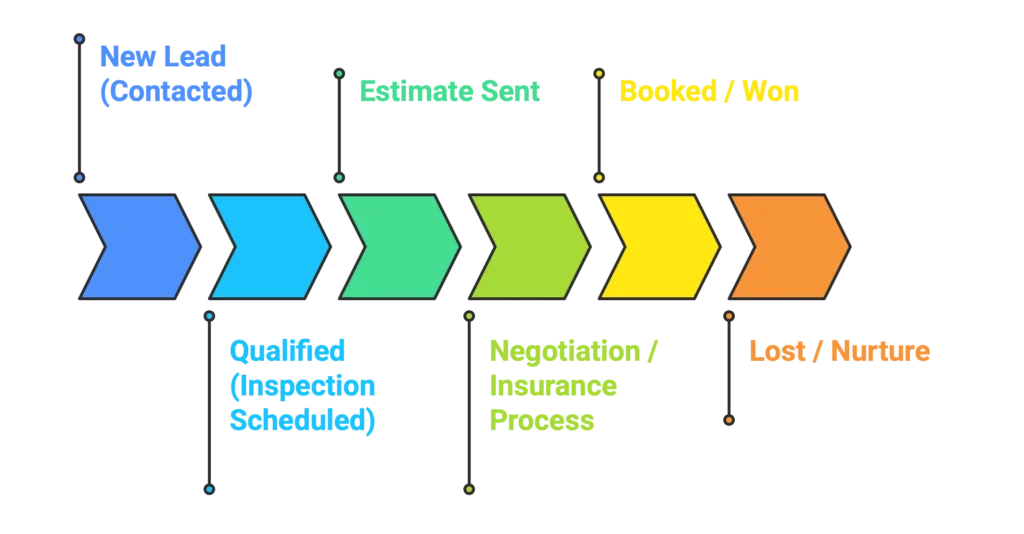
Your pipeline should reflect the natural flow of roofing jobs. Common stages include:
New Lead (Contacted): Initial inquiry received and first contact attempted.
Qualified (Inspection Scheduled): The lead meets criteria and inspection is scheduled.
Estimate Sent: After inspection, a proposal is shared with pricing and options.
Negotiation / Insurance Process: Any back-and-forth discussions or insurance approvals.
Booked / Won: Customer confirms the job.
Lost / Nurture: Leads that don’t convert immediately but may be viable later.
Keep the pipeline shallow and actionable, each stage should imply a specific next step. For example, after sending an estimate, the next step might be a follow-up call in 48 hours to discuss approval.
3) Standardize lead qualification
Effective lead management starts with consistent qualification. Create simple rules that define what a strong roofing lead looks like and ensure everyone follows the same criteria. Capture essential details like property type, urgency of the issue, insurance involvement, and decision timeline. This allows your team to focus effort on high-potential opportunities while placing lower-priority leads into nurture workflows instead of wasting time on poor fits.
4) Implement lead scoring and prioritization
Lead scoring helps your team focus on the opportunities most likely to convert. Assign points based on engagement, urgency, and qualification factors, such as answered calls, homeowner status, active leaks, or insurance claims. When combined with CRM automation, lead scoring ensures that high-value leads are followed up faster and more consistently, improving close rates without increasing manual work.
5) Automate first-response and nurture flows
Speed and consistency are critical in roofing sales. Set up automatic responses that confirm receipt of a lead and explain the next steps, creating a professional first impression. Follow this with internal reminders for sales staff to make direct contact. For leads that are not ready to commit, nurture sequences keep your company top of mind through helpful, non-pushy follow-ups until the timing is right.
6) Integrate estimating, scheduling and the field crew
A roofing CRM should connect sales with operations. After an inspection:
Upload photos, measurements, and estimates directly in the CRM
Assign tasks to field technicians, syncing jobs with their mobile apps
Track materials, crew schedules, and completion status
Using platforms like AccuLynx or JobNimbus ensures seamless handoffs, minimizing miscommunication and speeding up job completion.
7) Use templates and scripts
Templates and scripts are essential for consistent and professional communication across your team. Without them, messages to leads can vary widely, resulting in missed information or lost trust. Create templates for every stage of the customer journey:
Initial call scripts: Guide staff on what questions to ask, how to confirm property details, and how to explain next steps clearly.
Appointment confirmations: SMS or email templates that confirm inspection dates, provide directions, and set expectations for the visit.
Estimate follow-ups: Email or call scripts that remind homeowners about the proposal, explain financing options, or clarify insurance coverage.
Post-inspection messages: Templates for thanking leads, summarizing findings, and outlining next steps if they aren’t ready to book immediately.
Using these scripts ensures that every lead receives the same professional experience, even if handled by different team members. It also helps newer staff respond confidently without improvising critical conversations, reducing the risk of mistakes and improving the likelihood of booking jobs.
8) Connect payments and accounting
Integrating your CRM with accounting software like QuickBooks or Xero streamlines financial management and eliminates duplicate entry. Each job should have deposits, invoices, and final payment statuses linked directly in the CRM.
Benefits include:
Automatic tracking: As payments come in, your CRM updates the job record automatically, giving a real-time view of outstanding balances.
Revenue analysis: You can see which lead sources or campaigns generated the most revenue, helping you calculate cost per booked job.
Reduced errors: Eliminates manual data entry and miscommunication between sales and finance teams.
9) Track metrics that matter
A CRM’s value comes from actionable insights. Focus on metrics that show performance, not vanity statistics. Key metrics include:
Lead volume by source: Identify which channels, like Inquirly, Google Ads, or referrals, bring in the most leads.
Conversion rates between stages: Track how many leads move from initial contact to inspection, from inspection to estimate, and from estimate to booked job.
Average time to booking: Measure how long it takes for a lead to become a confirmed job, helping spot bottlenecks in your process.
Revenue per lead: Understand the financial value of each lead and channel.
10) Create a feedback loop
Lead management is not static – your CRM is most effective when it informs continuous improvement. Schedule regular reviews of your CRM data to answer questions like:
Which lead sources produce the highest number of booked jobs?
Are some sales reps consistently faster or more effective in follow-ups?
Where in the pipeline do leads tend to stall, and why?
Use these insights to refine lead scoring, adjust qualification criteria, tweak automated workflows, and invest more in channels that consistently produce results. Over time, this feedback loop allows your roofing business to optimize processes, improve team performance, and maximize ROI from each lead.
Looking for Exclusive Roofing Leads?
Exclusive roofing leads give contractors a significant advantage because they are delivered to only one company, reducing competition and increasing the likelihood of booking the job. Services like Inquirly specialize in providing these exclusive leads in real time, connecting roofing businesses with homeowners who are actively seeking services.
Setting up a roofing CRM effectively transforms how your business manages leads, from capturing inquiries to closing jobs. By defining sources, creating an actionable pipeline, standardizing qualification, scoring and prioritizing leads, automating responses and tracking key metrics, roofing businesses can increase efficiency, improve team performance, and maximize ROI. Paired with exclusive lead sources like Inquirly, a well-configured CRM ensures no opportunity is missed and every lead is given the attention it deserves, turning inquiries into booked jobs and predictable growth.
The residential and commercial roofing industry in 2025 is a high-stakes, high-reward environment. The difference between survival and scalability often comes down to one core element: the quality and quantity of your roofing leads.
But what is the real cost? It’s rarely just a dollar figure. It’s a complex equation involving time, strategy, customer lifetime value (LTV), and market competition. Chasing the cheapest roofing leads often results in the most expensive sales process.
This comprehensive guide breaks down the true cost of roofing leads across every major channel, from organic search and paid advertising to buying exclusive, high-intent leads – helping you determine the highest-ROI roofing lead generation strategy for your business in 2025.
1. Defining the Metrics
Cost Per Lead (CPL) vs. Cost Per Acquisition (CPA)
Before diving into specific channel costs, you must understand the two metrics that govern profitability.
Cost Per Lead (CPL)
The CPL is the total cost of all marketing and sales activities divided by the number of raw leads generated. This includes everything from marketing software subscriptions and ad spend to the salaries of the team members managing the campaign.
CPL= Total Number of Leads / Total Marketing Spend
A low CPL looks attractive, but if 95% of those leads are unqualified, your low CPL is worthless.
Cost Per Acquisition (CPA)
The CPA is the true measure of success. It calculates how much you spent, on average, to acquire one paying customer (i.e., one closed roofing job).
CPA = Number of Closed Sales / Total Marketing Spend
The most profitable roofing lead generation strategy is the one that minimizes your CPA, not necessarily your CPL. A lead costing $300 with a 50% closing rate (CPA: $600) is far better than a lead costing $50 with a 2% closing rate (CPA: $2,500).
2. Inbound Roofing Lead Generation
Inbound marketing focuses on attracting customers to your business through valuable content and visibility. While the monetary CPL starts high, it drops significantly over time, making it the most sustainable roofing leads generator.
Search Engine Optimization (SEO) and Content
SEO is the process of optimizing your website to rank highly on Google for terms like “emergency roof repair” or “best metal roofing contractor.” This is the foundation of long-term organic roofing lead generation.
Initial Cost: High. You need a fast, modern website and consistent, high-quality blog content, location pages, and service pages. If you hire an agency or internal SEO specialist, budget $1,500 to $5,000+ per month.
Timeframe to See Results: 6 to 12 months for new domains.
CPL Range (Long-Term): $10 – $50. Once content ranks, the cost of the lead is essentially just your monthly overhead for hosting and content maintenance. The intent of these organic roofing leads is extremely high because the user came to you.
Keywords: Target “near me” searches, specific material types (e.g., “TPO roofing installation”), and preventative topics (e.g., “signs your roof needs replacing”).
Google Business Profile (GBP) & Local SEO
For local businesses, your GBP profile (the map listing that appears in search results) is the single most valuable free asset.
Cost: Low monetary cost; high time cost for maintenance.
Strategy: Regularly post updates, respond quickly to all reviews, and ensure your service area and contact details are 100% accurate. Generating a consistent stream of five-star reviews is the primary focus.
CPL: Close to $0. The cost is the owner/manager’s time spent responding to inquiries and maintaining the profile. These are often the highest quality, lowest-cost roofing leads.
3. Paid Acquisition: Immediate, Measurable CPL
If you need roofing leads today, paid advertising is the quickest solution. It provides an immediate, predictable CPL, but you must constantly monitor performance to avoid excessive spending.
Pay-Per-Click (PPC) Advertising (Google Ads)
PPC is a competitive bidding war for prime spots on Google. In the roofing niche, the cost per click (CPC) is high, so conversion rate optimization is critical.
CPC Range: $5 to $25+ per click for high-intent keywords (“emergency roofing repair”).
CPL Range: $80 to $300. This assumes a relatively high 5-10% conversion rate from click to lead (a user filling out a form or calling). If your landing page is poor, the CPL can easily soar above $500.
Strategy: Focus on highly localized and specific terms (e.g., “hail damage roof repair in Dallas”) to narrow down your audience and improve conversion rates.
Google Local Services Ads (LSAs)
LSAs are becoming the preferred method for many local service companies. Customers see a list of “Google Guaranteed” contractors and can call directly from the ad.
Model: Pay-per-lead, not pay-per-click.
CPL Range: $75 to $150. Google charges you a flat fee only when a qualified lead calls or messages you.
Quality: Leads are generally high-intent because the user is ready to call immediately.
Caveat: You must be “Google Guaranteed,” which involves background checks and insurance verification.
Traditional Media (Radio, Print, Direct Mail)
While often overlooked, direct mail remains an effective strategy for targeted, large-ticket commercial roofing leads or for storm-chasing operations.
Cost: Very high initial outlay (design, printing, postage).
CPL (Highly Variable): Can range from $150 to over $500 due to low response rates, but the leads generated are often highly localized and exclusive to your campaign.
4. Buying Exclusive Roofing Leads
For contractors focused purely on service delivery and rapid growth, buying pre-qualified leads is the fastest path to revenue. The key distinction is between cheap, shared leads (where 3-5 competitors call the same person) and exclusive roofing leads.
Shared leads, while boasting a low CPL (e.g., $20), often lead to “race to the bottom” pricing wars, resulting in a disastrous CPA. Exclusive roofing leads are the superior investment.
Inquirly.com: Transparency and High ROI
Inquirly.com is a leading roofing leads generator that focuses solely on providing exclusive, high-intent opportunities to contractors, prioritizing long-term partnership over volume.
They offer a clear, tiered pricing structure based on lead quality and immediacy:
Lead Type
Cost Range
Average Conversion Rate
Form Leads
$15 – $150 per lead
High (exclusive)
Cost per Lead (CPL)
$50 – $300
Varies by job size/type
Cost per Call (CPC)
$100 – $900
Highest intent, instant delivery
The price variance depends entirely on the job’s scope, geographic location, and current market demand. A small repair form lead might be $15, while a high-value commercial re-roofing call could reach the high end of the range.
Key Advantages of Inquirly.com:
Exclusive Roofing Leads: This is the core value proposition. Every lead is sent only to you, eliminating the bidding war and allowing you to focus on selling value, not price.
Average Winning Cost Per Lead: Inquirly tracks the actual cost of a winning lead (a lead that converts to a closed sale). Their internal data shows an Average Winning Cost Per Lead of $90. This suggests that while CPL for individual calls can be high, the high conversion rate brings the average cost of a worthwhile lead down significantly.
Fair Billing: In a market plagued by long-term, restrictive contracts, Inquirly values transparency and fairness. They operate with No more long term contracts, giving contractors flexibility and cost-effective solutions tailored to their immediate needs.
ROI Focus: Investing in roofing leads from Inquirly is built around maximizing your ROI. Their strategy, which focuses on delivering qualified, ready-to-buy customers, is designed to boost your revenue and profitability by minimizing time wasted on low-intent or shared inquiries. This makes them a true roofing leads generator focused on profitability.
5. The True Cost of Your Sales Process
The cost of roofing leads is only half the battle. Your internal sales process can inflate your CPA dramatically, regardless of where the lead originates.
The Cost of Speed
When a lead is generated, whether from a website form or a purchased list, the speed of your response is the single greatest determinant of conversion.
Delayed Response Cost: If you wait 30 minutes to call a homeowner with a burst pipe, they have already called two other competitors. The cost of that roofing lead is effectively wasted.
Software Cost: To ensure rapid response, you must invest in business software for roofers. This includes CRM systems, automated text/email follow-up sequences, and instant dispatching tools. While this adds to your CPL, it dramatically reduces your CPA by improving conversion rates.
The Cost of Employee Efficiency
If your sales reps or estimators spend 50% of their time chasing unqualified leads, your CPA rises due to wasted salary dollars.
Solution: Use robust CRM features to qualify leads quickly and accurately. High-quality roofing leads (like exclusive calls) allow high-paid estimators to spend their time on revenue-generating activities (closing sales), rather than initial qualification.
6. The 2025 Hybrid Strategy
The most successful roofing companies do not rely on a single roofing lead generation method. They implement a hybrid strategy that leverages the strengths of each channel:
The Foundation (Low CPL, Slow Growth): Invest 15-20% of your budget in high-quality SEO content and website optimization. This builds long-term authority and provides the lowest possible CPL in 12-24 months.
The Predictable Revenue Engine (Medium CPL, Immediate Growth): Allocate 40-50% of your budget to PPC and LSAs. This ensures a steady flow of immediate roofing leads while the SEO efforts mature.
The Scalability Accelerator (High CPL, High ROI): Dedicate 30-40% of your budget to exclusive roofing leadsproviders like Inquirly.com. This allows you to scale rapidly in specific high-demand markets or during storm season without the long build-up time required for SEO or the high competitive cost of general PPC.
Conclusion: Don’t Chase Cheap, Chase Certainty
In 2025, the real cost of roofing leads is not the price tag; it’s the cost of time and resources wasted on low-intent inquiries.
The analysis shows that sustainable profitability comes from a balanced approach: relying on organic SEO for long-term low-cost leads, using PPC for immediate volume, and strategically investing in exclusive roofing leads for high-certainty, high-intent jobs. The value provided by a specialized roofing leads generator like Inquirly.com – where you can acquire an exclusive lead at an average winning CPL of $90, often justifies the initial cost due to the drastically reduced sales cycle and the increased closing rate.
Stop competing on price with shared leads. Start investing in certainty, transparency, and a high-ROI strategy that puts only qualified, exclusive opportunities directly in your pipeline.
Every roofing business owner has heard the same list of strategies: run Google Ads, collect reviews and rely on referrals. These were powerful a few years ago, but they’ve now become the industry default. When everyone uses identical playbooks, no one stands out.
In 2025, winning more roofing leads is about outsmarting saturation. The fastest growth comes from doing what others don’t: predicting demand before it happens, communicating with precision and moving faster from idea to test to result. Below, we’ll explore unconventional, high-leverage ways to generate roofing leads – strategies that feel closer to data science and digital psychology than traditional door knocking.
1. Master Local Visibility Before Anything Else
Most roofing leads come from local homeowners who are simply searching “roof repair near me.” That means local SEO is still the foundation of any high-performing lead system. Your Google Business Profile should be completely optimized: verified, frequently updated with photos of recent projects and filled with detailed reviews.
Companies that publish regular updates and respond to reviews within 24 hours tend to rank higher in the local map pack, where most customers click first. Adding location-specific landing pages also helps: for example, separate pages for “Roof Repair in Dallas,” “Roof Replacement in Plano,” and so on. These pages should load fast, include your phone number prominently, and feature photos from local jobs.
Google’s Local Service Ads have also become essential. They include verification badges like “Google Guaranteed,” which can increase conversion rates because homeowners see a layer of accountability. These ads also prioritize businesses with high review counts, so ongoing review collection directly boosts ad performance.
2. Capture Demand After Weather Events
While SEO and paid ads build steady visibility, the fastest lead spikes come after severe weather: hail, wind or heavy rain. Homeowners start searching for inspections or quotes within hours of the event. That’s when you need to appear first.
Set up weather alerts using tools like OpenWeather or AccuWeather Pro. When a storm hits your service area, run a time-sensitive ad campaign immediately on Facebook, Google or local radio. A simple message such as “Free Roof Inspections for Homes Impacted by Yesterday’s Storm” will outperform generic ads because it’s specific, relevant, and urgent.
If your budget allows, use a CRM system like JobNimbus or AccuLynx to upload homeowner lists in the affected ZIP codes and automate follow-ups. You can also use mailers or door tags within two to three days after the storm while the need is still top of mind.
3. Focus on Speed of Response, Not Just Ad Spend
One of the biggest reasons roofing companies lose leads isn’t poor advertising, it’s slow response time. In studies across home service industries, over 70% of leads choose the first company that replies to their request.
If you’re investing in lead generation, response automation is just as important as visibility. Use instant response systems through CRMs or messaging tools that reply to every inquiry within minutes, even outside working hours. A simple automated text such as, “Thanks for reaching out. We can inspect your roof tomorrow at no cost – would you prefer morning or afternoon?” keeps the homeowner engaged and prevents them from calling the next company on their list.
Once contact is made, schedule the inspection as soon as possible. Roofing leads are short-lived; the longer you wait, the more likely they’ll disappear. Prioritizing speed over long conversations often doubles your conversion rate.
4. Retain and Re-Engage
Every roofing company has leads that never converted — maybe they said “I’ll think about it,” or they never returned a call. These contacts are still valuable if approached correctly. Running small re-engagement campaigns every few months often brings old leads back at a fraction of the cost of new ones.
Send short, professional text or email sequences reminding them that inspections are still available or that prices may have changed.
You can also use retargeting ads on Google and Facebook that appear only to people who previously visited your website or filled out a quote form. These are inexpensive and maintain visibility among people already familiar with your business. The goal is consistent follow-up, not aggressive sales, but reminders that build familiarity and credibility over time.
5. Verified Lead Sources
Even with strong marketing in place, there are moments when you simply need more leads than your website or ads can generate. That’s when Inquirly.com can help.
Inquirly connects roofers with exclusive homeowner leads that are phone-verified and never shared with other companies. Each inquiry is checked for real intent, so you’re not wasting time chasing outdated or fake contacts. The leads come straight into your CRM the moment they’re verified, which means your team can call back while homeowners are still actively looking for help.
For most contractors, using Inquirly alongside their own advertising brings balance – your marketing builds local visibility, while Inquirly keeps a steady flow of qualified homeowners coming in. It’s a simple way to grow without losing control of your brand or your sales process.
6. Paid Ads
Paid ads can bring roofing leads fast, but only when every step is tracked and optimized. Focus on high-intent keywords, send traffic to dedicated landing pages, and monitor which campaigns actually convert.
Every click should go to a fast, mobile-friendly page with one clear goal: call or form submission. Add a visible phone number, short form and local trust signals such as reviews or certifications.
Recommended Tools for Roofing Lead Generation
Swipe through on mobile or scroll horizontally. Each card includes trusted tools for roofing ads, tracking, and lead management.
Keyword & Research
Find high-intent local searches and estimate CPC before you bid.
Tip: connect tracking → CRM → instant replies to keep response time under 5 minutes.
Conclusion
Generating roofing leads in 2025 is all about doing what works, faster and with better data. The tools above help you control every step: finding the right keywords, building landing pages that actually convert, tracking calls accurately, and responding through automated CRM workflows.
When you connect these systems and pair them with verified roofing leads from Inquirly.com, you create a marketing engine that never stops. Every click, call and inspection becomes measurable, letting you focus less on guesswork and more on steady, predictable growth.
Storm season isn’t just coming — it’s already here. If you’re in roofing or water damage restoration, this is your window of opportunity. Especially if your business is in states like Florida, Texas, Louisiana, or the Carolinas, where storms hit hardest and most often.
In 2024, insured storm-related damage topped $92 billion nationwide — and most of that came from wind, rain, and flooding. That’s not just weather. That’s demand. Thousands of homeowners needing emergency help. Roofs torn open. Basements flooded. Properties exposed.
The question is: Will they find you first — or your competitor?
The Problem
When the storms hit, homeowners move fast — but many contractors don’t. They stay passive, relying on word of mouth or waiting for referrals that never come. Others burn their budget on shared leads that have already been sold to five other companies.
And worse: some buy into cheap lead programs that deliver nothing but disconnected numbers or “just browsing” shoppers.
The result? Wasted time. Lost jobs. And a frustrating feeling that you’re always one step behind.
We deliver exclusive, real-time leads tailored to your location and services.
Whether you specialize in emergency water damage restoration or handle roof repairs and replacements, our leads come from homeowners actively searching for help — right now.
No shared leads. No filler. Just qualified, inbound calls and form submissions routed straight to you the moment they come in.
Why Now
Every major storm sends a flood of traffic online — people Googling terms like “emergency roof repair near me” or “water cleanup service fast.” The contractors who show up first, win. The ones who wait, lose out.
Storm leads spike fast and sell fast. If you don’t have a reliable flow of inbound leads when the rain starts falling, you’re already behind.
Why Inquirly
We’ve helped hundreds of contractors scale during storm season — without burning through ad budgets or fighting over shared leads. With no contracts, transparent pricing, and hands-on support, Inquirly is the trusted partner for serious growth.
Our system is built around exclusivity and quality. Every lead is sent to just one contractor. If a lead turns out to be invalid — like wrong numbers, spam, or outside your service area — it’s refunded or replaced, no questions asked.
But don’t just take our word for it.
In our Inquirly Leads Review, we break down everything from lead delivery speed to conversion rates. Contractors report solid close rates, real homeowners actively seeking help, and a clear return on investment — especially during high-demand periods like storm season.
You get:
Exclusive leads only sent to you
Real-time delivery
No long-term commitments
Refunds for invalid leads
Support from a real team who knows this industry
Inquirly vs Other Lead Generation Services
Feature / Value
Inquirly ✅
Other Services ❌
Lead Type
Exclusive — sent to only 1 contractor
Shared with 3–5+ contractors
Lead Delivery
Real-time (instant notification)
Delayed or batch-delivered
Service Customization
Choose service type & zip codes
Limited or generic targeting
Refunds for Bad Leads
Yes — clear, fair refund policy
Rare or slow to refund
Contract Required
No contracts — cancel anytime
Long-term commitments required
Transparency
Clear pricing & performance data
Vague or hidden pricing
Support
Real people, quick replies
Offshore call centers or email-only
Lead Quality
Pre-qualified, real intent
Often cold or low-converting
Industry Focus
Water Damage, Roofing, Restoration
Generic across all industries
Client Control
You set budget, filters, volume
Little control over volume/fit
Reputation
Trusted by 500+ U.S. contractors
Often churn-heavy and unvetted
Ready for Storm Season?
Don’t wait for the next storm to scramble. The demand is already here — and your competitors are gearing up.