Author Archives: Autumn Andel

How to rank a water restoration business on Google in 2026

Ranking a water restoration business on Google in 2026 depends less on marketing language and more on operational accuracy. Google’s search systems now prioritize verifiable business data, consistent local presence, and content that reflects how restoration services are actually delivered.

This article outlines the practical factors that influence rankings for water restoration and restoration business websites, based on how Google currently evaluates local service providers.

How Google Evaluates Water Restoration Businesses in 2026

Water restoration is treated as a high-risk service category. Google applies stricter quality thresholds because recommending the wrong provider can lead to property damage, financial loss, or safety issues.

In practice, Google evaluates whether a restoration business:

  • Exists as a real, operating company
  • Provides consistent information across platforms
  • Serves clearly defined geographic areas
  • Explains its services in a factual, understandable way
  • Receives ongoing user interaction and feedback

Local SEO

Most water restoration searches carry implicit local intent. Even when a user searches for “water restoration” without a city name, Google prioritizes nearby businesses.

The Google Business Profile is a core ranking asset. Its primary function is verification. Accurate service categories, realistic service areas, and up-to-date contact details matter more than keyword-optimized descriptions.

Photo uploads should reflect actual work rather than stock imagery. Google uses image metadata, user engagement, and cross-platform consistency to assess legitimacy.

To monitor local visibility, Google Business Profile Insights and Google Search Console provide sufficient data. Third-party tools are optional, not required.

Location Pages

Many restoration businesses still rely on thin city pages where only the location name changes. In 2026, this approach is largely ineffective.

Strong location pages reflect real, local context. They acknowledge common causes of water damage in the area, typical building types, seasonal risks, and realistic response times. A page targeting a coastal city should read differently from one targeting a dense urban neighborhood or suburban housing area.

These details signal to both users and search engines that your restoration business genuinely understands the areas it serves. Pages written with local awareness consistently outperform generic alternatives.

Reviews Function as Quality Signals

Reviews influence both local rankings and user trust, but not all reviews carry equal weight. Google evaluates review patterns rather than isolated feedback. Factors such as how frequently new reviews appear, how specific the review text is, whether it clearly relates to water restoration services, and how consistently the business responds all contribute to how reviews are interpreted.

A steady flow of detailed reviews over time is more effective than short-term campaigns aimed purely at increasing volume. Reviews that describe response time, the type of water damage, and the outcome of the job provide clearer signals than generic star ratings.

For monitoring review trends, Google Business Profile Insights is usually sufficient. It allows businesses to track review growth, visibility, and customer interaction without relying on third-party software. Review management tools can help with alerts and organization, but they do not influence rankings directly, the substance and consistency of customer feedback does.

Informational Content Supports Service Visibility

Informational content does not directly rank service pages, but it helps Google understand whether a restoration business has real topical coverage. Articles that reflect actual search behavior, such as what to do immediately after water damage, how fast mold can develop or what insurance documentation is usually required, support subject relevance and authority.

Content explaining different water damage categories is particularly useful because it mirrors how restoration professionals assess risk. When this information exists alongside service pages, it strengthens context rather than competing with it. Tools like Google Search Console can help identify which informational queries already generate impressions, allowing content to be refined based on real demand rather than assumptions.

Technical SEO

Technical SEO establishes the baseline for ranking but rarely creates a competitive edge on its own. For water restoration websites, the most common issues are slow mobile performance, unclear site structure, and poor internal linking.

Because many searches happen during emergencies, mobile usability and load speed directly affect user behavior. Secure hosting and HTTPS are now standard expectations. Google PageSpeed Insights and Google Analytics 4 are usually sufficient to identify technical problems. Fixing these issues improves usability and reduces drop-off, which indirectly supports search visibility.


Looking for exclusive water restoration leads delivered directly to your business without competition? Inquirly provides verified, exclusive leads so you can focus on serving clients. 
Contact us today to get started.

Conclusion

Ranking a water restoration business on Google in 2026 is less about optimization tactics and more about accuracy, consistency, and real-world alignment. Google’s systems increasingly reward businesses that present verifiable information, serve clearly defined areas, explain their services clearly, and receive ongoing user engagement.

Local presence, realistic location pages, detailed reviews, and supporting informational content all work together to establish trust and relevance. Technical SEO ensures that these signals are accessible and usable, but it does not replace the need for operational clarity.

For restoration businesses, sustainable rankings tend to follow when online representation matches how the business actually operates on the ground.

Appliance Repair Lead Conversion Rates: What’s Considered Good?

In the appliance repair industry, there is a fundamental distinction between high call volume and operational profitability. A common misconception among business owners is that a high volume of incoming inquiries equates to a successful marketing strategy. However, if call volume is high but your technicians’ schedules remain underutilized, the issue is not lead generation, it is lead conversion.

Understanding your conversion rate is the single most important KPI (Key Performance Indicator) for scaling a service business. In this guide, we will break down the actual benchmarks, why “industry averages” can be misleading, and the specific mechanics of turning a “Price Shopper” into a “Lifetime Customer.”

What is a “Good” Conversion Rate?

To determine if your business is healthy, you need to measure the gap between a “lead” (a phone call or form submission) and a “booking” (a scheduled appointment).

1. The Industry Benchmarks

Conversion rates vary by lead source, but for a healthy appliance repair business, these are the targets:

Lead Source“Good” Conversion Rate“Elite” Conversion Rate
Inbound Phone Calls45% – 60%75%+
Google LSA (Local Service Ads)30% – 50%60%+
Website Contact Forms20% – 35%45%+


Note: If your overall Lead-to-Booking rate is below 45%, your issue isn’t marketing, it’s sales operations.

2. The Economics of Conversion

Improving your conversion rate is the only way to grow revenue without increasing your ad spend. Small shops become large fleets by mastering this math.

The Scenario:

  • Ad Spend: $2,000/month
  • Leads Generated: 100 ($20 per lead)
  • Average Job Ticket: $300


The Comparison:

  • At 30% Conversion (Underperforming): 30 jobs = $9,000 Revenue
  • At 50% Conversion (Good/Healthy): 50 jobs = $15,000 Revenue

By simply training your dispatcher or adding a “Book Now” button, you’ve captured $6,000 in additional monthly revenue without spending an extra cent on Google or Facebook.

3. Checklist: How to Hit “Elite” Conversion Levels

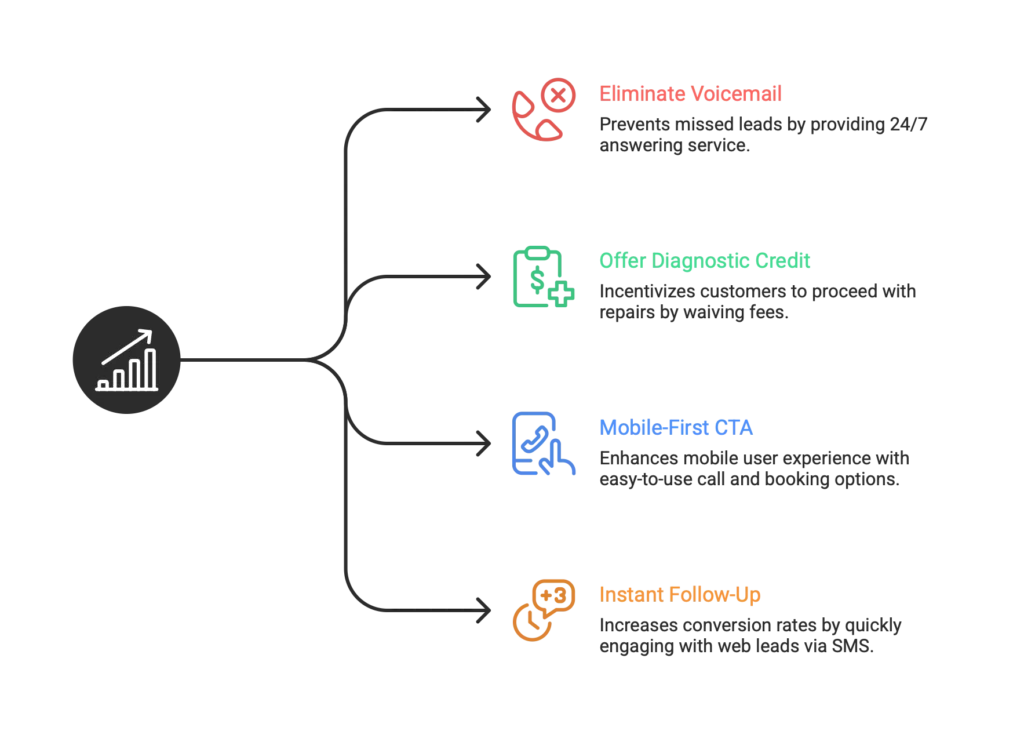
If you are currently below the 45% mark, implement these four friction-reducers:

  1. Eliminate Voicemail: Hire a 24/7 answering service for after-hours and overflow. Every missed call is a lead for your competitor.
  2. The “Diagnostic Credit”: Explicitly market that the service fee is waived if the customer proceeds with the repair.
  3. Mobile-First CTA: Ensure your website has a “Click-to-Call” button and an “Online Booking” option that doesn’t require a login.
  4. Instant Follow-Up: Use SMS automation to text every web lead within 2 minutes. Speed is the #1 factor in conversion.

4. The Power of Exclusive Leads

It is important to distinguish between “shared” leads and exclusive leads. Platforms like Angi or HomeAdvisor often send the same lead to multiple companies simultaneously, creating a “race to the phone” that results in lower conversion and lower margins.

By contrast, Inquirly focuses on generating real-time and exclusive appliance repair leads. Because you aren’t competing with three other technicians in real-time, these leads carry much higher intent.

  • Average Winning Cost Per Lead: ~$30*
  • The Benefit: Investing in exclusivity reduces the “noise” in your sales funnel and allows your dispatcher to focus on building rapport rather than just being the first to pick up the phone.


Whole process of generating leads is designed to turn a simple inquiry into a real customer for your business through a structured three-step delivery system:

  1. STEP 1: Call Tracking – Monitoring incoming interest to ensure high intent.
  2. STEP 2: Verification – Vetting the lead to ensure it’s a real repair opportunity.
  3. STEP 3: Delivery of Leads – Immediate routing directly to you as soon as they are generated.


Prices vary based on the type of interaction, allowing you to scale based on your team’s capacity to handle live calls versus following up on forms:

  • Form Leads: $10 – $30 per lead
  • Phone Calls: $20 – $100 per call


Conclusion: The Bottom Line on Success

In the appliance repair industry, a “good” conversion rate is more than just a statistic; it is the ultimate measure of your business’s operational health.

While the industry average hovers around 45%, elite companies consistently push past 70% by prioritizing exclusivity over volume. Choosing exclusive leads, ranging from $10 to $100 depending on the medium, effectively eliminates the “race to the bottom” associated with shared platforms.

Ultimately, growth doesn’t come from finding cheaper leads; it comes from maximizing the value of every incoming call. By focusing on immediate response times, transparent diagnostic pricing, and high-intent exclusive inquiries, you can scale your revenue significantly without ever needing to touch your marketing budget.

How Much do Snow Removal Leads Cost

For many landscaping and property maintenance professionals, the winter season represents a high-stakes pivot. When the ground freezes and the lawn mowers are tucked away, snow removal becomes the primary driver of revenue. However, the seasonal nature of the industry creates a frantic “gold rush” for clients as soon as the first snowflake falls.

Understanding the market for snow removal leads and specifically the difference between shared and exclusive opportunities, is the key to a profitable winter.

In this guide, we will break down the industry standards for lead generation and look specifically at how Inquirly’s pricing model helps contractors secure high-value contracts.

Shared vs. Exclusive Leads 

Before looking at specific dollar amounts, it is vital to understand the “Lead Quality Spectrum.” Most lead generation platforms operate on one of two models:

1. Shared Leads (The High-Competition Model)

Shared leads are the standard offering from large-scale home service directories.

  • How it works: A homeowner’s request is sold to 3 to 5 contractors simultaneously.
  • The Reality: This creates a “race to the bottom” on price. Because the customer is being bombarded by multiple callers, they often choose the lowest bid. For contractors, the true cost is the time wasted on low closing rates and prospects who have already hired a competitor.

2. Exclusive Leads (The High-Conversion Model)

Exclusive leads are routed to exactly one contractor, ensuring you own the opportunity.

  • How it works: The lead is locked to your business. You aren’t competing for the customer’s attention, allowing you to build a professional relationship from the first interaction.
  • The Reality: While the upfront investment is higher, the cost per acquisition is significantly lower. You close a higher percentage of jobs and protect your margins because you aren’t being pitted against “budget” competitors in real-time.

Breaking Down Lead Costs

When analyzing the market for snow removal opportunities, costs can be segmented by the type of interaction and the “exclusivity” of the lead. Generally, the market is divided into two categories: Shared and Exclusive.

Pricing for Shared Leads

Shared leads are the most common model found on large home-service directories. In this model, a homeowner’s contact information is sold to 3 to 5 different contractors simultaneously.

  • Average Cost: $15 – $30 per lead.
  • The Dynamics: Because these leads are cheaper, they appeal to businesses with very tight marketing budgets. However, because you are competing with several other companies in real-time, these often lead to a “race to the bottom” on price.
  • The Hidden Cost: While the entry price is low, the closing rate is typically much lower. You may spend more time calling prospects who have already hired a competitor than actually clearing snow.

Inquirly.com Pricing

Inquirly operates on an exclusive basis, focusing on high-intent traffic to ensure that contractors aren’t just getting names and numbers, but actual opportunities to book work. Here is how the pricing breaks down for snow removal:

Standard Lead Pricing – Prices vary based on the “delivery method” of the lead. Generally, the more direct the contact, the higher the value.

  • Form Leads ($25 – $40 per lead): These occur when a prospect fills out a detailed request on Inquirly. These are ideal for residential routes and smaller commercial properties where you need to see the scope of work before providing a quote.
  • Live Calls ($35 – $120 per call): A live call is the most valuable asset in the snow industry. This is a customer on the line, right now, looking for help. These leads have the highest conversion rates, especially during active snow events.


The “Average Winning Cost” Metric

Inquirly notes an Average Winning Cost Per Lead of $350.

While the initial acquisition cost may seem high, it is a strategic investment in securing high-value seasonal contracts, such as HOAs or commercial centers. When compared to the total value of these contracts, which can range from $5,000 to over $50,000, the marketing expense remains a small percentage of the overall revenue. This approach prioritizes long-term ROI and predictable cash flow over the upfront cost of the lead.

Why Snow Removal Lead Costs Vary

Whether you are buying form leads or taking live calls, several environmental factors will influence the price you pay:

  1. Lead Type: As noted, a direct phone call is always more expensive than a form fill because the “intent to buy” is significantly higher.
  2. Market Competition: In cities with frequent, heavy snowfall (like Minneapolis, Chicago, or Boston), the cost per lead is higher because more contractors are bidding for the same digital real-house.
  3. Property Scale: Commercial snow removal leads are inherently more expensive to generate than residential ones. A lead for a 50-unit apartment complex is a “whale” compared to a single-family driveway, and the pricing reflects that potential.
  4. Weather Urgency: During a “State of Emergency” or a blizzard warning, the demand for snow services spikes. Lead costs often fluctuate based on the immediate weather forecast.

Conclusion

Navigating the costs of snow removal leads requires a shift from looking at “price per lead” to “profit per lead.” While shared leads are cheap, they are often a waste of time. Exclusive leads from Inquirly, ranging from $25 for forms to $120 for calls, offer a direct path to growth. By understanding that a $350 winning cost can secure a massive seasonal contract, you can budget effectively and dominate your local market this winter.

Secure Your Winter Routes Today Don’t wait for the first blizzard to start marketing. Get exclusive snow removal leads tailored to your service area. Contact Us Today.

Shared vs Exclusive Painting Leads

In the world of residential painting, there is a massive difference between a “lead” and a “contract.” Most contractors are lured into buying shared painting leads because the entry price is low, often appearing as a manageable $20 to $40 expense. But if you have ever spent a Tuesday evening calling five different homeowners who all stopped answering their phones after the third contractor called, you know that the “cheap” lead is often the most expensive one you’ll ever buy.

Understanding the difference between shared and exclusive painting leads is critical if you want predictable revenue, higher close rates, and fewer wasted hours chasing prospects who were never serious to begin with.

This article breaks down how shared and exclusive painting leads actually work, the real costs behind each model and which option makes sense depending on your business stage.

What Are Shared Painting Leads?

Shared painting leads are homeowner inquiries that are sold to multiple contractors at the same time. In most cases, the same homeowner submits one request online, and that request is distributed to anywhere between 3 and 10 painting companies in the same area.

Lead platforms promote shared leads as affordable, scalable and low-risk. On paper, it looks attractive: pay a small fee, get more opportunities, and win jobs through speed or price competitiveness.

In reality, shared leads come with several built-in challenges.

How Shared Leads Typically Work

A homeowner fills out a short form requesting painting estimates. Within minutes, multiple contractors receive the same lead notification. The fastest contractor calls first, followed closely by several others. From the homeowner’s perspective, their phone rings nonstop for the next few hours.

By the time most painters make contact, the homeowner is already overwhelmed or annoyed. Many stop answering calls altogether.

The Real Cost of Shared Painting Leads

Shared leads are rarely evaluated honestly. Contractors focus on the cost per lead, but the real metric that matters is cost per booked job.

Here’s why shared leads often underperform.

  1. Low Contact Rates: Because the lead is sent to multiple contractors simultaneously, speed becomes the deciding factor. If you are not calling within the first 60-120 seconds, your chances drop significantly. Painters who are on job sites, driving, or managing crews often miss that narrow window.
  2. Price Wars and Race to the Bottom: Shared leads encourage price-driven competition. When homeowners receive multiple quotes within hours, many default to choosing the cheapest option, not the best contractor. This pushes margins down and attracts price-sensitive customers who are more likely to negotiate aggressively or cancel later.
  3. Lower Intent Homeowners: Shared lead platforms often prioritize volume over quality. Many homeowners submit requests “just to see prices” with no urgency or timeline. Others are renters, property managers shopping multiple vendors, or homeowners without approval to move forward. Contractors end up spending hours on estimates that never convert.

What Are Exclusive Painting Leads?

Exclusive painting leads are sold to one contractor only. When a homeowner submits an inquiry, it is routed directly to a single painting company instead of being shared across a network.

The contractor receiving the lead becomes the homeowner’s first and often only point of contact.

This fundamental difference changes the entire sales dynamic.

How Exclusive Leads Work

Exclusive leads are usually generated through targeted marketing channels such as:

  • SEO-driven local search pages
  • Google Ads campaigns
  • High-intent landing pages
  • Local service ads

Instead of being blasted to multiple painters, the homeowner is intentionally matched with one contractor based on location, service type, or availability.

Why Exclusive Painting Leads Convert Better

Exclusive leads consistently outperform shared leads across every meaningful metric.

  • Higher Contact Rates
    Since the homeowner is expecting one contractor to call, they are far more likely to answer the phone, respond to texts, or reply to emails.
    There is no call fatigue and no confusion about who contacted them first.
  • Stronger Trust From the Start
    When a homeowner speaks with only one contractor, the conversation starts as a consultation rather than a negotiation.
    You are positioned as the expert, not one of many interchangeable quotes.
  • Less Price Sensitivity
    Without immediate price comparisons, homeowners focus more on professionalism, communication, and confidence. This allows contractors to sell on value instead of racing to the lowest bid.
  • Better Use of Time
    Exclusive leads reduce wasted estimates, ghosting, and follow-ups that go nowhere. Even though the upfront cost is higher, the overall efficiency improves dramatically.

Shared vs Exclusive Painting Leads

When comparing the two models, the difference becomes clear. Shared leads prioritize quantity, while exclusive leads prioritize quality.
Shared leads are cheaper upfront but cost more in time, energy, and missed opportunities. Exclusive leads require higher investment but generate more consistent results and predictable revenue. For contractors focused on growth, stability, and long-term profitability, exclusivity often wins.

Which Type of Painting Lead Is Right for Your Business?

The right choice depends on your current business stage, capacity, and goals.

When Shared Leads Might Make Sense

Shared painting leads are most effective in specific, limited scenarios where immediate volume is more important than profit margins. New contractors often use these leads as a testing ground to refine their sales scripts and learn how to handle customer objections. They also serve as a useful tool for businesses that find themselves with excess crew capacity or those operating in dense, highly competitive urban areas where any foot in the door is valuable. Additionally, shared leads are a reliable way to fill short-term gaps in the schedule during the slower winter seasons.

When Exclusive Leads Are the Better Choice

In contrast, exclusive painting leads are the ideal choice for established contractors who prioritize predictable, high-quality jobs over raw volume. These leads are better suited for businesses that focus on higher-value residential or commercial projects where the homeowner is looking for quality rather than the lowest bid. Companies with strong branding and well-defined sales processes find that exclusive leads offer a much better return on investment. Ultimately, exclusive leads are the preferred option for business owners who value time efficiency and want to avoid the high-stress race to call a customer before their competitors do.

Inquirly Exclusive Painting Leads

Inquirly provides exclusive painting leads, meaning each homeowner inquiry is sent to only one contractor. There is no lead sharing, no bidding wars and no competing calls going out at the same time. This allows painting contractors to speak with prospects before they experience call fatigue and price overload.

Leads are priced based on job type and location, and contractors only pay for verified opportunities that match their selected criteria. Inquirly offers both form-based leads and inbound calls, giving contractors flexibility depending on how they prefer to handle new inquiries.

Common Myths About Exclusive Painting Leads

Despite their advantages, exclusive leads are often misunderstood.

“Exclusive Leads Are Too Expensive”
While exclusive leads cost more per inquiry, they usually cost less per closed job. When evaluated correctly, many contractors find that exclusive leads deliver a lower overall customer acquisition cost.

“I Can Just Outwork Shared Leads”
Speed and persistence help, but they do not solve the core issue of lead saturation. Even the best salespeople struggle when competing against five other painters simultaneously.

“Shared Leads Bring More Volume”
Volume does not equal results. Ten shared leads that produce no jobs are worth less than one exclusive lead that turns into a $6,000 project.

How to Evaluate Any Painting Lead Provider

Regardless of lead type, contractors should ask critical questions before investing. Transparent providers are willing to explain exactly how leads are generated and distributed.

Key factors to look for include:

  • How many contractors receive each lead
  • How homeowner intent is verified
  • Whether service areas are capped
  • Refund or replacement policies
  • Average close rates reported by existing clients

Final Thoughts: Leads vs Contracts

At the end of the day, painting businesses are not built on leads. They are built on signed contracts, completed jobs, and satisfied customers.

Shared painting leads may look attractive on the surface, but they often come with hidden costs that eat away at profits and morale. Exclusive painting leads, while more expensive upfront, provide clarity, control, and consistency.

For painting contractors who are serious about scaling, protecting margins, and working with better clients, exclusivity is rarely a luxury. It is a strategic advantage.

AI Tools for Appliance Repair Lead Management 

The appliance repair industry is centered on timely service, as homeowners need quick assistance when an appliance breaks down. For this reason, the most crucial part to growth is lead management – the speed and accuracy with which an initial inquiry is converted into a scheduled and completed repair job.

Traditionally, lead management in this sector has been labor-intensive and error-prone. It involves manual phone answering, slow data entry into a CRM, inconsistent scheduling based on geographic guesswork and reactive follow-up. This “inefficiency tax” results in:

  1. High Customer Acquisition Cost (CAC): Leads slip away due to slow response times.
  2. Suboptimal Dispatching: Technicians spend time driving instead of repairing.
  3. Stagnant Revenue: Growth is limited by human capacity, not market demand.


The solution is intelligent automation. Artificial Intelligence (AI) tools are moving from optional novelty to essential infrastructure, offering appliance repair companies the capability to manage leads with a speed, precision and personalization that was previously impossible.

This article outlines a strategy plan for incorporating AI into your lead management process to generate predictable, scalable revenue.

Lead Capture & Qualification

The first and most common failure point in appliance repair lead management is availability. Appliance breakdowns happen at night, early mornings, and weekends, while most offices operate limited hours.

How AI Fixes the Availability Gap

AI chatbots and virtual assistants act as a 24/7 digital receptionist across your website, SMS, and social channels. Unlike basic contact forms, they engage prospects instantly and guide them through structured qualification.

What AI Collects Automatically

  • Appliance type (fridge, washer, dryer, oven, etc.)
  • Brand and model number
  • Problem description (e.g., “won’t drain,” “not cooling”)
  • Customer location / ZIP code
  • Urgency level

All of this information is captured conversationally and pushed directly into your CRM or field service system and no manual entry Is required.

Tools Worth Looking At

ToolWhat it’s best for
TidioSimple AI chat for websites and Facebook; quick setup and well suited for small teams
Yellow.aiAdvanced conversational AI across chat, SMS, and voice channels
Pipedrive ChatbotChatbot tightly integrated with the Pipedrive CRM and sales pipeline
involve.meConversational, interactive lead forms used to pre-qualify appliance repair jobs

Knowing Which Leads Deserve Immediate Attention

Every repair business has more leads than it can handle at peak times. The problem isn’t volume—it’s knowing which calls matter most.

AI can help prioritize leads by looking at patterns in your past jobs. It learns which types of inquiries turn into profitable repairs and which ones tend to drag on or cancel.

Instead of treating every lead the same, AI can factor in:

  • Appliance type and age
  • Distance from current technician routes
  • Lead source quality
  • Past customer history

From there, leads are ranked so the most valuable ones get attention first.

CRMs That Do This Well

ToolWhat it’s best for
HubSpot CRMStrong automation and predictive lead scoring, even for service businesses
Zoho CRMIncludes AI features that help prioritize follow-ups
PipedriveCleaner, simpler pipelines with basic lead ranking


This doesn’t replace your judgment, it supports it. Dispatchers still decide, but now they’re working with better information.

Smarter Scheduling

Scheduling is where many appliance repair businesses quietly lose money. Too much driving between jobs, poorly grouped appointments, and technicians ending the day either overloaded or underutilized all eat into margins without being immediately obvious. Over time, these inefficiencies add up and limit how many jobs a team can realistically complete.

AI-powered scheduling tools improve this by constantly adjusting schedules based on what is actually happening in the field. They take into account where technicians are in real time, how long similar repairs typically take, which technicians are qualified for specific brands or appliance types, and how traffic patterns change throughout the day. Instead of relying on static service zones or manual guesswork, schedules remain flexible and responsive.

The result is a more balanced workload, less time spent on the road, and more repairs completed per technician. Without adding pressure or rushing jobs, businesses can increase daily capacity simply by making smarter scheduling decisions.

Scheduling & Dispatch Tools to Explore

ToolWhat it’s best for
FieldCamp.aiA complete field service platform with scheduling, CRM, and invoicing built in
FieldproxyStrong at workforce coordination and route optimization
GorillaDeskHelpful for automated booking and SMS communication
Salesforce Field Service Best suited for large or multi-location operations

Following Up

Most appliance repair jobs don’t end when the technician leaves. A part may need replacing later, routine maintenance might be due, or the customer could face the same issue again months down the line. Without follow-up, those future opportunities are often lost.

AI helps by handling follow-ups automatically and at the right time. After a successful repair, it can send a review request while the experience is still fresh. For certain appliances, it can schedule maintenance reminders based on the type of work done. If a repair was declined because it wasn’t cost-effective, AI can check back in later with helpful information or alternative options. It can also reach out seasonally, reminding customers of services they may need before problems arise.

All of this happens in the background through tools like HubSpot, Zoho, or field service platforms, keeping your business visible without adding more work for your team.

Conclusion

Adopting AI doesn’t mean replacing all your existing systems at once. The most effective approach is to add AI gradually on top of what you already use.

Start by improving lead capture so inquiries are handled faster and more consistently. Once that’s working, introduce lead prioritization to focus on the most valuable jobs. After that, move into smarter scheduling to reduce drive time and improve technician productivity.

Throughout this process, clean and consistent data is essential. AI relies on accurate information, so keeping records organized ensures the tools actually deliver useful results instead of creating confusion.

How to Set Up a Roofing CRM for Better Lead Management

The difference between a scaling roofing business and one struggling with stagnation often comes down to one factor: flawless lead management execution.

If your team is managing valuable prospects through scattered spreadsheets, emails, and fragmented communication channels, you are actively sacrificing revenue and eroding your competitive edge. These inefficiencies directly lead to missed follow-ups, slow quoting times, and critically poor conversion rates.

Why a Roofing CRM? 

A CRM centralizes all your prospects, automates routine tasks, and gives your team a single source of truth for lead status, communications, and next steps. For roofers, the right CRM ties together leads from paid vendors, web forms, phone calls, referral sources, and field estimates so nothing slips through the cracks.

This guide provides a practical, 10-step strategic framework for implementing and leveraging your CRM. 

Tools to consider

  • AccuLynx – an all-in-one roofing platform combining CRM, job production, aerial measurements and estimating – built specifically for roofers. Great when you need job-level operations tightly coupled with leads. 
  • JobNimbus – a flexible roofing CRM with workflows, mobile app, QuickBooks sync and payment features; popular with small-to-medium roofers.
  • HubSpot CRM – a general-purpose CRM that’s excellent for organized lead management, marketing automation, and scaling processes (free tier is useful for startups). 

Set up your Roofing CRM to manage leads effectively

1) Define your lead sources and capture points

Begin by identifying every channel where roofing leads originate, including lead generation services, your website, paid ads, social media messages, referrals, walk-ins, and direct phone calls. Each source should have a clearly defined path into your CRM so no lead is lost or delayed.
Decide how leads are captured (API, Zapier, email forwarding, or call tracking integrations) and assign clear ownership for first contact. For example, exclusive leads from Inquirly should enter the CRM instantly, trigger an automated confirmation message, and create a follow-up task for a sales call within minutes.

2) Create a simple, actionable pipeline

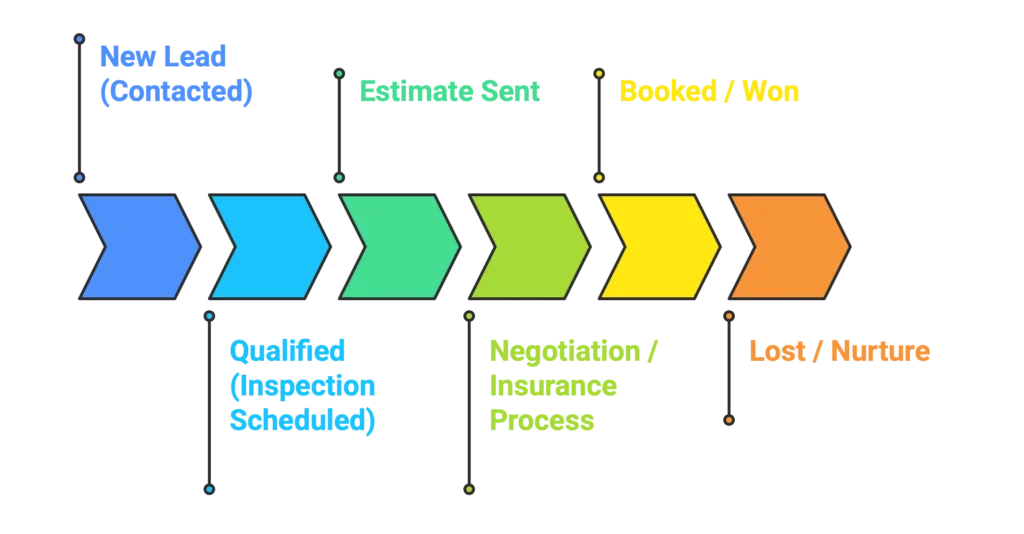
Your pipeline should reflect the natural flow of roofing jobs. Common stages include:

  • New Lead (Contacted): Initial inquiry received and first contact attempted.
  • Qualified (Inspection Scheduled): The lead meets criteria and inspection is scheduled.
  • Estimate Sent: After inspection, a proposal is shared with pricing and options.
  • Negotiation / Insurance Process: Any back-and-forth discussions or insurance approvals.
  • Booked / Won: Customer confirms the job.
  • Lost / Nurture: Leads that don’t convert immediately but may be viable later.

Keep the pipeline shallow and actionable, each stage should imply a specific next step. For example, after sending an estimate, the next step might be a follow-up call in 48 hours to discuss approval.

3) Standardize lead qualification

Effective lead management starts with consistent qualification. Create simple rules that define what a strong roofing lead looks like and ensure everyone follows the same criteria.
Capture essential details like property type, urgency of the issue, insurance involvement, and decision timeline. This allows your team to focus effort on high-potential opportunities while placing lower-priority leads into nurture workflows instead of wasting time on poor fits.

4) Implement lead scoring and prioritization

Lead scoring helps your team focus on the opportunities most likely to convert. Assign points based on engagement, urgency, and qualification factors, such as answered calls, homeowner status, active leaks, or insurance claims.
When combined with CRM automation, lead scoring ensures that high-value leads are followed up faster and more consistently, improving close rates without increasing manual work.

5) Automate first-response and nurture flows

Speed and consistency are critical in roofing sales. Set up automatic responses that confirm receipt of a lead and explain the next steps, creating a professional first impression.
Follow this with internal reminders for sales staff to make direct contact. For leads that are not ready to commit, nurture sequences keep your company top of mind through helpful, non-pushy follow-ups until the timing is right.

6) Integrate estimating, scheduling and the field crew

A roofing CRM should connect sales with operations. After an inspection:

  • Upload photos, measurements, and estimates directly in the CRM
  • Assign tasks to field technicians, syncing jobs with their mobile apps
  • Track materials, crew schedules, and completion status

Using platforms like AccuLynx or JobNimbus ensures seamless handoffs, minimizing miscommunication and speeding up job completion.

7) Use templates and scripts

Templates and scripts are essential for consistent and professional communication across your team. Without them, messages to leads can vary widely, resulting in missed information or lost trust. Create templates for every stage of the customer journey:

  • Initial call scripts: Guide staff on what questions to ask, how to confirm property details, and how to explain next steps clearly.
  • Appointment confirmations: SMS or email templates that confirm inspection dates, provide directions, and set expectations for the visit.
  • Estimate follow-ups: Email or call scripts that remind homeowners about the proposal, explain financing options, or clarify insurance coverage.
  • Post-inspection messages: Templates for thanking leads, summarizing findings, and outlining next steps if they aren’t ready to book immediately.

Using these scripts ensures that every lead receives the same professional experience, even if handled by different team members. It also helps newer staff respond confidently without improvising critical conversations, reducing the risk of mistakes and improving the likelihood of booking jobs.

8) Connect payments and accounting

Integrating your CRM with accounting software like QuickBooks or Xero streamlines financial management and eliminates duplicate entry. Each job should have deposits, invoices, and final payment statuses linked directly in the CRM.

Benefits include:

  • Automatic tracking: As payments come in, your CRM updates the job record automatically, giving a real-time view of outstanding balances.
  • Revenue analysis: You can see which lead sources or campaigns generated the most revenue, helping you calculate cost per booked job.
  • Reduced errors: Eliminates manual data entry and miscommunication between sales and finance teams.

9) Track metrics that matter

A CRM’s value comes from actionable insights. Focus on metrics that show performance, not vanity statistics. Key metrics include:

  • Lead volume by source: Identify which channels, like Inquirly, Google Ads, or referrals, bring in the most leads.
  • Conversion rates between stages: Track how many leads move from initial contact to inspection, from inspection to estimate, and from estimate to booked job.
  • Average time to booking: Measure how long it takes for a lead to become a confirmed job, helping spot bottlenecks in your process.
  • Revenue per lead: Understand the financial value of each lead and channel.

10) Create a feedback loop

Lead management is not static – your CRM is most effective when it informs continuous improvement. Schedule regular reviews of your CRM data to answer questions like:

  • Which lead sources produce the highest number of booked jobs?
  • Are some sales reps consistently faster or more effective in follow-ups?
  • Where in the pipeline do leads tend to stall, and why?

Use these insights to refine lead scoring, adjust qualification criteria, tweak automated workflows, and invest more in channels that consistently produce results. Over time, this feedback loop allows your roofing business to optimize processes, improve team performance, and maximize ROI from each lead.


Looking for Exclusive Roofing Leads?

Exclusive roofing leads give contractors a significant advantage because they are delivered to only one company, reducing competition and increasing the likelihood of booking the job. Services like Inquirly specialize in providing these exclusive leads in real time, connecting roofing businesses with homeowners who are actively seeking services. 

Conclusion

Setting up a roofing CRM effectively transforms how your business manages leads, from capturing inquiries to closing jobs. By defining sources, creating an actionable pipeline, standardizing qualification, scoring and prioritizing leads, automating responses and tracking key metrics, roofing businesses can increase efficiency, improve team performance, and maximize ROI. Paired with exclusive lead sources like Inquirly, a well-configured CRM ensures no opportunity is missed and every lead is given the attention it deserves, turning inquiries into booked jobs and predictable growth.